
The slowing US economy should continue to weigh on employment and wages, helping inflation to trend lower and US Federal Reserve (Fed) policy rates to fall in the quarters ahead. This view is largely priced into bond markets already, suggesting that Treasury returns in the third quarter will be driven primarily by the income provided by bond yields.
Risks, meanwhile, are growing – particularly for the US government’s fiscal outlook – as we approach the November presidential election. Budget deficit worries could put upward pressure on inflation expectations.
The political landscape in Europe has changed and uncertainty has risen, meaning volatility is likely to remain high. Particularly for France, the political outlook remains unclear.
Slowing consumption should weigh on the economy
While US growth is slowing, we do not expect a recession (the consumer and corporate sectors are too robust for that), but we do believe consumption is running out of steam. Excess savings built up during the pandemic have largely been spent, and real inflation-adjusted wages are not high enough to sustain the spending levels we saw last year.
Low and middle-income households, in particular, are increasingly showing signs of stress. Car loans, consumer loans and credit card delinquencies have all risen above pre-pandemic levels.
Rising home prices, while boosting homeowners’ wealth, have taken a toll on discretionary spending. More buyers are finding the larger down-payments required to purchase a home prohibitive and are forced to remain renters in an increasingly costly rental market. Until interest rates fall enough to make loan payments more manageable and housing more affordable, we expect consumers to be increasingly cautious.
The labour market is returning to equilibrium
The jobs market has been strong, but increased immigration and a rise in the labour participation rate has created an unusual environment in which wage gains are slowing even as jobs openings are rising. The swell in workers has helped fuel consumption. We think, however, that this anomalous period is coming to an end. The gap between job openings and the number of job seekers is closing, and the rate at which employees are quitting their jobs has slowed. Unsurprisingly, the pace of wage growth has recently moderated (to about 4.2% a year) as workers are less able to demand higher wages (see Exhibit 1).

We expect wage growth to continue to fall as the labour market returns to balance. We are closely monitoring the pace of hiring for signs of a downturn and keeping an eye out for an uptick in layoffs. Either one could confirm a peak in the employment cycle, putting additional downward pressure on both wage growth and inflation.
…but inflation risks remain
Despite the normalisation of the labour market, the risk of higher inflation remains. Shelter cost inflation could rise if the shortage in rental units persists. Although building construction recovered after the Global Financial Crisis (GFC), soaring building costs during the pandemic, and now higher borrowing costs, have cooled investment in housing just as more is needed to accommodate a growing population.
More recently, rapidly rising insurance premiums as a result of natural disasters (wildfires in California, rising seas in Florida) and higher tax rates in some states has only added fuel to the fire and doused the appetite for new construction.
The good news is that non-shelter services inflation should continue to moderate as wage growth slows, and goods inflation has fallen back to roughly zero. Even so, we think the ‘last mile’ of disinflation could prove to be the hardest due to secondround effects. Furthermore, exogenous factors abound, from conflict in the Suez Canal (threatening global supply chains) to the possibility of higher oil prices or a loosening of fiscal discipline in the US and Europe as a result of upcoming elections.
The election raises the inflation stakes
The market consensus for inflation to slowly decline and for policy rates to fall modestly is already reflected in current prices for both Treasuries and Treasury Inflation-Protected Securities (TIPS). While we do not disagree that inflation and rates should both decline in the months ahead, we do think the risk that inflation rises – or at least stays stubbornly high – is greater than the risk it falls faster than is priced into the market.
Inflation risk is undervalued
The market consensus for inflation to slowly decline and for policy rates to fall modestly is already reflected in current prices for both Treasuries and Treasury Inflation-Protected Securities (TIPS). While we do not disagree that inflation and rates should both decline in the months ahead, we do think the risk that inflation rises – or at least stays stubbornly high – is greater than the risk it falls faster than is priced into the market.
In our view, a faster-than-expected decline in inflation would require significantly weaker economic data, a sharp drop in energy prices, or an exogenous shock to the global economy or financial system. As none of these scenarios seems likely, we maintain our view that Treasury yields are more likely to be volatile within a range, say between 4.1% and 4.6% for benchmark 10-year Treasuries.
While our base case is that inflation is likely to slow, we encourage investors to be slightly more conservative than the consensus and note that the cost of protecting a portfolio against rising inflation is, in our view, curiously low.
Despite the risk that inflation remains sticky, or even rises after the election, the break-even inflation rate for 10-year TIPS is near 2.3% (see Exhibit 2). That is, the market is currently assuming that inflation averages 2.3% over the next 10 years. With the core Consumer Price Index (CPI) currently at around 3.4%, this is a market which looks priced for the best-case scenario.

EUROPEAN UNION: THE RETURN OF POLITICAL RISK
The results of the European Parliament election in early June rattled markets when farright parties made surprising gains, prompting an immediate flight to higher-quality bonds. The effect was amplified because many active investors were positioned for a typically slow, uneventful summer of low volatility. Credit spreads widened sharply as did sovereign bonds spreads for France and other peripheral eurozone countries relative to German Bunds.
The political landscape in Europe has changed and uncertainty has risen, meaning volatility is likely to remain high. France could see a less cooperative stance towards European Union (EU) politics and policy, which could increase fragmentation or at least deter consolidation. Insofar as financial markets generally believe the eurozone needs more structural reform rather than less if it is to compete effectively with the US and China, a more protectionist approach on strategic industrial sectors and key materials would likely disappoint investors, weighing on long-term growth expectations.
Economic fundamentals improving
Economic growth in the eurozone has generally been holding up better than expected, led by peripheral countries. Higher real inflation-adjusted disposable income has fuelled the consumer sector. Headwinds from tightening financial conditions and Germany’s economic slowdown have also begun to recede.
Meanwhile, headline inflation is falling and we expect both headline and core inflation to continue falling towards the European Central Bank’s (ECB) target and reach 2% next year, allowing the ECB to continue cutting interest rates.
Finally, the fiscal outlook for the region is improving, with the reinstatement of EU wide fiscal rules and an acceptance of the need for fiscal discipline.
Volatility can create opportunities
We believe the economic outlook will remain the most important driver of sovereign bond yields in the months ahead. An extreme political outcome could change expectations, but with economic growth slowing and inflation falling the ECB is currently forecast to cut interest rates by 25 basis points two more times this year (see Exhibit 3). We foresee between one and two cuts and would see any significant deviation in market pricing from this as an opportunity to take a contrarian view.

The US election wildcard
The result of America’s presidential election could have a significant impact on global investor sentiment, regardless of which party assumes power. Recent campaigning from both parties has signaled a willingness to commit to higher spending, lower taxes and higher tariffs. Any or all of these could have a significant affect inflation and raise concerns about fiscal deficits and bond issuance. If markets come to believe US politicians will ultimately favour populism over fiscal prudence, we would expect the US Treasury yield curve to rise and steepen.
Though eurozone countries are strongly incentivised to comply with the EU fiscal framework, we would expect the eurozone yield curve would trade higher in sympathy with the US yield curve on fears that any US inflation or fiscal deterioration could be exported.
UK
The Labour party has secured a large majority in the UK General Election to govern for the next five-year parliament. The economic backdrop to this UK election has been a still-stretched fiscal position. Labour has pledged to keep the Conservatives’ current debt target of ensuring that the debt-to-GDP ratio is declining in five fiscal years’ time. This implies that there is little fiscal wiggle room for expansionary policies. Still, in contrast to the political and policy uncertainty over the past five years where the UK had rotated through four Conservative prime ministers, a stable Labour government should boost business confidence and support investment. The large majority also means that the new government has a better chance of introducing important supply side policies such as planning reform, which have historically been difficult to achieve. And while Prime Minister Keir Starmer has ruled out rejoining the single market, his government will work on fostering a closer relationship with the EU, with side agreements on services and agri-foods which could prove to be growth tailwinds.
While it is too early to tell when and to what extent the Labour government will be able to deliver their growth agenda, the UK should be on track for modest growth in the coming quarters. The economy has exited recession, with real GDP rising by 0.7% q/q in the first quarter. Although growth momentum seems to have decelerated in the second quarter, the combination of cuts in national insurance contributions, decline in utility bills and still elevated wage growth have kept real disposable income growing and should support consumption. That said, in addition to the tight fiscal backdrop, interest rates will likely remain at restrictive levels in 2024 after accounting for potential BoE rate cuts, which should continue to depress output.
Services inflation remains persistently high and wage growth has remained robust. However, there are clearer signs of a cooling labor market: job vacancies have continued to fall, and the unemployment rate has risen to 4.4%. More encouragingly, productivity (as measured by output per worker) has risen by 0.8% y/y in the first quarter 2024. The combination of weaker labor demand and improvements in productivity should help soften services inflation going forward.
Indeed, the increasingly dovish tone from the BoE suggests that it is preparing to cut the Bank Rate, perhaps as early as at the August meeting. With the aggregate fiscal policy setting unlikely to be very different given the UK’s limited fiscal space, and headline CPI expected to stay at around 2% in the upcoming releases, the BoE may not need to wait to see the first Labour fiscal event before embarking on rate cuts. The broad shape of fiscal policy will nonetheless be an important driver of the extent and pace of rate cuts to come, particularly in 2025.
With massive bond issuance in the pipeline amid high debt levels, term premium could drive real yields higher. In addition, pension funds are now enjoying much stronger funding status and hedge ratios, such that their liability-driven activity, which was a major source of demand for index-linked Gilts, has declined meaningfully.
We believe reduced inflation hedging needs on the back of strong pension solvency ratios and continued softening in the labor market could weigh on BEI rates. In the near term, however, fiscal policy evolution, especially regarding taxes and administered prices, such as VAT on school fees, will affect BEI levels.
CORPORATE BONDS: FOCUS ON THE YIELD
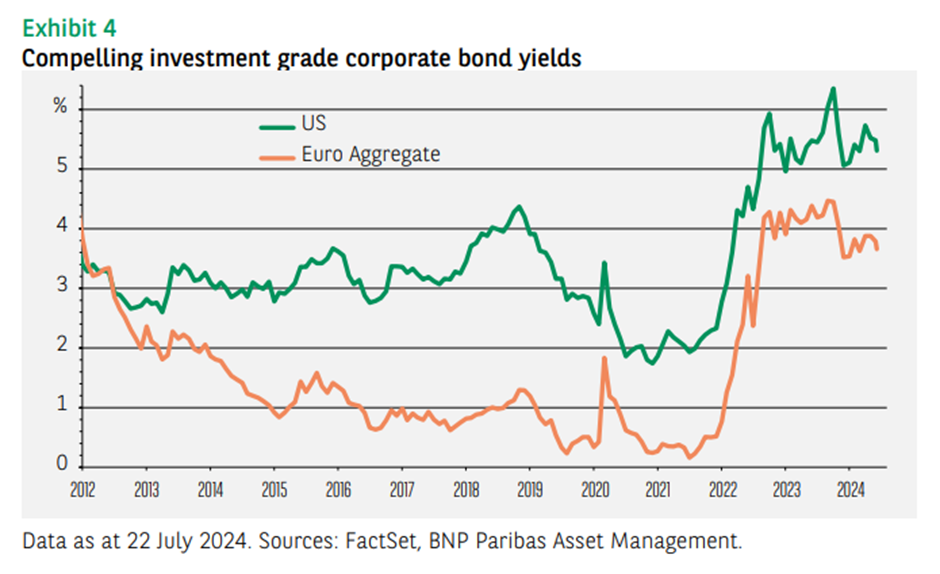
The volatility of corporate credit spreads was relatively low through the first half of 2024. The European Parliament election in early June, however, rattled the eurozone markets.
Investor sentiment towards corporate bonds had been broadly positive, but the election results turned investors’ attention to the risks that could emerge from the French and US elections…
but yields remain compelling
Yields for investment-grade bonds are high by historical standards, and the resulting income can act as a significant buffer against elevated volatility weighing on bond prices.
In the US, the combination of stable economic fundamentals and still mixed inflation data has lead markets to expect official interest rates to be held higher for longer than thought at the beginning of the year. This expectation should support corporate bond yields in the region insofar, though it could weigh on some sectors and companies. Attention to sector and security selection remains critical.
High yield remains attractive
High yield valuations may seem high, but they reflect an underlying positive dynamic: The new issuance market has been very active (May saw the largest high-yield issuance in the eurozone since the Global Financial Crisis), and demand has so far met the increased supply, pushing back the 2025/2026 maturity wall. We believe demand for high yield will remain strong, which should make the market more resilient to the risk of further delays in rate cuts.
In this context, we believe high-yield default rates have likely peaked, and we are focusing on the most rate sensitive companies, hence the importance of the issuer selectivity.
Favour the eurozone over the US
While election-related volatility has tempered our enthusiasm for eurozone investmentgrade bonds, we believe valuations are more attractive than those for US bonds. Spreads in the US have returned to near pre-pandemic levels, while eurozone spreads remain above these lows.
Eurozone corporate fundamentals have remained good through the recent economic downturn and high cash levels should help companies weather any economic or political uncertainty.
EMERGING MARKETS: STAY INVESTED, SELECTIVELY
High yields for emerging market (EM) debt provide a competitive level of income and we believe that rebounding economies, declining interest rates, and stronger currencies mean the asset class offers a compelling opportunity set for investors (see Exhibit 5).
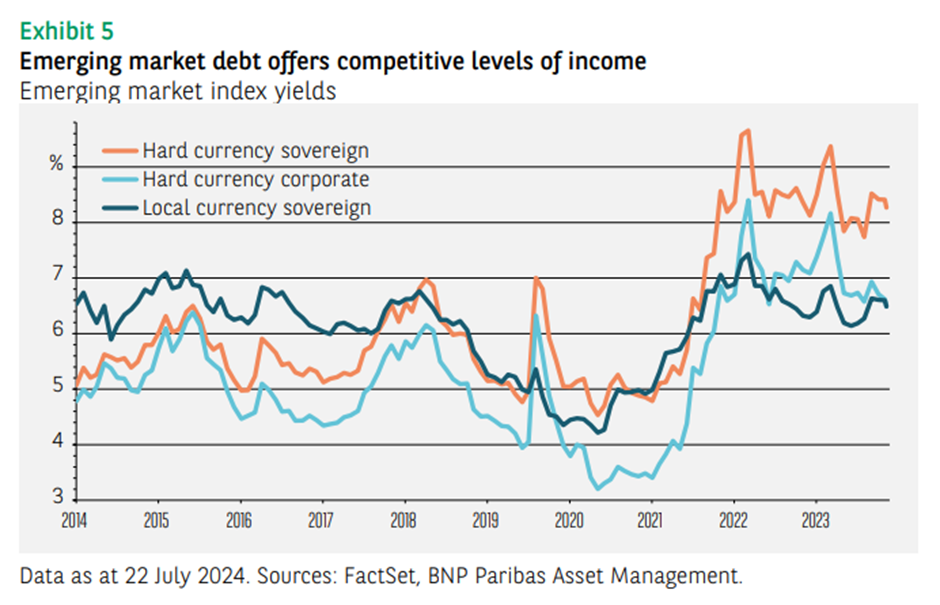
Developed markets are beginning to grapple with election-related volatility, while emerging markets have already had a busy election calendar. The volatility that arises from elections may provide opportunities for active investors.
In countries that have strong fundamentals, such as South Africa or Mexico, election headlines can result in excess market reactions. In our view, focusing on a country’s path of economic growth and commitment to reforms can reveal attractive opportunities.
US dollar bonds offer compelling yields and selective opportunities
EM hard currency bonds have rallied significantly in recent months, supported by good fundamentals, declining defaults, and attractive yields. Even after the recent gains, hard-currency sovereign bonds offer spreads over equivalently rated US corporate bonds in excess of 200 basis points (2%). Furthermore, we expect supply to be restrained in the remainder of 2024 and into 2025.
This year, a number of countries have seen a significant rally in their government bonds as they have gone through a debt restructuring or negotiation of external financial support (Egypt, Turkey, Zambia). Looking ahead, countries such as Sri Lanka (which has yet to conclude its restructuring), and Ghana (which should finalise its restructuring soon given the upcoming election), may offer more potential upside. Even Argentina, which is still adjusting to the new president’s economic agenda, is likely to reward investors with constructive market reforms and positive headlines.
Focus on security selection in corporate bonds
We believe EM corporate bonds remain attractive relative to their US corporate peers, particularly for high-yield corporate bonds.
EM corporate fundamentals continue to compare favourably to similarly-rated US companies. Emerging market companies have in aggregate higher cash levels, comparable interest-coverage ratios and lower leverage ratios. Additionally, as with EM government bonds, we expect the supply of corporate bonds to remain relatively modest through into 2025.
As corporate index spreads have rallied over the last year, certain segments of the market look more expensive, notably within investment-grade. We see greater opportunities within frontier markets.
We remain positive on local-currency bonds
EM local currency-denominated bonds have fallen in price recently even though fundamentals remain supportive. Economies are recovering without the flood of fiscal stimulus seen in many developed countries, while central banks have been largely successful in meeting their inflation targets. We remain constructive on both currency appreciation and falling bond yields across emerging markets.
Valuations, in our view, remain attractive within Latin America and most of the EMEA region, while opportunities in Asia are more muted given the delayed easing cycle in South Korea, India and the Philippines.


