
By BNP Paribas Asset Management portfolio managers Lazare Hounhouayenou, Fadi Berbari and Mathieu Jourde
- Two years after Mario Draghi’s 2024 competitiveness report, implementation of recommendations is uneven; while security and defence have seen significant progress other sectors have advanced more slowly
- There is substantial investment growth across several strategic areas, including a rising defence budget and €21.1 billion earmarked for critical raw materials projects
- The focus is transitioning from policy announcements to execution, where the primary challenge for investors is identifying which companies and issuers can successfully convert increased EU spending into sustainable earnings and durable economic returns
In September 2024, former European Central Bank President, Mario Draghi presented a landmark report on the future of European competitiveness.
The report diagnosed structural weaknesses in productivity, investment and industrial capacity relative to the US and China and set out 383 recommendations spanning several sectors.
Its central thesis is that Europe must mobilise substantially higher public and private investment – originally estimated at between €750 billion and €800 billion annually – and streamline decision-making if it is to safeguard strategic autonomy.
The agenda has since become a reference point for European Union industrial and security policy.
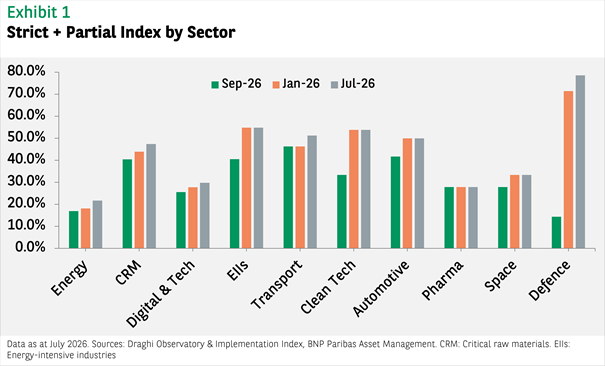
Two years on, the so-called Draghi Implementation Index shows that 15.7% of the recommendations have been fully implemented, with the combined strict-plus-partial rate – a measure of how much of Draghi’s competitiveness report has been turned into binding law – at 41.3%.1
Progress is uneven but tangible in security-linked areas. Defence has reached 78.6% (strict-plus-partial), but digitalisation and advanced technologies (29.8%), pharmaceuticals (27.8%) and energy (21.7%) have advanced more slowly. These results indicate that delivery has been strongest where competitiveness overlaps with security imperatives.
Addressable markets are expanding
In defence, EU member states spent €418 billion in 2025 and are projected to reach €454 billion in 2026, with trends indicating further growth toward as much as €547 billion by 2029.2
A substantial share of equipment and investment spending flows to European industry, generating multi-year opportunities measured in the high hundreds of billions of euros. Additional demand for non-traditional defence suppliers could reach up to €500 billion over 2026–29.3
Major joint programmes can be tricky to agree on as Germany and France have showed recently: the next-generation fighter Future Combat Air System and the Main Ground Combat System initial plan have been cancelled which will reduce economies of scale.4
In space, the Infrastructure for Resilience, Interconnectivity and Security by Satellite – IRIS constellation – with a total cost of €15.6 billion, has moved into the implementation phase.
Major manufacturing contracts awarded in August–September 2026 cover the bulk of the 348-satellite programme, with first launches scheduled for 2029.5
Furthermore, space sovereignty has moved higher up in Europe’s strategic agenda: Thedisruption to Starshield connectivity in Ukraine on 14 October 2026 has highlighted Europe’s dependence on US space infrastructure.
While Eutelsat OneWeb satellite and IRIS provide European-controlled alternatives, Europe still lacks Starlink’s scale and a sovereign space-based missile-warning capability. Limited launch capacity remains another vulnerability.
This urgency is strengthening political support for Project Bromo (proposed consolidation of the satellite-manufacturing activities of Airbus, Thales and Leonardo).
Further spending on secure communications, missile warning and Earth observation should support the order pipeline. However, without greater launch capacity, Europe risks developing sovereign satellite capabilities while remaining reliant on US infrastructure to deploy them.
Raw materials and clean tech bolster backdrop
Critical raw materials offer a growing project pipeline: the 46 new strategic projects selected in October 2026 under the Critical Raw Materials Act are expected to mobilise around €21.1 billion in public and private investment, advancing capacity in lithium, nickel, cobalt, rare earths and related materials for batteries, defence and permanent magnets.6
Clean technologiesand the energy transition continue to present large-scale opportunities, in our view. Draghi’s original framework of roughly €750 billion to €800 billion in annual additional investment needs remains a useful reference, while McKinsey analysis highlights multi-trillion-euro global cleantech capital expenditure by the mid-2030s, with substantial accessible value for European players in e-mobility, grids and related technologies.7
Digitalisation and advanced technologies offer long-term markets linked to AI and industrial connectivity.
Industrial policy measures are reinforcing these dynamics. The EU steel measure, effective from 1 July 2026, establishes a duty-free quota of 18.3 million tonnes with a 50% out-of-quota duty, supporting domestic capacity utilisation.8 Strategic designations for critical materials and refinements to battery local-content rules further strengthen the operating environment for European producers.
Equity valuations in exposed sectors have adjusted from earlier peaks, creating interesting entry points alongside still-elevated earnings growth expectations in defence.
| Index valuation | PE NTM* ~one year ago | PE NTM now (approx.) | EPS CAGR** now (approx.) |
PEG*** one year ago |
PEG now |
FCF**** yield one year ago |
FCF yield now |
Market cap variation in one year |
|---|---|---|---|---|---|---|---|---|
| MSCI World | 20.1 | 17.6 | 19.0 | 1.2 | 1.0 | 3.1 | 3.4 | 12.6% |
| MSCI Europe | 14.9 | 14.0 | 13.5 | 1.3 | 1.1 | 4.0 | 4.8 | 5.2% |
| MSCI Europe Aerospace & Defense | 29.4 | 23.6 | 18.3 | 1.9 | 1.5 | 2.8 | 3.5 | -5.0% |
| MSCI Europe Industrials | 21.3 | 19.3 | 16.7 | 1.6 | 1.3 | 3.8 | 4.4 | -1.3% |
| MSCI Europe Energy | 10.1 | 9.1 | 10.0 | 1.3 | 0.8 | 8.1 | 13.3 | 48.2% |
| MSCI Europe IT | 27.9 | 24.9 | 26.7 | 1.3 | 1.1 | 2.8 | 2.1 | 27.7% |
| MSCI Europe Materials | 16.9 | 15.9 | 15.9 | 1.5 | 1.1 | 3.0 | 4.1 | 6.7% |
| MSCI Europe Utilities | 14.2 | 14.8 | 9.9 | 1.9 | 1.6 | -1.8 | -2.0 | 15.7% |
*PE: Price to earnings ratio, NTM: Next twelve months. **EPS: Earnings per share, CAGR: Compound annual growth rate. ***PEG: Price/earnings to growth ratio. **** FCF: Free cash flow
Source consensus Factset as of 19 October 2026, past performance is not indicative of future results
Fixed-income markets continue to see increased issuance linked to defence and infrastructure, new issuers mainly in euro are paving the way, the market is broadening and new eastern European and Nordic companies are now using the euro bond market to fund their needs. The EU money injections are driving a whole ecosystem all over Europe.
2027: From policy ambition to investment execution
Europe’s strategic-autonomy agenda is increasingly translating into tangible investment across defence, energy infrastructure, space and critical supply chains. For investors, however, the opportunity is becoming more selective.
In equities, the focus is shifting from policy announcements and order intake towards companies able to convert larger backlogs and capacity investment into sustainable earnings and cash flow.
In fixed income, higher investment creates additional issuance opportunities but also requires greater differentiation. Sector selection is key and rating agencies are really segregating between companies that are benefitting from the EU umbrella (upgrades such as in the defence sector) and those losing momentum in the face of fierce global competition.
The key investment question for 2027 is therefore no longer simply whether Europe will spend more, but which companies and issuers can translate strategic autonomy into durable economic returns.
[1] Draghi Observatory & Implementation Index – EPIC
[3] A €500 Billion Opportunity for Nondefense Firms | BCG
[4] Defense Magazine
[5] European Commission / SpaceRISE
[6] McKinsey


