
James McAlevey, Head of Global Aggregate and Absolute Return at BNP Paribas Asset Management, explains how his award-winning team empowers investors to utilise ongoing unpredictability to achieve positive absolute returns while preserving capital.
Q1: What’s driving the heightened interest in absolute return bond strategies, and how do you manage it differently from traditional fixed income strategies?
JM: The traditional model of long-only fixed income faces significant challenges today. These funds track an index and are usually very sensitive to interest rate increases. When rates rise, they often decline in value, reflecting the benchmark’s performance.
Absolute return bond strategies are multi-directional and aim to generate positive returns regardless of market conditions. They offer an attractive risk-return profile, targeting excess returns of 2% to 3% over cash per year with low volatility. This was evident in 2022, when these strategies delivered positive returns while benchmarked fixed income returns suffered significant drawdowns.
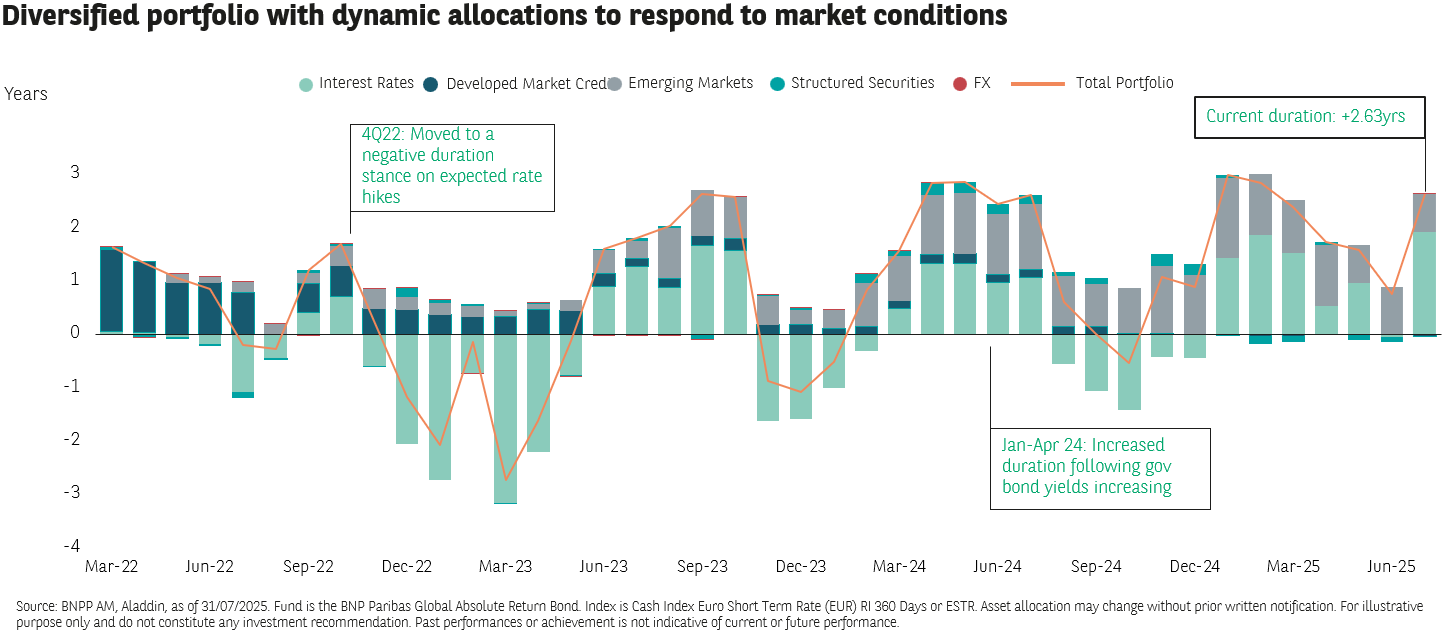
Investing in absolute return strategies provides us with the flexibility to allocate capital across the global, unconstrained fixed income market, including government securities, corporate bonds, emerging market local and hard currency bonds, structured securities, interest rates and currencies at different stages of the cycle. If we do not favour a particular asset class, we simply do not hold it, or we can even short the asset class in question.
Q2: What major market changes have happened recently, and how are your preferred sectors and asset classes responding?
JM: We began the year with significant short positions in US corporate credit and the US dollar, expecting a slowing labour market and an unwind of US exceptionalism. With US tariffs starting to impact the economy, stagflation risks are rising; however, second-round inflation effects are expected to be limited. Globally, we see downside risks to growth and inflation, particularly in the UK, with a weakening labour market. The ECB is likely to continue easing, while the Bank of Japan may raise rates more than expected.
In this environment, we favour nominal government bonds in the UK and New Zealand, alongside US and UK inflation-linked bonds. We prefer local rates in emerging markets with strong fundamentals. In Japan, we take a short position on the front end and belly of the curve while adopting a long duration stance at the long end. We see opportunities in mortgage-backed securities (MBS) with attractive spreads for high-quality credit risk. Additionally, we maintain a structural short on the US dollar and have reinstated our outright short in European investment grade credit, as we believe the market is complacent about fundamental headwinds and rich spreads.
We still favour MBS over US corporate credit and have increased our exposure in this view recently. This allows us to short credit without giving up carry, while holding a higher credit-rated asset class that we believe can outperform in the medium term. Current coupon MBS, for instance, yields more than US investment grade credit (See Exhibit 1).*
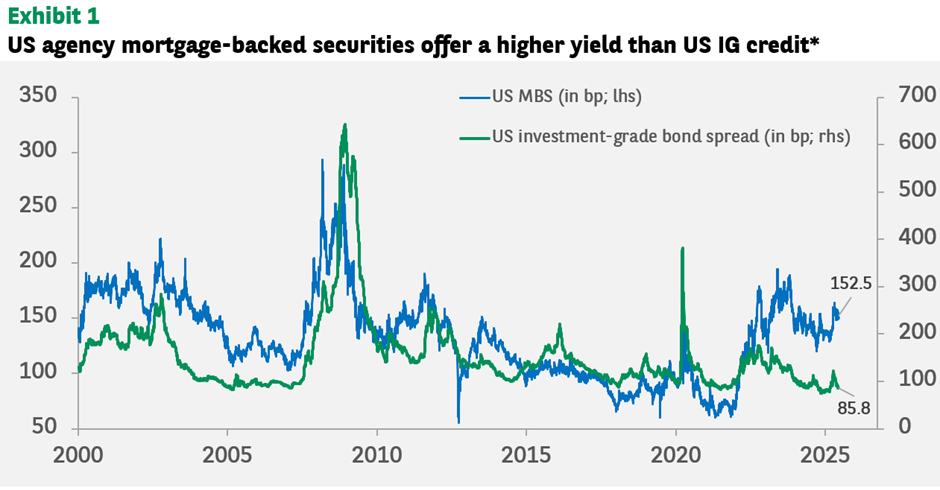
*US investment-grade corporate bonds. Source: BNP Paribas Asset Management, Bloomberg, as of 12/06/2025.
Q3. What trends do you foresee shaping the future of absolute return strategies?
JM: The increased market volatility and dispersion in the fixed income market, which is expected to continue, favour absolute return fixed income strategies because the product is highly flexible and well-positioned to benefit from opportunities across global fixed income.
With lower cash rates expected to decline further, duration-sensitive products present attractive total return prospects and the chance to secure higher yields. However, given the near-term risks of stagflation and fiscal deterioration, longer-dated yields may remain elevated, necessitating flexibility in duration allocations.
Our flagship global absolute return bond strategy maintains a symmetric duration range of around zero (-4 years to +4 years), significantly lower than traditional fixed income products, such as the Global Aggregate index, which is closer to 6 years. This means investors can profit from fluctuations in interest rates without facing significant risks about future movements.
Q4: As an award-winning fixed income team, what element sets your investment approach apart from peers?
JM: It’s all about bringing together the best that the firm has to offer. To identify promising market opportunities, we collaborate with our internal Global Fixed Income Platform and other teams. By sharing insights and respectfully challenging one another, we enhance client outcomes and leverage departmental expertise in our multi-sector strategy.
We also prioritise portfolio construction, viewing it as essential as idea generation. Proper allocation sizing supports consistent performance and capital preservation during unpredictable markets. Our dedicated front office risk analyst plays a vital role in guiding our informed decisions.


