
By Jane Ambachtsheer, Chief Sustainability Officer
- The focus is shifting from purely ‘green’ investments toward financing the transition of high-emission businesses, with an emphasis on the credibility of corporate governance and technical capacity
- There is an urgent need to balance emissions mitigation with climate adaptation and nature-positive strategies, using new frameworks to assess corporate dependencies on ecosystems and physical climate risks
- While AI offers productivity gains, investors must consider its absolute environmental impact and social consequences, while leveraging stewardship to help address systemic risks
Looking ahead to 2027, sustainability remains central to understanding the multiplicity of changes unfolding in the world and their potential implications for investment.
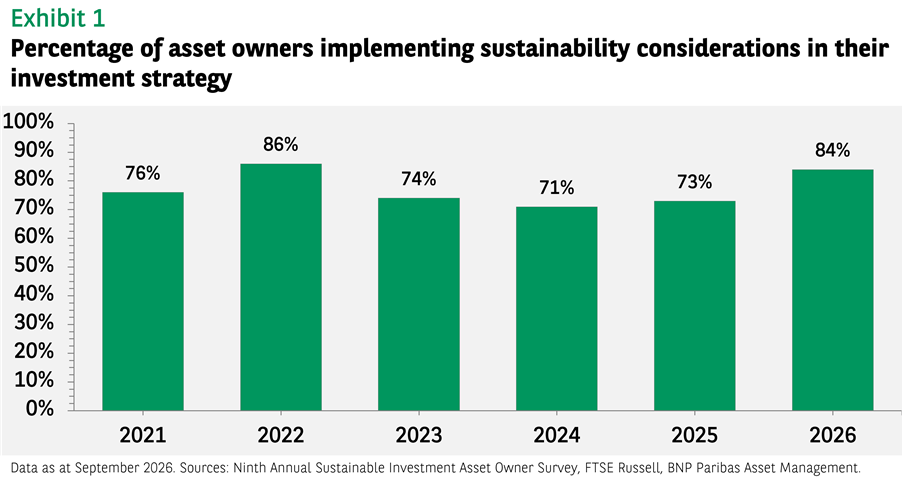
As highlighted by FTSE Russell, sustainability adoption has rebounded to the near-record levels of 2022, with 84% of asset owners integrating sustainability considerations into their investment processes in 2026.1
Environmental pressures, geopolitical fragmentation, demographic shifts and technological innovation are reshaping business models and economies. These interconnected forces create opportunities but also risks that traditional financial analysis may not fully capture.
For instance, a growing emphasis on sovereignty is putting pressure on food, energy and critical mineral supply chains, with the results often aligning sustainability priorities with political considerations.
For investors, the challenge is to distinguish durable opportunities from compelling narratives and understand where risks may not yet be adequately reflected to make better-informed investment decisions and achieve resilient long-term outcomes.
We brought these considerations together in our recent 2026 – 2030 Global Sustainability Strategy.
From green to transition
The transition opportunity set is becoming broader than merely investing in clean-energy generation. A growing emphasis globally on energy security, affordability and reliability is bringing greater attention to necessary investments in grids, storage, electrification and novel energy production technologies.
In 2027, we expect greater emphasis on financing the transition of higher-emission businesses, alongside investing in activities that are already green. Extractive or carbon-intensive sectors need capital to transform their operations, particularly where technological and economic barriers remain significant.
The differentiator in transition finance will be credibility. Investors need to look beyond targets set by companies to the governance and technical/financial capacities in place to support their achievement.
Forward-looking analysis and frameworks should help distinguish companies making substantive progress from those whose ambitions remain disconnected from their business decisions.
Climate action: Broadening the focus on mitigation to include adaptation
With 2030 fast approaching, less time remains to deliver near-term emissions reductions. But even as the urgency of mitigation increases, so too does the urgency of adapting to physical climate risks reinforced by increasingly visible climate impacts.
Understanding physical climate risk requires attention to asset locations, macro weather shifts and institutional preparedness. But the need for adaptation creates opportunities for a different set of climate solutions such as resilient infrastructure, precision agriculture or alternative risk financing. Identifying these risks and opportunities will become increasingly important.
Beyond real assets where the opportunity for greater investment in adaptation and resilience is gradually unlocking with evermore enhanced risk analytics and growing awareness, investing in adaptation in listed markets could also present opportunities. Environmental infrastructure, for instance, is a focused and forward-looking sub-set of this growth. It can help scale adaptation solutions by financing companies developing and deploying new adaptation solutions.
Nature: Making transition progress more assessable
Nature belongs in this same discussion alongside resilience. Dependencies on water, land and ecosystem services can affect operating capacity and supply-chain continuity. Investment analysis needs to consider not only businesses providing nature-related solutions, but also how existing companies reduce their dependencies and pressures on ecosystems.
A development to watch in 2027 is Finance for Biodiversity Foundation’s Nature Transition Framework, which we are helping to develop. It aims to translate existing guidance, including the Taskforce on Nature-related Financial Disclosures work on transition planning, into a more consistent and decision-useful assessment of corporate progress towards a nature positive economy.
The current timetable envisages consultation and publication in 2027, subject to completion. Its potential contribution is practical: helping investors assess issuers, set engagement priorities and monitor progress. The objective should be stronger investment and stewardship decisions, rather than another layer of disclosure.
AI: Look beyond the efficiency promise
Technological innovation will remain part of the sustainability opportunity set. Artificial intelligence can definitely improve natural resource productivity, but efficiency gains should not be confused with a reduction in absolute environmental pressures.
Lower resource use per activity may be offset by expanding demand, the rebound effect often referred to as Jevons’ paradox. Investors therefore need to assess absolute energy, water and resource requirements alongside the benefits of individual applications.
Additionally, AI holds promise to increase human resource productivity which could yield dividends for shareholders in the short term but have many potential adverse social impacts later as jobs are lost and/or transformed.
In 2027, the challenge will be to distinguish applications that deliver durable economic and environmental value from those whose benefits are outweighed by negative consequences. Governance and accountability matter too.
Investor collaboration can help develop shared expectations where standards remain incomplete, while keeping the focus on how technologies are deployed and scaled.
Regulatory and disclosures
Addressing these opportunities and challenges often requires conditions beyond the control of individual companies and investors. For 2027, the focus should be on how regulation and disclosure frameworks can support informed investment decisions globally.
Clearer sustainability-related information can help investors assess corporate progress and distinguish investment approaches, including transition strategies. The review of the European Union’s Sustainable Finance Disclosures Regulation (SFDR) is one example of this broader discussion, with final requirements and application dates remaining subject to the legislative process.
Across jurisdictions, simplification should preserve the information investors need. Clear product descriptions, credible claims and useful corporate data support trust and informed allocation decisions.
Greater coherence across disclosure and transition frameworks would help investors navigate regional differences, while keeping the emphasis on decision-useful information rather than additional reporting alone.
Systemic risk requires system-level stewardship
Climate change, nature loss, and social pressures can affect the wider systems on which diversified portfolios depend. However, security selection alone cannot address every risk to long-term returns.
This is why stewardship needs to connect issuer engagement with public-policy advocacy. Dialogue with issuers can identify barriers to investment; engagement with policymakers can help explain the conditions needed to overcome them. Collaboration should focus on material, strategic issues, while recognising the limits of any individual investor’s influence.
In 2027, we should see public policy advocacy increasingly address the underlying drivers of systemic risk. The aim would be to support conditions that enable issuers and investors to act and strengthen the resilience of the wider economy.
The continuing transition
Looking ahead to 2027, the themes explored in this outlook are only part of a broader landscape of opportunities and challenges. Geopolitics and demographic shifts will also require close attention.
Keeping these interconnected themes in view will be essential to understanding emerging risks and opportunities and informing our approach in the year ahead.
[1] FTSE Russell’s 9th Annual Sustainable Investment Asset Owner Survey 2026 | LSEG


