
This article is the second in a series of weekly updates on our COVID-19 strategy: our assessment of the virus itself and the public health approach for containing it; the economic cost of dealing with the pandemic and the policy responses to mitigate the damage; and ultimately, the implications for financial markets and investment strategy.
The only place to start is with the headline numbers on COVID-19. As of 7 April, the global caseload had topped 1.4 million and the death toll has now climbed to above 79,000.
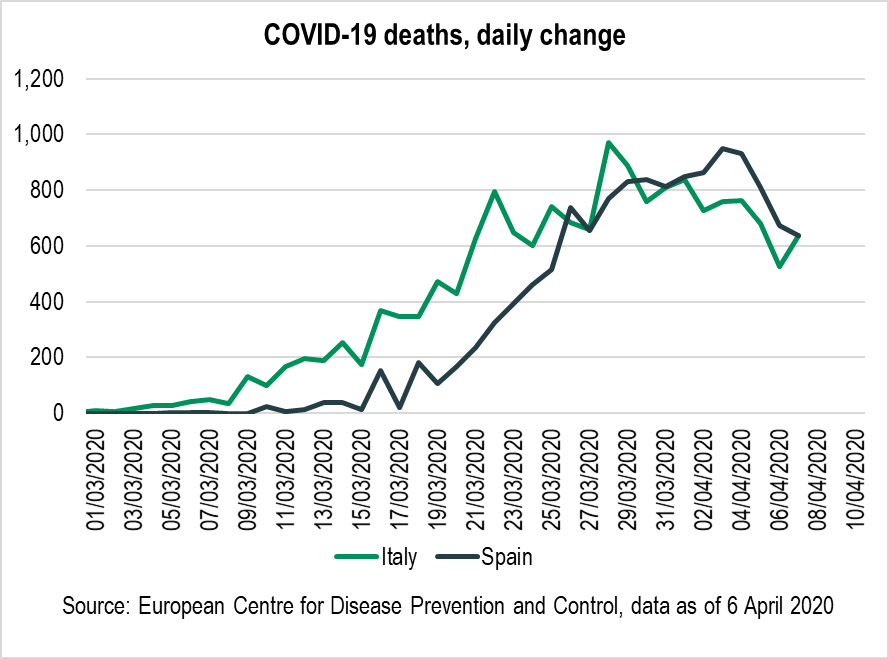
There is an understandable focus on the national data and what can be learned about the efficacy of the different strategies that countries have pursued from the numbers on new infections and fatalities.
However, as with all statistical analysis, it is important not to draw strong conclusions about evolving trends from a couple of recent data points. Moreover, we need to be conscious of the fact that the way that cases are identified and fatalities are recorded can vary both from country to country and within a country through time. Having said that, we think a few points are noteworthy:
- After a harrowing experience in recent weeks, the data suggest that Italy and more recently Spain are now starting to win the war against COVID-19 as the countries’ extreme quarantine measures are finally being reflected in a decline in fatalities.
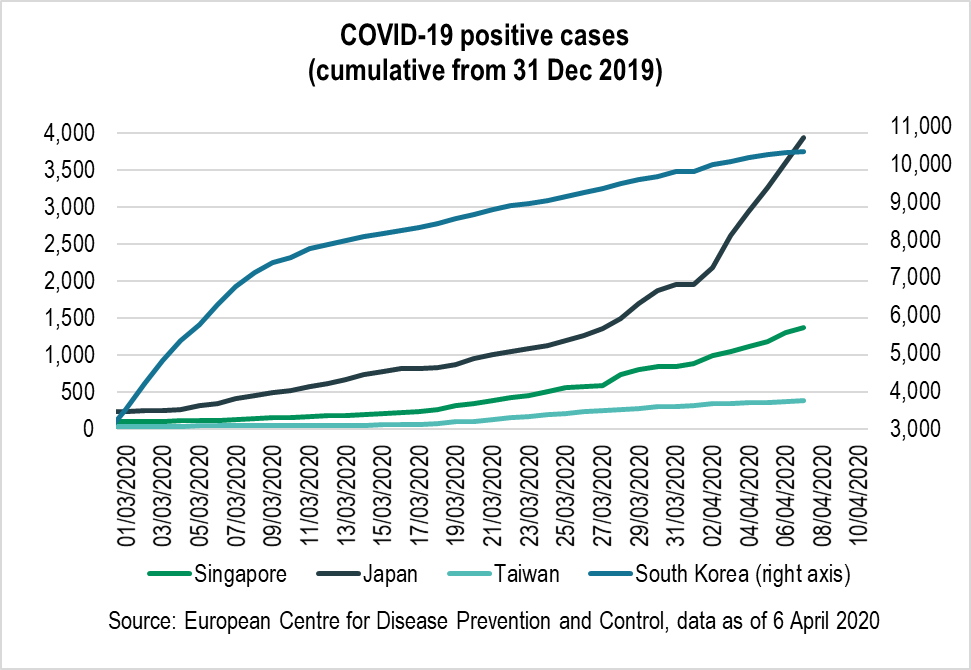
- Although numbers remain low in absolute terms, we are observing a clear resurgence of the virus in parts of North Asia, notably in Japan and Singapore. This development may challenge complacency in the markets that these countries had the virus under lock and key.
- The evolution of the virus in the US remains a cause for concern, with the US now responsible for more cases than any other country, and with a death toll rapidly approaching that of Spain and proceeding on a worrying trajectory similar to that experienced by Italy.
The public health response
Our focus remains above all on the public health response because that in turn will drive the economics, and ultimately asset valuations. The authorities in most advanced economies have been forced to adopt extreme social distancing measures as a last resort to contain the spread of the virus, in the knowledge that this will inevitably lead to a deep recession.
If an alternative strategy presents itself, they will seize it. Two points are worth emphasising here:
- Rather than the rest of the world moving towards the approach pursued in North Asia, where some measure of control had been achieved without huge disruption to society and the economy, the opposite is occurring. The trend in recent days has been for the North Asian economies to move towards the stringent lockdown model, with, for example, the closure of non-essential workplaces and schools in Singapore and the declaration of a national emergency in several regions of Japan.
- Discussions about the exit strategy from lockdowns have begun in Europe. Austria, which has managed to surpass even Germany on the rate of diagnostic testing per capita, looks set to be the first country to attempt a gradual exit this month. Austria will become a key signpost for the market: if it can learn to live with the virus, that will be hugely significant.
The economic situation
Turning to news on the economy, the data tells a different story depending where you look. A range of economic and social indicators point to continued progress towards normality in China, from coal consumption to industrial production, from traffic volumes to the re-opening of shops.
Elsewhere, the high-frequency data continues to tell the story of the severe contraction in activity as many of the advanced economies entered the lockdowns. The US initial jobless claims numbers continue to stand out, with 10 million workers claiming unemployment benefit in the space of a fortnight. With many tens of millions of more Americans working in sectors that have been directly impacted by the shutdowns, the unemployment rolls could continue to grow in coming weeks.
Policy response
The news on the policy response has been somewhat mixed. The central banking community certainly has its collective foot hard down on the monetary pedal. In the last week for which we have data, total assets held by the US Federal Reserve increased by over half a trillion dollars. While not in the same ballpark, the European Central Bank managed a more than respectable EUR 30 billion of purchases in the first five days of the new Pandemic Emergency Purchase Programme.
On the fiscal front, the US authorities continue to press ahead. For example, the Paycheck Protection Program, which effectively provides grants to small businesses that retain all their employees for eight weeks, is set to be scaled up within days of its launch.
Europe continues to debate the merits of a collective financial response. The Eurogroup meeting failed to come to an agreement on 7 April on a strategy to deal with the severe economic downturn due to the pandemic. The largest sticking point is the introduction of a joint Eurobond, which would fund the significant fiscal spend and act as a euro-wide backstop. Without this backstop, the question of debt sustainability comes to the fore, potentially putting pressure on ‘peripheral’ countries given the extent of their needed fiscal interventions to tackle the COVID-19 fallout.
An update on the market environment
Valuations of risky assets have continued to rebound, reflecting cautious optimism that the spread of COVID-19 seems to be slowing, especially in Europe. Furthermore, it reflects the fact that central bank interventions and the fiscal rescue packages are limiting the adverse downside effects on economies.
Funding markets, apart from the cross-currency market, remain stressed. We expect USD funding to improve, to some degree, with the introduction of the Commercial Paper Funding Facility on 14 April. That said, while the lockdown persists and especially if it is extended, demand for US dollars will likely continue. As such, we think USD funding will not revert to unstressed levels until the lockdowns are lifted.
No time to sell risky assets
In summary, there are some grounds for optimism, although there are clear risks to the downside if the lockdowns are extended. Our signposts still suggest to us that this is no time to sell risky assets. We continue to seek opportunities to rebuild positions in those asset classes where valuations reflect indiscriminate selling.
Denis Panel, Chief Investment Officer Multi Assets & Quantitative Solutions, and Marina Chernyak, senior economist and coordinator of COVID-19 research


