
The widespread expectation of the global economy heading for a soft landing will be put to the test amid major political change and the risk this creates for economic stability.
Uncertainty will challenge both central banks as they chart monetary policy and investors as they grapple with the new US administration’s policies, a vulnerable Europe, and a struggling China.
We believe investors should focus on the long term and the opportunities presented by environmental sustainability, the energy transition, and the shift to a low carbon economy. We see transition finance, climate adaptation investment and natural capital allocations moving to the top of the priority list for sustainability-minded investors in 2025.
Elsewhere, we see artificial intelligence continuing to drive innovation, creating new investment opportunities. Private credit offers investors a rich pipeline. For those focused on income, there is a broad set of fixed income opportunities, and for those keen on diversification benefits, emerging market debt can be a rich furrow to plough.


Three sustainability themes for 2025

Alexander Bernhardt, Global Head of Sustainability Research, Boston
We see transition finance, climate adaptation investment and natural capital allocations moving to the top of the priority list for ESG investors in 2025. Growing global climate challenges and the evolving regulatory landscape will set the agenda.
Increasing access to private market investments makes these themes increasingly available to a wider group of investors.
Transition finance plays a key role in helping high-emission sectors such as energy and heavy industry shift toward more sustainable operations.
For investors, this presents opportunities to support businesses in their decarbonisation efforts, mitigating risks associated with stranded assets as carbon-intensive activities face increasing scrutiny. By financing transition pathways, investors can tap into long-term value creation while aligning with climate goals.
The challenge with this approach will be in underwriting the strength and integrity of company decarbonisation commitments, which can be fickle.
Robust policy frameworks are required to send the right signals. The industry needs to confront this challenge head on. In May 2025, the European Securities and Markets Authority’s (ESMA) fund naming guidelines will require that, any funds using ‘transition’-related words in their name demonstrate their investments are on a clear and measurable path to social or environmental transition.
By financing transition pathways, investors can tap into long-term value creation while aligning with climate goals
Currently, we are not transitioning fast enough to avoid significant physical impacts from climate change, such as extreme weather and rising sea levels, which makes investing in climate adaptation critical.
Investors who focus on climate resilience strategies for vulnerable businesses or non-corporate securities issuers can reduce their exposure to economic losses.
We expect to see this topic on the priority list of a growing number of sovereign debt issuers and investors. Investors should be on the lookout for more adaptation-themed fund offerings coming to market (notably, this theme is not directly covered by the ESMA guidelines).
In addition to traditional infrastructure build-out, natural capital investment will become central to both transition and climate adaptation efforts.
Investing in forests, farms or water resources restores and preserves their ecosystem benefits, reduces environmental degradation and improves economic stability.
As biodiversity loss threatens global supply chains, investing in regenerative agriculture, forestry, and water conservation is not only socially responsible but also financially prudent. Governments and institutions are increasingly recognising natural capital as a valuable asset, further incentivising investors to prioritise it.

Macroeconomics

Richard Barwell, Head of Macro Research and Investment Strategy, London
It has become increasingly clear in recent months that inflationary pressures have abated, allowing the world’s central banks to start easing monetary policy. As we enter 2025, the market will have to focus on two questions:
• Where is the global economy heading next?
• How will geopolitics shape the outcome?
The consensus expectation has been that there will be a soft landing for the global economy. Inflation returns to target and the economy continues to tick over, growing at a reasonable pace with low and stable unemployment, allowing central banks to continue cutting interest rates back to so-called neutral levels. This would be a very happy ending to the inflation scare for investors. Lower interest rates coupled with an ongoing recovery in activity makes for a rising tide that can lift many asset classes.
Such a happy ending is far from assured. One possibility is that there is no landing whatsoever. The recovery could re-gather momentum, perhaps prompted by easier financial conditions. But no landing cannot be the end of the story.
Policymakers are likely to be ‘once bitten, twice shy’ when it comes to inflation
Stronger growth in spending and falling unemployment could all too easily reignite inflationary pressures, forcing a re-think within the central bank community. Policymakers are likely to be ‘once bitten, twice shy’ when it comes to inflation, so interest rates might have to go back up and this time stay up for an extended period to drive inflation conclusively back to the target.
Thus far, there has been a surprisingly small price to pay for tackling inflation. We might have expected that a coordinated tightening in monetary policy around the globe would have led to weaker spending and rising unemployment. But the latter, in particular, has not happened.
Indeed, the unemployment rate is still hitting fresh lows in the eurozone. However, it would be complacent to assume that there will not be any impact on the real economy if policy rates had to be hiked and stay up. In other words, the ‘no landing’ scenario could easily end in a recession.
In fact, recession – or a so-called hard landing – could be where we are heading next. After all, growth is already uninspiring in parts of the global economy. In this scenario, the monetary policy stance will quickly have to swing from restrictive to accommodative. Interest rates will have to be cut below neutral, to stimulate spending.
One of the striking features in 2024 has been the willingness of the global investment community to repeatedly revise its view of the likelihood of these different scenarios playing out as new information arrives, whether it be data on the health of the US labour market or news on the evolving policy response of the Chinese authorities.
As ever, a single global narrative cannot capture the significant differences in the economic outlook around the globe. The US economy has consistently outpaced its European peers over recent years. However, concerns have started to build about whether the current pace of US growth can be sustained, with the data on vacancies and jobs taken as one possible bellwether of a cooling economy.
Growth has been anaemic across much of Europe, with the German economy in particular confronted by cyclical and structural headwinds, and the survey data is yet to signal a change of fortunes. Last, but by no means least, the Chinese economy has also been struggling, beset by long-standing problems in the property market, leading the authorities to announce a significant stimulus package.
The focus now shifts to geopolitics with the election of Donald Trump as the next President of the United States. The broad contours of Trump’s agenda are well understood, given the policies he pursued when he was last in office and his comments on the campaign trail. What matters for markets are the specific policies that will eventually be implemented and their likely impact on the economy and asset prices. Whether it is taxes, tariffs, deregulation, foreign policy, immigration or his approach to the Federal Reserve, there remains considerable uncertainty about whether, when and which policy choice will be delivered.
That uncertainty may not be resolved for many months to come, and that could have a chilling impact on corporate behaviour in the short term. Companies could put plans to invest or recruit on pause until the macro landscape becomes clearer, in which case markets could have to deal with weakness in the data before we get to the detail on policy.

The outlook for financial markets

Daniel Morris, Chief Market Strategist, London
The Republican party’s sweep of the US election is likely to boost equity markets, particularly those in the US, if the pattern of the first Trump administration is any guide. The risks are that either growth accelerates by too much and the US economy overheats, or that large tax cuts prompt a negative reaction from the bond market. We will have to wait until there is more clarity, not only on any policy proposals, but also on what can actually be implemented.
Aside from political developments, developed market central banks are cutting policy rates. This should boost both equities – as shorter-term financing costs fall – and fixed income, as the policy rate component of bond yields declines. Of course, anticipating the reaction of markets is not as simple as that because the other, arguably more important, factor driving asset prices is economic growth.
Investors should initially be circumspect in anticipating positive equity returns during a rate-cutting cycle given that four out of the last five such cycles in the US coincided with a recession. Not surprisingly, the onset of a recession led to negative returns in equities alongside gains for government bonds.
The critical consideration in anticipating returns for next year is whether 2025 will be exceptional in not having a recession.
A preference for US equities
The consensus view has been that the US will indeed see a soft landing – that growth will slow, but remain positive as core inflation moves back towards the US Federal Reserve’s 2% target. Europe has already had a slowdown, but we believe 2025 should see a modest rebound. Economic growth would be supportive of equity markets and earnings, leading to price gains in the year ahead.
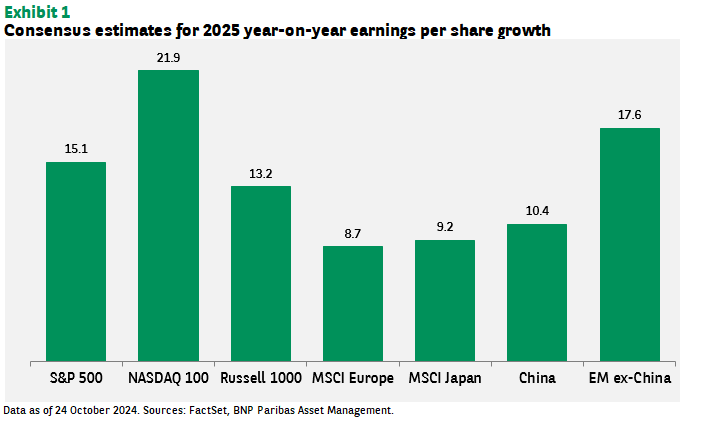
Our regional preference remains the US. Enthusiasm for artificial intelligence was the primary driver of rising earnings in 2024; the bulk of earnings derived from the types of stocks making up the tech-heavy NASDAQ 100 index, while the rest of the market saw barely positive growth.
In 2025, the distribution is expected to be more balanced, even if NASDAQ earnings growth is still superior (see Exhibit 1).
European equities should also see market gains, but once again lag most other major markets. The region remains hindered by the overhang of geopolitics and structural challenges facing its largest economy, Germany.
Consumer demand in Europe will need to rebound much more strongly than we anticipate for consumer-linked sectors to thrive. Exporters will benefit from robust US growth, though tariffs remain a worry. China is unlikely to pull in European products the way it has in the past as growth in China slows.
The potential for superior returns in China will depend primarily on actions from the central authorities. China remains distinct in its dependence on government policy to drive economic growth and hence corporate profits.
While we anticipate more stimulus from Beijing, it does not look likely there will be a major change in economic policy; Beijing will probably continue to focus on investment in new, developing industries rather than nurturing household consumption or bailing out property developers.
We question whether these privileged sectors will be able to generate growth for the whole economy at the rate the authorities would like. Without a stronger rebound in the property market, consumer sentiment is likely to remain depressed. Looking to exports to make up the slack may also prove insufficient due to rising global protectionism.
Chinese earnings should nonetheless rise, at more than 10% year-on-year if consensus estimates are correct, though this is not that much more than Europe at 9%. Valuations are low relative to history, but there may now be a permanent discount to multiples versus the past, meaning price-earnings ratios will not necessarily revert to the mean.
Fixed income – Opportunities and concerns
The risk to market expectations for short-term rates in the US comes from the potentially inflationary impact of the new Trump administration’s policies (tighter immigration, tariffs, tax cuts). At this point, however, one can only speculate on what will actually be implemented.
Longer-term Treasury yields could rise to reflect an uncertain inflation outlook
Longer-term Treasury yields could rise to reflect the uncertainty about the outlook for inflation, to say nothing of the US budget deficit. An extension or expansion of tax cuts would only lead to a further deterioration in the fiscal outlook.
As always, however, it is unclear if and when the market will decide to fully price in these risks. We would anticipate ongoing support for gold prices as investors look for alternative safe haven assets.
Investment-grade credit should provide superior returns relative to government bonds as spreads remain contained alongside steady economic growth.
While spreads are narrow – both in the US and in the eurozone, and both for investment-grade and high-yield – they are relatively better for eurozone investment-grade credit, and we see this asset class as offering the best risk-adjusted returns.

Private credit opens the door


Koye Somefun, Head of Multi-Assets & Solutions in Quant Research Group, Amsterdam
Stéphane Blanchoz, Head of Alternative Solutions, Paris
The private credit market is expanding, maturing and opening up to retail investors. What are the trends driving the market? What are the considerations for investors, existing and new, in 2025?
ELTIF 2.0 regulation democratises private credit access
Since banks were forced to tighten lending standards and reduce balance sheet risk in the wake of the Global Financial Crisis, non-banking lenders have played an increasing role in providing loans directly to borrowers.
The private credit market has grown rapidly, to reach approximately USD 1.5 trillion in size at the start of 2024, and is forecast to expand to USD 2.8 trillion by 2028.1 However, the asset class has historically been the preserve of large institutions who can meet high minimum investment requirements and commit to lock-up periods of eight years or more.
The new version of the European Union’s Long-Term Investment Fund regulation, referred to as ELTIF 2.0, heralds a democratisation of private credit, enabling the creation and distribution of funds accessible to retail investors.
Unlike the closed-end funds through which large investors have typically allocated to the asset class, vehicles operating under ELTIF 2.0 can be structured as evergreen funds: open-ended funds with no fixed end date, investing in loans of different maturities or vintages. Such funds provide more flexibility because the capital is not locked: investors are allowed to redeem units periodically. They are also likely to have lower minimum investment thresholds.
The availability of these funds in Europe is part of a broader trend that is set to transform the market in 2025 and beyond. Retail access is also opening up in Asia, while the US Securities and Exchange Commission is evaluating applications for the first private credit exchange-traded funds (ETFs).
Partnerships reshape the market
An important trend in private credit markets is the establishment of partnerships, either through joint ventures or acquisitions, between insurance companies, banks and asset managers.
Such partnerships bring together the full chain needed for private credit investment, from those with the money to lend to those with the clients to lend to. Asset managers gain privileged access to deals, as well as a base for distribution in the form of the insurance or private banking partner, removing the need to fundraise.
This trend looks set to continue in 2025, driving increasing efficiency in private credit markets and contributing to the maturation of the asset class.
Scalability becomes a differentiator
Absent the credit rating agencies and flow of information that support the evaluation of investments in public bond markets, analysis of private credit transactions is comparatively labour-intensive. The result is fierce competition for the largest transactions.
Today, though, we are seeing direct lenders move into the mid-market and lower mid-market, where access to different types of companies represents a potential source of diversification and opportunity. The challenge is information. For those with the contacts and organisation, the ability to scale lending efficiently to this part of the market has the potential to be a differentiating factor in 2025.
Investor requirements drive sustainability
In private credit, as in other asset classes, sustainability is a requirement for European investors. However, in the same way that the credit characteristics of private debt transactions require more bespoke analysis than in public markets, managers need their own methodologies to evaluate the sustainability of private borrowers.
Managers who took the focus on sustainability seriously from the start have by now formalised and embedded sustainability frameworks and can drive progress. While larger companies must meet disclosure requirements, smaller companies that have never accessed capital markets are less familiar with the ESG questions that matter to investors. The process of seeking answers can involve significant educational work.
LBO concentration is a risk to be managed
Private credit plays an increasingly important role in financing leveraged buyout (LBO) activities, providing 86% of loans for the market in September 2023, up from 65% in 2021. According to data collected by Preqin, 40% of all private credit deals since 2010 have been used to finance buyouts (see Exhibit 2).
Another related category is public-to-private, where the capital is used to transition a publicly owned firm to private ownership by acquisition of most of its shares. This category represents only 2% of the total deals recorded by Preqin but accounts for 31% of total deal value.
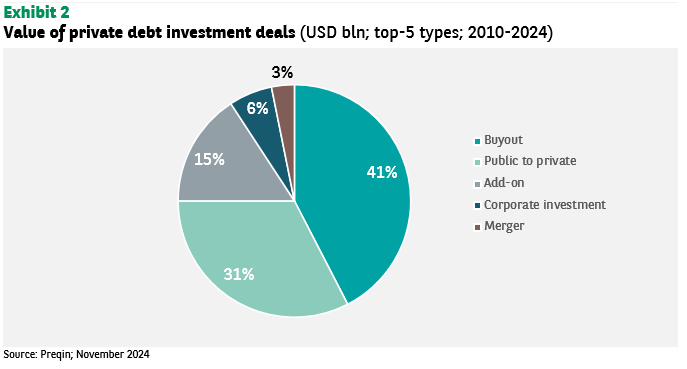
Combined buyout and public-to-private transactions represent 71% of the total deal value. Financing these activities comes with its own specific risk, so it will be important for investors to ensure they remain well diversified and avoid following the trend upwards.
Bank disintermediation broadens the opportunity set
In addition to private corporate credit, the private debt market includes real asset debt, such as infrastructure debt and real estate debt, issued by non-bank institutions. These different categories enable investors to create diversified portfolios with broad exposure to different sectors of the real economy and parts of the business cycle.
As the asset class continues to develop and mature and the bank disintermediation trend continues, we expect to see a wider range of private credit initiatives, including asset-backed finance, equipment leasing and expansion into niche real estate markets.
Private credit should not be seen as an opportunistic asset class
Investment considerations for 2025
Importantly, private credit should not be seen as an opportunistic asset class, but rather a long-term one, linked to the structural bank disintermediation trend.
For those looking to diversify into the market in 2025, the key is to look for a partner with access to borrowers; experience in negotiating, closing and monitoring loans; and a credible framework to manage liquidity.
In 2025, we see private credit as well placed to attract inflows. The fundamentals of companies across Europe are very strong after extensive deleveraging of balance sheets. Investors are searching for yield, as witnessed by the strength of public credit markets. For those investors with an appropriate investment horizon, private credit can generate attractive risk-adjusted returns relative to traditional fixed income. This can be all the more valuable at a time of the indexation and commoditisation of public bond markets, and with savers seeking high-quality investment income for their retirement.
ELTIF 2.0 set to drive growth in European private markets
The advent of ELTIF 2.0 has the potential to significantly increase both the volume and source of capital flows into European private markets.
Forecasts for the growth of the ELTIF range from EUR 35 billion by the end of 2026, according to German rating and analytics firm, Scope, to a European Parliament report suggesting that ELTIF assets might reach EUR 100 billion by 2028.
There is clearly broad confidence that the legislative and regulatory tools are now in place for Europe’s long-term fund regime to fulfil its potential.
Sustainable thematics make their own case in 2025 and beyond


Edward Lees, Co-Head of the Environmental Strategies Group, London
Ulrik Fugmann, Co-Head of the Environmental Strategies Group, London
The outcome of the US election leaves question marks over the future pace of progress in tackling climate change and other environmental challenges. But regardless of the political landscape in the US and elsewhere, the economic drivers and real-world needs are powerful. Here are three themes for 2025.
Power demand drives clean energy story
As homes and businesses electrify, populations grow, and electric vehicle adoption accelerates out of the current slowdown, global demand for power is forecast to increase by 100% by 2050.
In the US, demand is growing for the first time in almost two decades as efficiency improvements can no longer balance out additional power demand. Artificial intelligence and the data centres needed to support its infrastructure drives significant additional power demand capacity. The thirst for power to support artificial intelligence technologies alone is such that clean energy is becoming seen as a second derivative on the AI theme.
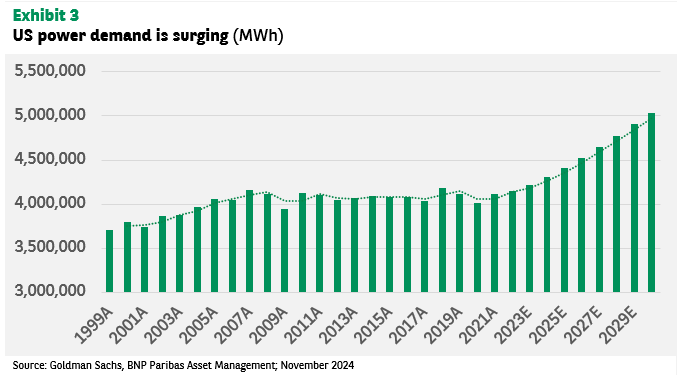
Global power demand growth is creating an urgent need for clean, affordable and readily available supply – and that has to come from renewables. As the falling cost of solar panels, wind turbines, hydrogen electrolysers and batteries drives a significant increase in adoption, the marginal cost of producing additional renewable energy nears zero.
Wherever climate sits on the political agenda, traditional energy cannot compete, due to the higher operating costs and price volatility related to extraction, transport and conversion, and the limited availability of further efficiencies to unlock. Indeed, energy security and a more volatile geopolitical landscape further complicates dependence on fossil fuels.
Wherever climate sits on the political agenda, traditional energy cannot compete
On the demand side of the equation, research¹ suggests there is a significant increase among consumers and corporations in their desire to use new energy sources in homes, vehicles, communities and as part of broader societal goals. Indeed, technology companies have emerged as the biggest buyers of clean energy globally, and this is expected to grow in importance and size.
A ready supply of cheap, clean energy has the potential to be a deflationary force for the global economy. To reach that point, though, investment will be vital. One area of opportunity is in grid connectivity. Almost 2 600 gigawatts of electricity generation and storage are actively seeking grid interconnection today, and the backlog has grown by 30% in 2023 alone. To enable power to flow where it is needed, there is a significant structural need to upgrade grids and connect supply.
The environmental solutions theme has been out of favour since 2021, as investment in capital-intensive solar, wind, battery and other renewable projects has stalled in the face of a higher interest-rate environment. As central banks embark on a coordinated global interest-rate cutting cycle, project economics are beginning to look more attractive, while the efficiencies companies have been forced to find over the past three years will represent a powerful tailwind.
As a result of the secular need for power demand, decarbonisation and growth in artificial intelligence and critical environmental infrastructure, we expect environmental solutions companies to be supported by macroeconomic tailwinds, close to all-time low valuations and cost advantages that could drive significant outperformance relative to global markets.
The goal – Real zero, not net zero
The limitations of net zero are becoming clear, with the reliance on carbon offsetting resulting in companies producing more, at greater environmental cost. Analysis by Carbon Brief shows two-thirds of the world’s biggest companies with net-zero targets are using offsets to help them meet their climate commitments.1 According to the 2024 Net Zero stock-take, while more and more countries, regions, cities and companies are setting net zero targets, 5% or less meet Net Zero Tracker’s procedural and integrity criteria.2
In 2025 and beyond, it will be even more important to invest in companies that can help us reach not net zero, but real zero. Alongside clean energy producers capable of crowding out gas and coal, companies operating in the circular economy, whose products and services reduce the need to produce or extract new resources, represent another important piece of the puzzle.
Business models and sectors offering potential investment opportunities include resource recovery companies in the waste management and environmental services sectors, as well as companies working to extend product lifecycles or offering sharing platforms.
These companies are often characterised by high degrees of product innovation and long-duration growth, where deep research and know-how is needed to address the associated risk by investing in newer technologies. However, for investors who can take a long-term perspective and invest in solutions that will have positive real-world impact, we believe the potential rewards are significant.
Weather events highlight investment needs, opportunities
Catastrophic flooding in central Europe, south Asia and the US this year is the latest reminder of the increasing threat global weather patterns pose as temperatures rise. The effects of climate events are felt across our society, in our food systems, supply chains and water cycles, creating the need for significant additional expenditure and investment.
As well as strengthening the case for faster progress on climate mitigation, this creates opportunities for companies providing adaptation solutions – both those involved in dealing with the aftermath of climate-related disasters and those building the more robust infrastructure required to withstand the challenges ahead.
Water is an area in which investment is urgently required. Both droughts and floods are harmful to water quality, which is also under pressure from human-made contaminants. Water scarcity is a threat to human welfare, with the problem most acute in sub-Saharan Africa, but extending to the developed world as temperatures rise.
Ensuring access to safe, healthy and reliable water will create investment opportunities across a wide range of companies, including those providing smart irrigation systems and pipes, and those involved in water treatment, quality monitoring, and tracking usage and leaks. The opportunity is surprisingly diverse and resilient, encompassing both defensive and cyclical businesses and spanning geographies, sectors and end markets.
2 https://zerotracker.net/analysis/net-zero-stocktake-2024
Life after cash

James McAlevey, Head of Investment Team – Global Aggregate & Absolute Return, London
The period of higher official interest rates triggered by the post-pandemic surge in inflation drew more than USD 6 trillion1 into short-term cash investments. Now, as central banks lower interest rates, where might money market fund assets find a home in 2025?
Fixed income reclaims its rightful place
Money market funds have provided substantial benefits in the recent higher interest-rate environment, but with cash rates coming down it’s time to look ahead. While we see rates declining, we don’t expect policy rates to go to zero.
For the period ahead, a more useful model than the Covid19 pandemic or the Global Financial Crisis can be found in ‘conventional’ recessions, in which rate cuts of 200-300 basis points were sufficient to reduce unemployment and provide economic stimulus.
With inflation now well under control, central banks have embarked on easing cycles for ‘conventional’ reasons, not crisis management. If growth weakens too much, we could see interest rates move below their long-term trend level, but we don’t expect them to do so significantly.
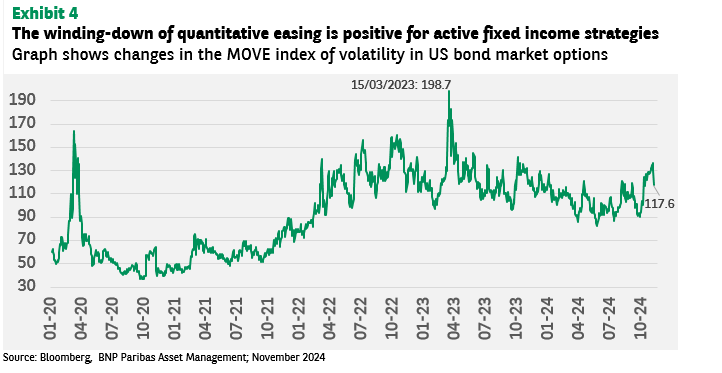
Moreover, central banks are unwinding quantitative easing. That means a transfer of debt to the private sector, which in turn means we’re unlikely to see a return of the flat yield curves that were characteristic of the zero-rate environment.
If interest rates do fall, we expect yield curves to remain steep and long-term rates relatively high. There are concerns about budget deficits, which look large for this stage of the cycle, but there currently appears to be little political appetite for fiscal prudence.
This is a positive environment for fixed income, in which bonds can again offer the income, carry and defensive characteristics to which investors were accustomed before the crisis years.
Meanwhile, the falling cash rate represents an incentive to move out of money market funds and to reinvest before policy rates hit their trough.
Bonds can offer the income, carry and defensive characteristics investors were used to
The opportunity set favours a flexible approach
Corporate credit is often the go-to area for income, but it looks expensive today given that we are at an advanced stage in the economic cycle, and seems even more expensive were we to head into an economic downturn.
Investors thinking about the year ahead should be aware of the sizeable corporate refinancing wave coming up in the next 12-18 months, which could lead to higher yields (and lower prices). US mortgages can be a useful substitute, offering a higher yield in combination with an implied triple-A rating given their government backing.
In emerging markets, as in developed, most central banks have embarked on cutting cycles. However, emerging market yield curves have been upward sloping for some time, and real yields are significantly higher.
As a result, we see emerging markets bonds – particularly those denominated in local currencies – as a better place to take interest-rate risk. Country selection is of course important given some markets are further along the easing path than others.
Volatility and dispersion make a comeback
If 2022 brought too much volatility in bond markets, the preceding years saw too little. Quantitative easing not only starved investors of income but suppressed volatility. There was little dispersion and little opportunity to benefit from arbitrage between or within fixed income segments.
Today, we are in a volatility sweet spot, with markets living, breathing and adjusting to fundamental developments in a way they haven’t for years. With more normalised volatility comes greater dispersion. Value-based investors can take advantage of this through intra-market and cross-market strategies or through the timing of allocation changes.
Economic dispersion is another area of opportunity. During the financial crisis and the pandemic, global central banks moved in lockstep, slashing rates at the same time for the same reasons and arriving quickly at the same destination. Now, we’re having very different conversations: who will go first, who will cut most, who’s ahead of or behind the curve, what might terminal rates be in which market?
One example is Canada versus the United Kingdom (UK) or versus Norway. Canada has sub-trend growth and below-target inflation, and is already well entrenched in its easing cycle. The UK has proceeded more cautiously, while Norway is yet to move. As the central banks plot different courses towards their respective targets, investors who get the sequencing right can benefit.
For investors not eager to make these decisions themselves, flexible funds targeting total and absolute return or income can take advantage of both attractive opportunities and useful places to hide out. When combined with their ability to navigate the ongoing uncertainties that might be giving investors pause, these strategies may be an attractive option for cash currently on the sidelines.
Politics and the Fed pivot drive emerging market debt

Alaa Bushehri, Head of Emerging Market Debt, London
Elections and Fed easing will shape the landscape for emerging market debt in 2025, while China remains a potential source of risk. Where are the areas of opportunity?
Election outcomes play out
The past year has seen a packed electoral calendar both within and outside emerging markets. With key polls having taken place in South Africa, Indonesia, India and Mexico, as well as in the US, policy rollout will be an important driver for 2025.
Elections are always consequential, regardless of the headline outcome. Even if the same party gains a majority, the policies on which it has won that majority, the composition of the new government, and the resultant ability to drive through policy all have implications for fundamentals.
The first policies are beginning to be rolled out in Mexico and Indonesia, giving us some idea of the future backdrop for those markets, but overall, we are still waiting to learn the degree of consequence of 2024’s elections for the emerging market (EM) debt asset class. Everything from fiscal and monetary policy to global trade and investor risk appetite remains in play.
The Fed’s path is key
The performance of emerging market debt tends to ebb and flow with the health of the US economy. Cycles of interest-rate cuts from the US Federal Reserve have typically served as a strong tailwind for riskier market segments like emerging market debt.
Today, with the Fed’s easing cycle underway and a soft landing on the horizon, the prospects look good. The trajectory of the path from September’s 50 basis point cut is still unclear. Whether the progress is linear or more stop-start will affect the broad rates environment, the cost of refinancing and the overall performance of the EM debt asset class.
The good news is that the easing cycle started early in 2024 for EM economies, with central banks, notably in Latin America, putting themselves in a position to cut rates through their effective management of their inflation targets.
Having met their economic targets through those early cuts, some are now on hold, having afforded themselves the opportunity not to follow the Fed but to wait. Against this policy backdrop, we expect EM economic growth to remain resilient into 2025, supported by robust private consumption, investment and exports.
Robust private consumption, investment, exports should allow for resilient 2025 growth
The picture is a little different in the rates market, where the adjustment, led by the US, has just begun. The extent and the pace at which the Fed lowers its policy rates will be key to how we position our portfolios in 2025. The exception is in more idiosyncratic countries – for example, Sri Lanka, where restructuring is likely to be the dominant driver.
China – Uncertainty persists
Beijing has recently broadened and deepened its attempts to revitalise China’s economy. While it is too early to judge how successful these measures will be, or to predict how much more stimulus the government will ultimately provide, success could significantly improve the outlook for regional EM economies.
However, China’s challenges remain and are significant to the world economy. Growth targets will remain the primary focus into 2025, as local property market woes weigh on economic activity. But if current or forthcoming measures are more pronounced, we could see positive growth sooner than we expect.
Local currency offers the strongest opportunity
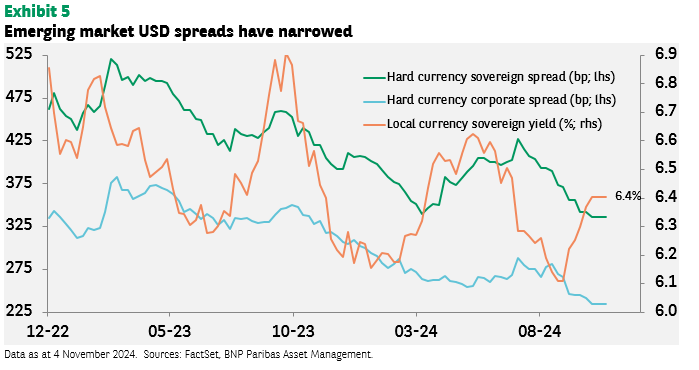
We maintain our positive outlook for EM US dollar government bonds, supported by improving fundamentals, lower developed market interest rates and consistent demand for the relatively high yields on offer. However, performance looks likely to remain diverse, with select pockets offering greater potential for outperformance.
We believe the most compelling opportunities lie in local currency bonds, where headline yields have risen significantly in recent years and real (inflation-adjusted) yields are now at historically attractive levels, particularly relative to real yields in the US.
However, country selection will be important. We expect Latin America to remain a leader in lowering rates, driven by Colombia, Chile and Peru. In Eastern Europe, Hungary, Czechia and Romania are likely to lead the way with cuts.
We are also seeing interesting turnaround potential in several markets. In Turkey, the new central bank governor is driving a return to orthodoxy, independently managing inflation targets and tackling other important economic indicators.
In Egypt, the government has worked closely with the International Monetary Fund and attracted significant foreign direct investment from Gulf countries in 2024.
In Argentina, a new president is succeeding in driving through policies that have the potential to improve key indicators for the country. The challenges for the market remain considerable, but the direction of travel is positive.
In all three markets, these stories have driven positive performance in US dollar bonds in 2024. If progress continues in the year ahead, this has the potential to feed through into sentiment and performance for local currency bonds.
Corporate bond yields hold relative attractions
EM corporate bond spreads over US Treasuries have compressed in recent quarters and some countries and sectors have begun to look expensive on an absolute basis. However, relative to their counterparts in the US and other developed markets, they remain attractive.
Corporate fundamentals are robust, with recent earnings reports supporting a resilient outlook. Geopolitical tensions, notably conflict in the Red Sea, mean there is potential for supply chain disruption, but EM corporates have proven agile in their operating models, shifting providers or optimising their cost structure to minimise the impact.
Finally, the technical environment is positive. Corporate supply has picked up recently but remains well below pre-pandemic levels, and we expect a similar picture in 2025.
Written: November 2024


