
Food production is integral to life.
Yet, current agricultural and food supply practices can be unsustainable and wasteful. To ensure a secure food supply for the future, production needs to become more regenerative and resilient.
Such a transition will require innovative solutions throughout the food value chain and can create long-term opportunities for investors.
Unsustainable food practices
During the 20th century, production-maximisation was the goal which allowed certain resource-intensive agricultural practices to gain popularity. These practices relied heavily on fertilisers, pesticides, and other unsustainable practices which are no longer fit for the future. Aside from the unacceptable environmental costs and the high volume of global greenhouse gas (GHG) emissions, the planet is being rapidly drained of the vital resources needed to produce sufficient food.
Inordinate amounts of the food produced are also wasted throughout the food value chain. Almost a decade on from limiting food waste being designated as one of the UN’s Sustainable Development Goals (SDG), scant progress has been achieved. The UN estimates that as much as 39% of the world’s food goes unconsumed[1].
If we are to achieve a secure food production system for the future, change must happen now.
Regulatory and consumer drivers
Two factors are helping to propel change. In recognition of the social and financial costs of food insecurity, several countries have set targets to address food waste. The US, Japan, and Australia amongothers have set targets to halve food waste by 2030, while other countries have enacted legislation: Spain, for instance, has mandated that companies throughout the food supply chain (except for small shops) must operate food waste reduction plans.
At the same time, there is growing political recognition that the environmental impacts of agriculture must be reduced, given the sector’s contribution to global GHG emissions. At the COP28 climate summit in 2023, national governments representing 75% of the world’s population signed a declaration that included commitments to shift to more sustainable food production practices, protect and restore natural ecosystems, and increase climate adaptation and resilience.
The EU’s Farm to Fork initiative seeks to walk this talk by aiming to accelerate the transition to a more sustainable food system while also maintaining access to safe, nutritious and affordable food. Yet, while these legislative efforts are laudable over the long term, they have prompted a near-term backlash among some farmers amid rising production costs, with protests taking place across Europe during 2024.
It is not just the ratcheting of legislation that will compel change, however. Many consumers are becoming increasingly environmentally conscious about their food choices, particularly the younger generation. A 2023 survey of US consumers found that 42% said they always or usually consider the environmental impacts of their food purchases – double the proportion in 2019[2]. This is putting pressure on food producers to demonstrate a more transparent and traceable supply chain.
A more circular approach
The implementation of circular economy principles in food production is an essential way to achieve the needed transformation of our food systems. Instead of practices that revolve around extraction, a circular economy encompasses regenerative, recycling and repurposing processes. In practice, this means reducing synthetic inputs and closing the resource loop to boost sustainability and resilience.
This may involve recycling organic waste into compost and improving soil health; encouraging businesses to focus on repurposing food by-products and minimising waste; and supporting the adoption of regenerative agriculture methods, such as organic no-till or low-till farming.
Adopting such methods would not only address supply-chain inefficiencies and food waste but would also help to preserve natural habitats and lower agriculture’s environmental impact.
Key investment opportunities
From an investment perspective, there are multiple opportunities for investors to harness the transition to a more circular, sustainable and secure food supply.
Companies are already creating natural feed additives derived from plants, minerals and micro-organisms to improve the health and welfare of animals, without many of the negative environmental externalities associated with inorganic nutritional additives and antibiotics. In particular, the development of innovative feed additives has been proven to reduce the methane emissions associated with beef and dairy products by suppressing the enzyme that triggers methane production in cattle’s stomachs.
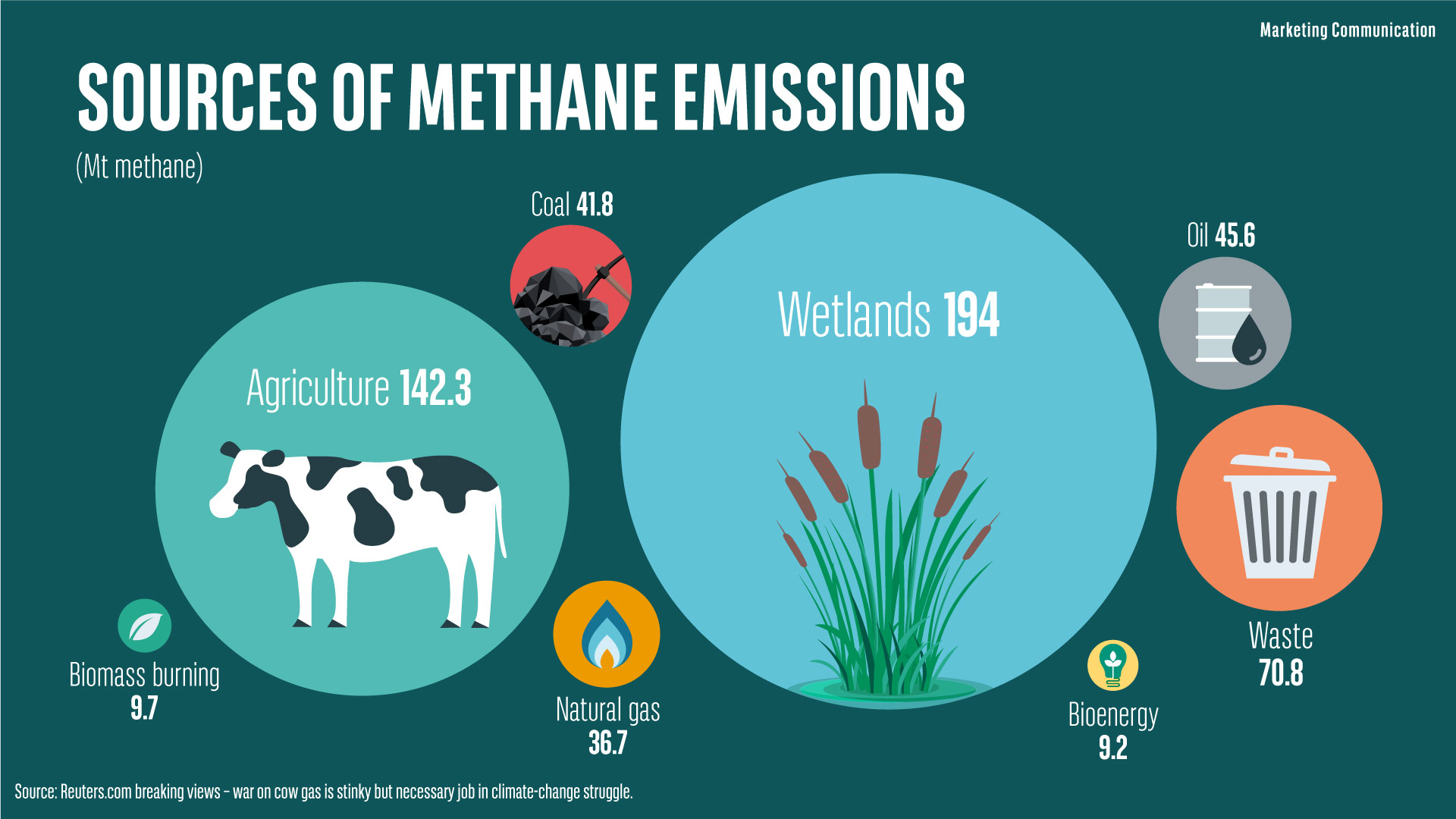
Source: Reuters.com breaking views – war on cow gas is stinky but necessary job in climate-change struggle.
The adoption of precision agriculture techniques has been shown to make farming operations more efficient by reducing the volume of agricultural inputs needed, and cutting the environmental and financial costs of food production. For example, intelligent farm equipment guidance technologies can save a typical farmer 10% of their diesel consumption through improved route optimisation, while technology for targeted weed spraying reduces herbicide use by as much as 30%[3].
To tackle waste, more efficient solutions for food distribution can help reduce GHG emissions and improve access to safe, nutritious and affordable food. Food waste tracking technology enables professional kitchens to identify opportunities to minimise food waste using real-time tracking and dashboard reporting. The analysis of this data can then reduce future kitchen waste.
Meanwhile, a shift to more sustainable packaging can limit the use of single-use plastic and also reduce the use of virgin fibre materials – which can be a driver of deforestation. Companies are starting to take a more circular approach to packaging so that it can be reusable, recyclable or compostable. Fibre-based food packaging solutions have been developed that have barrier properties to protect products from moisture and still ensure long shelf lives.
Conclusion
Securing food for the world’s population while reducing food waste is a critical challenge. To ensure a reliable and adequate food supply chain, businesses and key stakeholders must adopt circular economy practices, enhance production methods and implement effective policies and educational initiatives.
At BNP Paribas Asset Management, we believe the transition to a more sustainable and resilient food system will create long-term investment opportunities. The Smart Food strategy is centred around investments in sustainable food supplies, resource efficiency and the development of nutritious and healthy food options. By applying a thematic lens, the investment team seeks to construct a diversified portfolio of companies providing environmental solutions with attractive growth prospects, while avoiding those businesses unable or unwilling to adapt. This supports our aim of delivering long-term returns to our clients alongside real-world outcomes that are aligned with the UN’s Sustainable Development Goals.
[1] Champions 12.3, 2021. SDG Target 12.3 on Food Loss and Waste: 2021 Progress Report
[3] Nature Research, 2022


