
Both interest rates and credit spreads influence bond performance. Both are typically negatively correlated, providing attractive diversification potential for fixed income portfolios, write Johann Plé, Senior Portfolio Manager, and Rui Li, Portfolio Manager.
This article was first published on the AXA Investment Management Investment Institute website.
Historically, diversified portfolios have delivered better risk-adjusted returns than either high-yield or investment-grade portfolios, and the past five years should not confuse investors.
In an environment of global fragmentation and market volatility, diversification has again come to the forefront for building a portfolio. However, a diversified portfolio doesn’t just mean a mix of equities and bonds. Fixed income itself is a broad and deep asset class offering myriad opportunities to diversify, for example, by credit quality, geography, or bond maturity.
The impact of credit spreads
Despite the uncertain backdrop, credit spreads – the yield premium over higher rated bonds of similar maturity – are currently historically low: they reached their tightest levels for the year by the end of July. This spread tightening has helped high-beta asset classes1 outperform a diversified portfolio2, even when adjusted for risk. However, this might not be what to expect from now on.
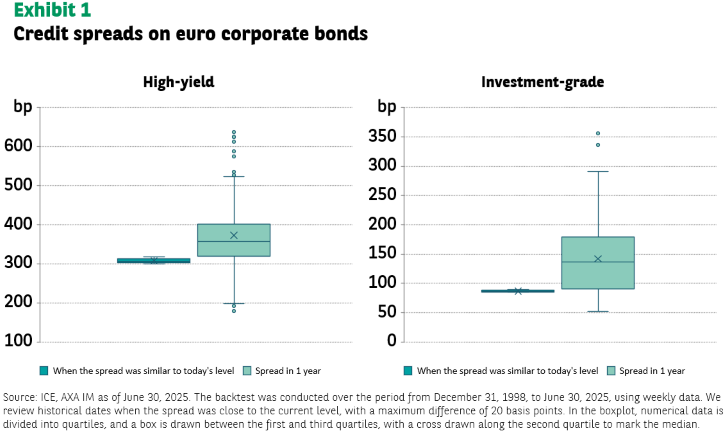
Looking at historical data, when spreads were at similarly tight levels, there was a significantly higher probability that they would widen within the next 12 months.
Using euro high-yield corporate bonds (HY) as an example, the chance of widening is currently 81%, with potential increases in spread of up to 341bp. Conversely, the probability of (further) tightening is only 19%, with maximum decreases of 125bp.
Similar results have been observed for euro investment-grade credit (IG), with an 80% probability of a widening in spread and a notable asymmetry favouring the upside (see Exhibits 1).
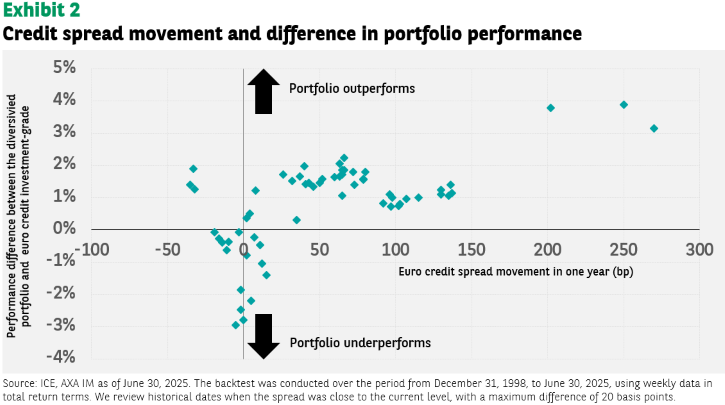
In total return terms, the picture appears different. Although there is a similar probability of spread widening for both IG and HY bonds, HY tends to be more resilient thanks to the carry component (i.e., a relatively high coupon income).
In only 42% of cases, HY would underperform a diversified portfolio despite spread widening. In fact, the diversified portfolio begins to truly outperform HY when the HY spread widens by at least 100bp over a year.
For IG credit, where the carry component provides less cushion against spread widening, the diversified portfolio outperforms in 74% of cases (see Exhibit 2).
Diversification and targeting optimal risk-adjusted returns
So why should an investor adopt a diversified approach if allocating only to HY, or subordinated debt, usually delivers a better return versus a diversified portfolio?
This is where focusing on risk-adjusted returns can be important, as higher returns tend to be accompanied by higher volatility and higher drawdowns.
As exhibit 3 indicates, diversification has historically helped to significantly reduce the percentage decline in the value of a portfolio from its highest point to the subsequent lowest point before a recovery – the maximum drawdown (MDD).
Diversification should thus improve the risk-adjusted return of a portfolio as measured by the Sharpe ratio3 (SR). To demonstrate this, if we look at euro fixed income, a diversified portfolio exhibited the lowest MDD and the highest SR over the long-term.
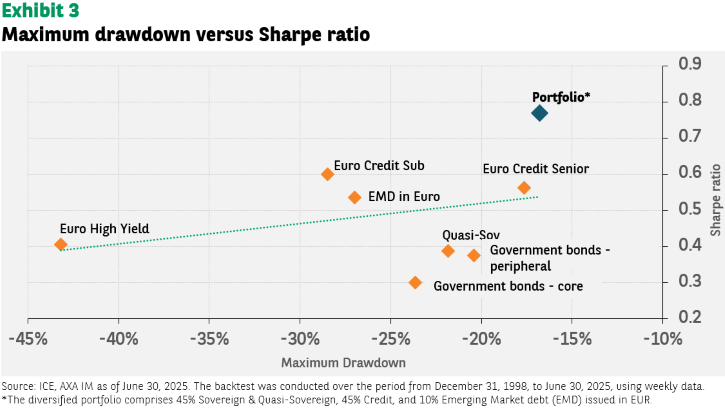
In contrast, looking at each asset class individually, the data shows that they all have a larger MDD than the asset classes combined (shown below as the portfolio).

Source: AXA IM as of June 30, 2025. For illustrative purposes only
Indeed, during previous economic crises, a diversified portfolio has consistently demonstrated greater resilience, experiencing lower drawdowns compared to single asset classes.
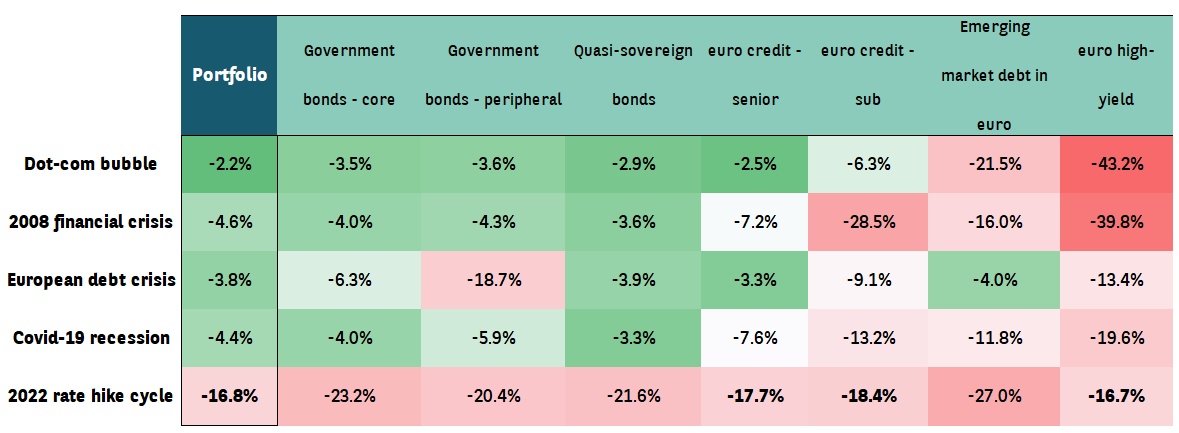
Source: ICE, AXA IM as of June 30, 2025. The back test was conducted over the period from December 31, 1998, to June 30, 2025, using weekly data. *The diversified portfolio comprises 45% Sovereign & Quasi-Sovereign, 45% Credit, and 10% Emerging Market debt (EMD) issued in EUR. For illustrative purposes only
A significant drawdown requires time and patience to recover from and may not be suitable for investors with a lower risk tolerance.
We recognise that a lower drawdown does not always translate into a higher Sharpe ratio, but over the past five years, credit — especially HY — has delivered a more attractive SR compared to a diversified portfolio. Clearly, the tightening of credit spreads highlighted earlier has contributed to this, along with their lower duration profile.
Why it’s important to manage duration
The importance of duration has grown compared to the period before central banks started raising rates four years ago.
This is illustrated by the fact that duration risk now accounts for over 90% of the volatility in the euro aggregate bond segment (see Exhibit 4), making it a notable source of risk, but also return.
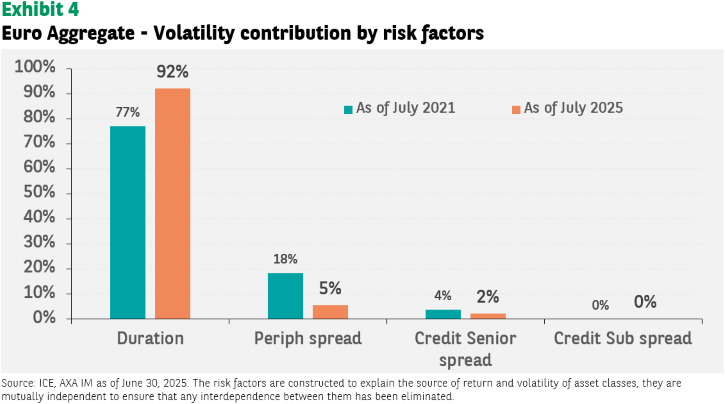
As a result of the change of regime in monetary policy and an increase in rates volatility, duration is no longer a strategic asset allocation choice, but instead offers another potential lever to tactically manage an investment portfolio’s risk-adjusted return profile.
Diversification – Still key longer-term
Diversification enables a better balance among risk factors, helping to cut duration risk as a source of volatility and enhancing spread factors to improve the return profile. Combining diversification and flexible duration management may provide a key to success in the current fixed income markets.
Historically, diversified portfolios have delivered better Sharpe ratios than high-yield or investment-grade portfolios.
If history is right, the chance of seeing similar tightening to what was seen over the past five years looks unlikely. Hence, in a world of high uncertainties and tight spreads, a diversified allocation might be appropriate for investors looking to allocate within fixed income.
In an environment with structurally high rates volatility, bringing flexible duration management to a diversified allocation may be an appealing way to deliver potentially superior long-term returns with attractive Sharpe Ratios and limited drawdowns.
[1] A security with a high beta experiences bigger ups and downs in price, suggesting that it shows a greater potential for growth and a greater risk of losses
[2] Diversified portfolio is defined as 45% sovereign and quasi-sovereign bonds, 45% credit and 10% emerging market debt in EUR
[3] Sharpe ratio: A measure of the performance of an investment adjusting for the amount of risk taken (compared to a risk-free investment). The higher the Sharpe ratio the better the return compared to the risk taken.


