
Developed market interest rates remained generally range bound in the second quarter. The US economy can be expected to pivot towards higher inflation and slower growth. Such a trajectory may well lead the US Federal Reserve to loosen monetary policy in the third quarter, writes Olivier De Larouziere.
At the start of the quarter, we acknowledge the passage by the US Congress of a more stimulative budget bill, but remain concerned about the prospects of a damaging tariff schedule. Although President Trump once again delayed the deadline for an EU trade deal, he has ramped up pressure on other trade partners – threatening 25% tariffs from 1 August on imports from Japan and South Korea, as well as 50% tariffs on Brazil and copper imports.
For now, the equity markets trade as if Trump is bluffing. But we think there are several reasons to expect confrontation.
- First, risk assets have recovered from the drawdown after April’s ‘Liberation Day’ tariffs announcements, which the administration probably interprets as a sign of confidence
- Second, Trump is a committed protectionist who rejects the standard arguments that trade can be mutually beneficial, instead seeing trade as a zero-sum game
- Third, Trump’s rejection of his own USMCA deal with Canada and Mexico signals to other trade partners that the US is not a dependable trade partner, and that making concessions simply invites demands for further concessions
- Fourth, China’s strategy of confronting the US by raising its own tariffs and limiting exports of strategic inputs and popular consumer goods forced a US climb-down, and demonstrated to the EU that large economic blocs can stand up against the unilateral imposition of tariffs by the US.
We are concerned that the EU will show only limited flexibility vis-à-vis US demands, and will wish to ensure the US feels the consequences of its protectionist turn, even as, geopolitically, the EU will not wish to accelerate a US military withdrawal from Europe.
In sum, we continue to expect a tariff schedule that will inflict serious damage on US growth, with an effective rate closer to 20% than the 10% consensus. The market’s apparent assumption of a TACO (Trump Always Chickens Out) outcome only has validity if asset prices actually take Trump’s threats seriously and impose discipline on the White House. For the moment, risk assets appear complacent instead.
US policies will likely harm long-term growth
Overall, the net result of these protectionist trade and expansionary fiscal policies is probably negative for long-term growth, but likely positive for near-term growth (given the front-loading of tax cuts) and drives up core goods prices on a one-off basis. While we may have more clarity on the fiscal path, the trade outlook remains uncertain.
We forecast that the fed funds rate likely remains on hold at 4.25-4.50% until the Fed’s September policy meeting and that the Fed will provide two further cuts in 2025, taking the rate to 3.75-4.00%. However, we are now less confident that the central bank will reduce rates to the 3.0% neutral level in 2026, given the passage of the stimulative fiscal bill.
Of course, it is hard to have a firm view on policy rates beyond May 2026, given that President Trump will be nominating a new Fed Chair, but our best guess is policymakers on the Federal Open Market Committee will stall rates at around 3.50-3.75%, versus our previous view that rates would fall back to the 3.0% neutral level.
Will investors continue to finance high US deficits?
Indeed, should immigration curbs lead to labour shortages and tariffs have second-round price effects, it is even conceivable that the FOMC might need to resume rate hikes in late 2026 – which at that point could trigger concerns about the fiscal situation.
On this topic, we remain worried about investors’ willingness to continue financing elevated US deficits. Recent comments from Treasury Secretary Bessent suggest a recognition that the term premium is already high, and hence there is a reluctance to add to longer-dated bond issuance.
A shift in the maturity profile of Treasury issuance could provide a reprieve of the curve steepening trend, but will not solve the underlying problem – unsustainable deficits that are placing upward pressure on yields.
Recent sharp sell-offs in the UK and Japanese government bond markets driven by debt sustainability concerns illustrate investor nervousness on this topic – and it would be naïve to assume that US Treasuries would be forever immune.
Furthermore, attempts by the US administration to pressure this (or a future) Fed Chair have the potential to backfire if investors conclude that the Fed’s operational independence and inflation credibility are being compromised.
What next for Treasuries?
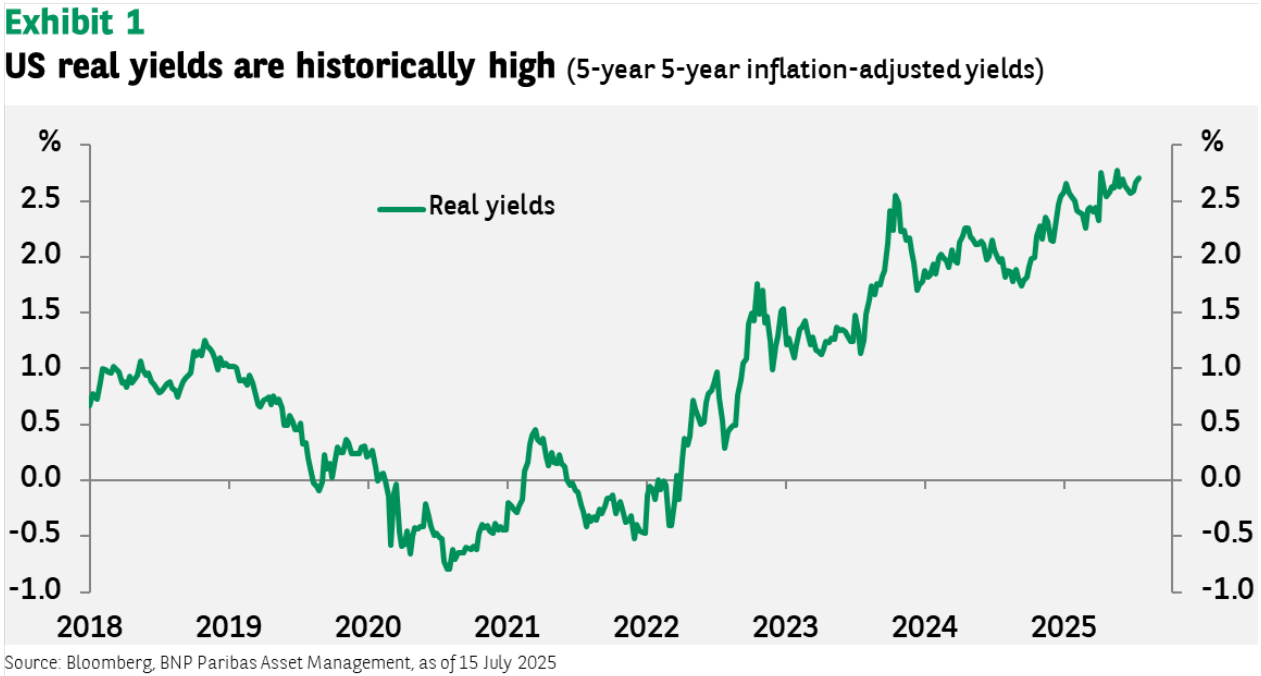
As a result, we are, on the one hand, tempted to sell US Treasuries to position for further increases in term premia, but, on the other hand, also tempted to buy given the historically elevated real yields.
While we find ourselves in this dilemma, we remain tactical and are trading the 4.25-4.75% range for 10-year yields. We begin the third quarter with portfolios having modest modified duration contribution in 10-year real yields.
We are retaining a core 7s30s curve steepening exposure, but also emphasise that it is roughly half the size of what we held in early June. Paradoxically, US 10-year breakeven inflation rates have traded with an inverse correlation to the tariff developments as announcements of tariffs hurt risk assets and stoked fears of a disinflationary recession. In breakevens, we continue to trade the 2.15-2.45% range in effect since October 2024.
This is an extract from our Q3 2025 quarterly fixed income outlook – full document.


