
We expect large growth stocks to continue to outperform other asset classes and the broader US equity market, even as market leadership changes, leading to less concentrated performance, writes Chris Fay.
- Large growth companies are among the most innovative and disruptive ones in the world. These companies are well-established, with strong financial foundations and experienced management teams that have consistently delivered robust capital appreciation.
- They are generally less vulnerable to economic downturns than small, mid-sized or value stocks through their globally diversified businesses.
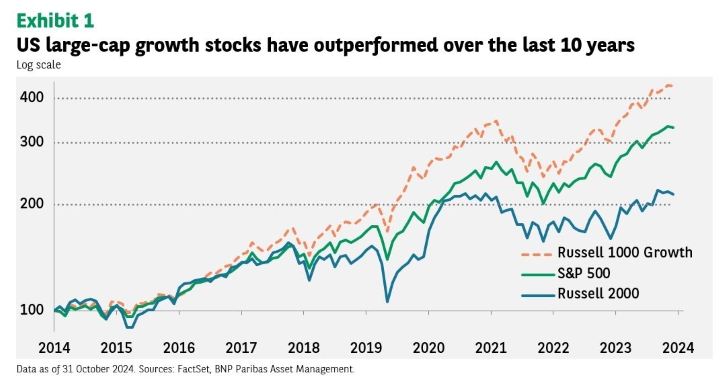
- The Russel Growth index has returned about 400% over the last 10 years with a roughly 16% annual growth rate, which is higher than many other asset classes.
- We see an opportunity outside of the mega-cap stocks in benchmarks, looking for improving fundamentals, valuation dislocations, high capital spending, and a changing interest rate environment to lead to a more varied leadership among other growth sectors.
Long-term asset class of choice
Large growth as an asset class is worth around USD 40 trillion (market value of MSCI AC World Growth index). Over the last 10 years, the Russell 1000 Growth index has had a cumulative return of over 300%, equivalent to a compound annual growth rate (CAGR) of 16% as at October 2024 (see Exhibit 1).
The index has outperformed the broad S&P 500 and Russell 2000 small-cap indices, which have gained 231% and 114%, respectively. The growth index has underperformed only once in the last 10 years – in 2022, when there was a 29% drawdown. The slippage was more severe for large growth companies due to their greater interest rate sensitivity.
Over the last five years, the Russell 1000 Growth index and the S&P 500 have been dominated by several mega-cap stocks, most notably the ‘Magnificent 7’ (Apple, Microsoft, Google parent Alphabet, Amazon.com, Nvidia, Meta Platforms and Tesla).
These seven stocks collectively gained about 78% in 2023 and 56% through 3 October 2024 whereas the two other benchmarks were up by 43% and 31%, respectively. Only three of the Mag 7 stocks, however, outperformed the Russell 1000 index in 2024 verses all seven in 2023.
Market concentration in Mag 7 and IT may be an opportunity
The Mag 7 are now about 32% of the S&P 500 market capitalisation and 55% of Russell 1000 Growth, though its contribution is far higher in terms of earnings. The IT sector in itself is also large (about 34% of the S&P 500 and about 56% of Russell 1000 Growth).
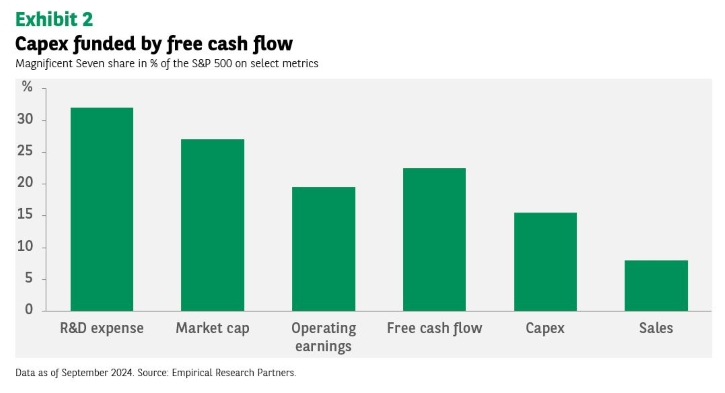
The Mag 7’s share of the S&P 500’s market cap is not much different from its share of market-wide free cash flow production, which is impressive (see Exhibit 2).
Some investors are concerned, however, by the Mag 7’s high share of capital expenditure (capex) and research and development (R&D) spending. The group accounts for about half of the entire capex spending growth for the S&P 500 according to analysis by Empirical Research Partners.
Can these companies turn this huge investment into near-term sales and earnings? We are not sure.
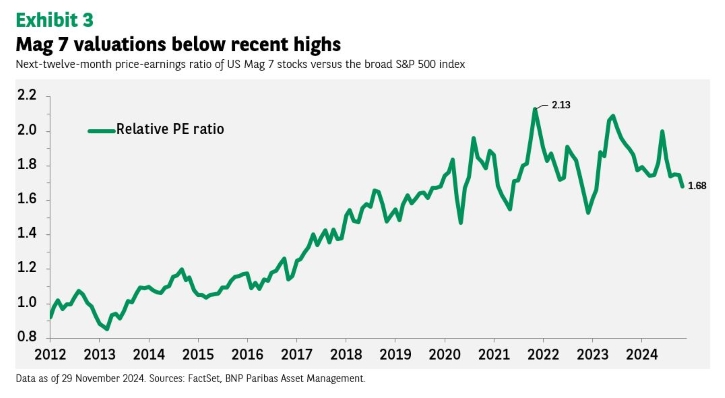
In terms of valuation, Mag 7 stocks are trading at about 1.7x above the S&P 500’s forward price/earnings ratio, below the highs seen over the last few years (see Exhibit 3).
We believe that we can identify other growth companies that can outperform the broader market. The combination of the high current concentration in earnings, above-peer valuations, and the significant capex and R&D spending could lead to earnings reductions relative to the rest of the market.
While we doubt that the concentrated outperformance we have seen can continue, this does not necessarily mean that these stocks will all underperform the broader market. Rather, we believe that allocating overweight positions to only a few of the names and underweighting the others allows us to make room for other sectors and ideas.
What we find intriguing for 2025
In the year ahead, we are focused on secular growth themes such as artificial intelligence (AI), semiconductors, cloud computing and datacentres, reshoring and infrastructure, and innovative healthcare. Other areas of interest include consumer spending, which may rebound as interest rates fall, as well as companies who could be considered merger & acquisition targets.
Within the technology sector, we expect AI to continue to advance as a theme in 2025 and beyond. The sector’s leadership will broaden to include companies that provide semiconductors (going beyond well-known early winners such as NVDA), networking and storage systems, database software, and software applications that embed AI functionality.
In the consumer space, we are looking at companies tied to housing as we expect market conditions to improve given the lower interest rates, as well as replacement cycles (a lot of home buying during Covid means that home goods will need to be replaced). We are also looking at companies that are tied to megatrends such as healthy living, demographic shifts, and the rise of the emerging market consumer.
In healthcare, we like small and mid-cap biotechnology (rare disease and oncology in particular), especially given there is about USD 200 billion of branded drugs going off patent [1] over the next decade and large pharmaceutical and biotech companies will need to replenish their pipelines. Fortunately, in aggregate the major companies have about USD 200 billion in aggregate cash flow available to fund this.
In financials, we believe some banks will benefit from a less stringent regulatory regime (capital, liquidity, M&A), improving profitability and growth. We expect loan growth to accelerate as political uncertainty fades and given the pro-business policies of the new Trump administration. Yield curves could steepen, which would be a tailwind for the sector.
Within industrials, we are looking at those companies levered to reshoring, electrification and automation. Although near-term manufacturing activity is still weak (purchasing manager indices are at below 50), we are evaluating ‘short-cycle’ companies whose stock prices we believe already reflect most of the bad news.
Our long-term focus on growth companies that are innovative, well run, with differentiated products and services, and that have idiosyncratic drivers that can work in any regime.


