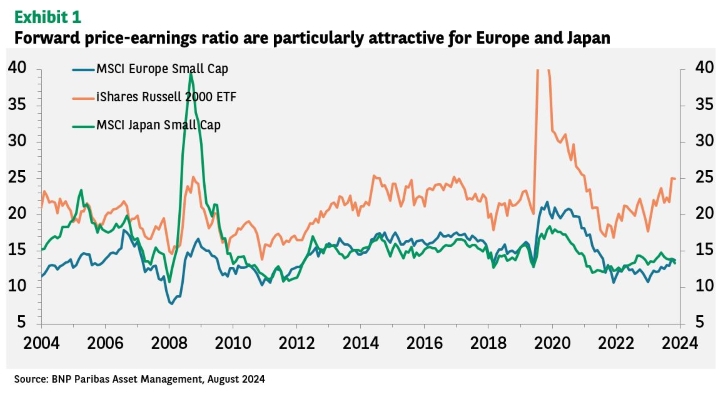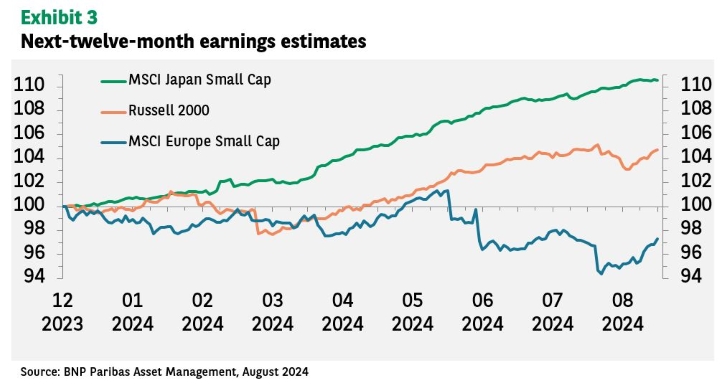
There are valuation arguments in favour of European, Japanese and US small capitalisation stocks. For different reasons, favourable trends are also apparent in the domestic economies in each of these regions. Last but not least, diversification underpins the rationale for allocations.
US
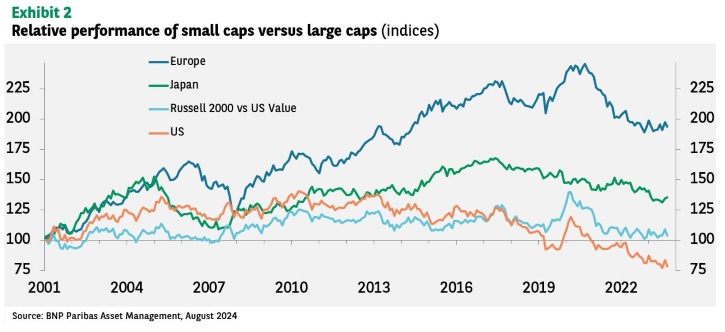
US small caps have underperformed US large caps, but so have most other major markets. In the US, the underperformance reflects the strong returns (at least until recently) of mega-cap US technology stocks. However, relative to the non-tech parts of the market, US small cap stocks have done well.
As the US economy is still in growth mode, that positive performance should continue. If Donald Trump is re-elected to the White House, the prospect for higher tariffs (and hence greater demand for goods and services produced in the US) should provide a further boost to small-cap companies.
Japan
Japanese small-cap stocks have outperformed large caps handily over the last 20 years (9% compound annual growth rate for small caps versus 7% for large caps). Japan’s move from deflation to inflation should be a boon for revenue growth at domestically focused companies.
Inflation should also encourage consumption as Japanese households no longer have an incentive to delay purchases in the expectation that prices will fall in the future. Wages are rising at an accelerating rate, putting more money in consumer’s pockets.
Europe
European small caps have also outperformed large cap stocks (10% vs. 7%), by more than in any other major market. The region’s economic recovery, supported by declining central bank rates, argues for further gains. Small caps would benefit in the event of US tariffs since these tariffs would have comparatively little impact on them. Wage growth is strong and consumer sentiment is improving.
Valuations look attractive for European and Japanese small caps: forward price-earnings ratios are below average (at 8 times in Europe and 14 times in Japan). This compares to 25 times for stocks in the US Russell index.