
Market gyrations due to rapidly changing tariffs are likely to continue until some sort of agreement is reached between the US and China on trade. Current tariff levels have rendered commercial relations between the world’s two largest economies practically impossible and the disruption to business is significant.
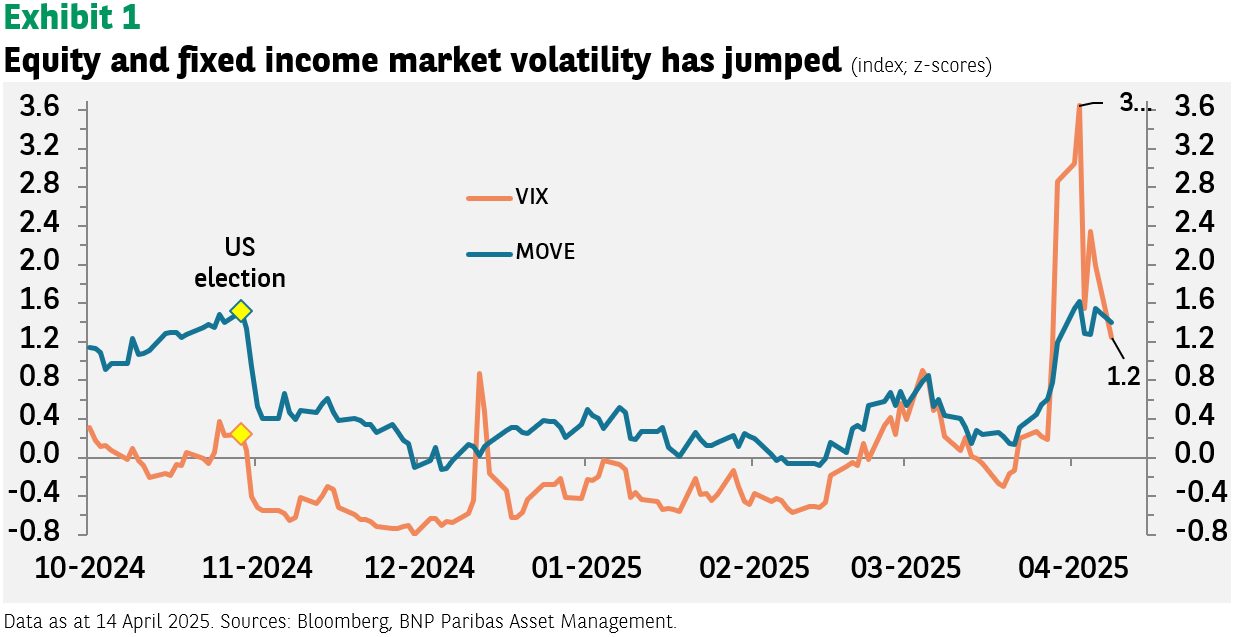
The surprising large increase in tariffs announced by the Trump administration on ‘Liberation Day’ has been reflected in market volatility. The VIX index, measuring US equity market volatility, jumped to 52, while the MOVE index (for fixed income) spiked to 140.
Relative to history, these values are one to nearly four standard deviations above average (see Exhibit 1). It is little comfort that they are nonetheless lower than levels reached during the Global Financial Crisis or the Covid pandemic.
At first blush, the market reaction seems exaggerated relative to trade exposures: US exports to China only represent 0.5% of US GDP, while for China, exports to the US are 2.5%, although this figure understates China’s exposure as some of its exports pass through third countries.
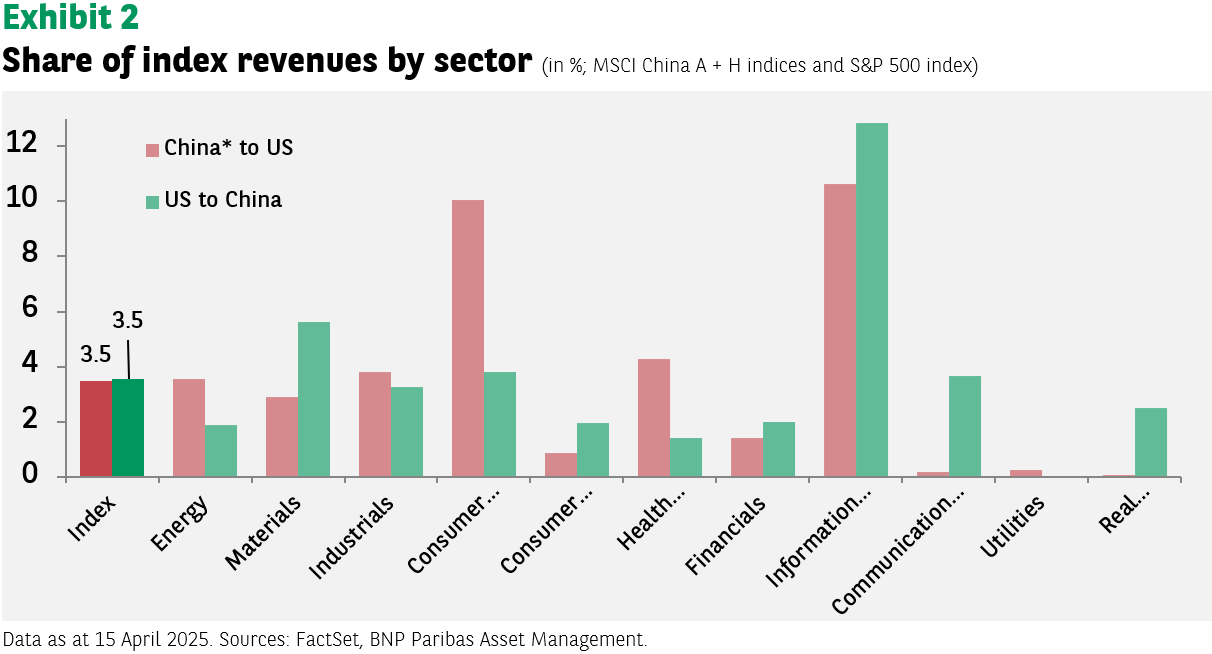
Revenue exposure, however, is greater for US and Chinese equity indices than the GDP figures suggest, particularly for certain companies and sectors. Sales to China account for about 3.5% of S&P 500 revenues – as it happens, the same figure as US sales for Chinese companies.
For the US consumer discretionary and information technology sectors, the share is much higher (see Exhibit 2). Business models premised on low-cost production in China cannot be changed overnight. And these figures do not capture production inputs for some US companies that have suddenly become prohibitively expensive.
Because of the near-term disruptions to growth for both countries, we are hopeful an agreement can be reached eventually. But as geopolitical considerations factor heavily in the minds of the countries’ leaders, one cannot know if or when this might happen. The risk is that the longer it takes, the more market turmoil could eventually begin to damage the real economy. Predictions of a recession in the US or elsewhere are not unfounded.
An optimistic scenario would see tariffs lowered to a level which allows trade to resume, though this is not likely to apply to all products. There are numerous sectors where the Trump administration sees a strategic, national interest in protecting US domestic production, in which case higher tariffs may be levied to make imports less competitive.
One objective of the Trump administration is to regenerate manufacturing capacity in the US for sectors such as steel and pharmaceuticals. It hopes to end the stagnation in US industrial production that has set in over the last 20+ years (see Exhibit 3).
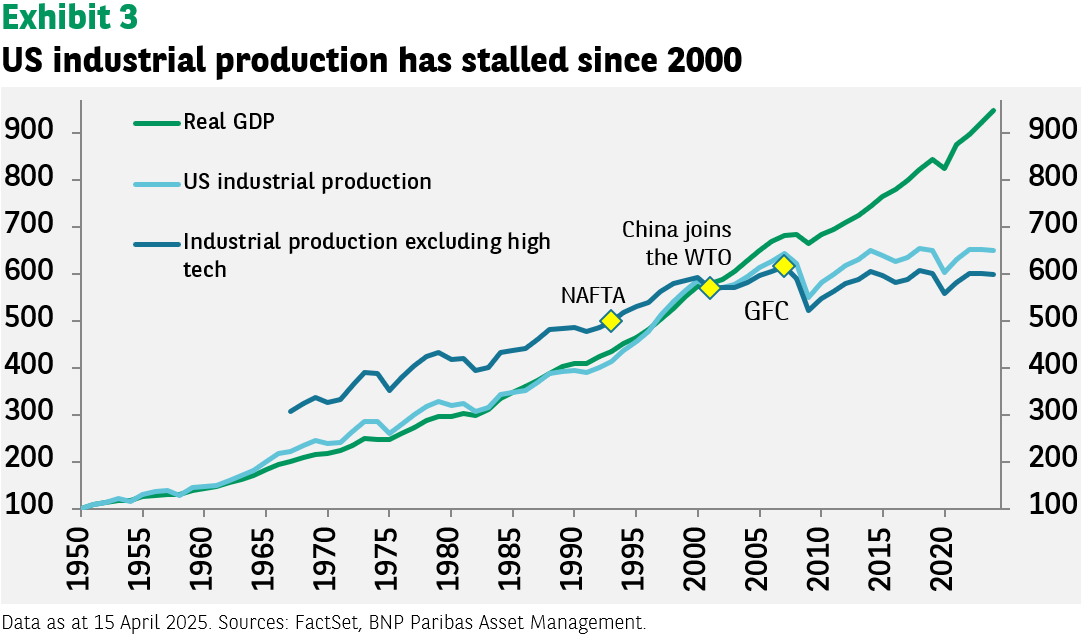
While the US economy has continued to grow thanks to a vibrant services (and high-tech manufacturing) sector, the administration believes it is not in the country’s long-term strategic interests to lack domestic production capacity in key areas. A fundamental change in the relationship between the US and the rest of the world is likely occurring.
Baseline tariffs
If the negotiations with other US trading partners are successful, we could foresee the currently suspended ‘reciprocal’ tariffs permanently removed, though the baseline 10% tariff may remain. While this will affect sales and profit margins, with winners and losers globally, companies will be able to adjust, and earnings growth should resume. Recall that the tariffs are not applied to all sectors and the revenue exposure for most countries is relatively low.
Moreover, the negotiations could lead to lower tariffs both on US exports and imports in certain sectors, partly offsetting the 10% baseline tariff. A timely announcement of progress on these negotiations could provide a useful boost to market sentiment.
Equity outlook
Earnings expectations will likely be revised downwards in the weeks ahead, but we believe recession worries are currently overdone. Earnings growth forecasts were high enough for most countries prior to the Liberation Day announcement that, even with lower earnings per share this year than previously expected, profits should still be higher than they were in 2024.
Equity prices should appreciate again once markets have found their footing. Though markets have been rising unsteadily since 8 April, a further ratcheting-up of tensions could easily reverse these gains. For now, we remain cautious on equities.
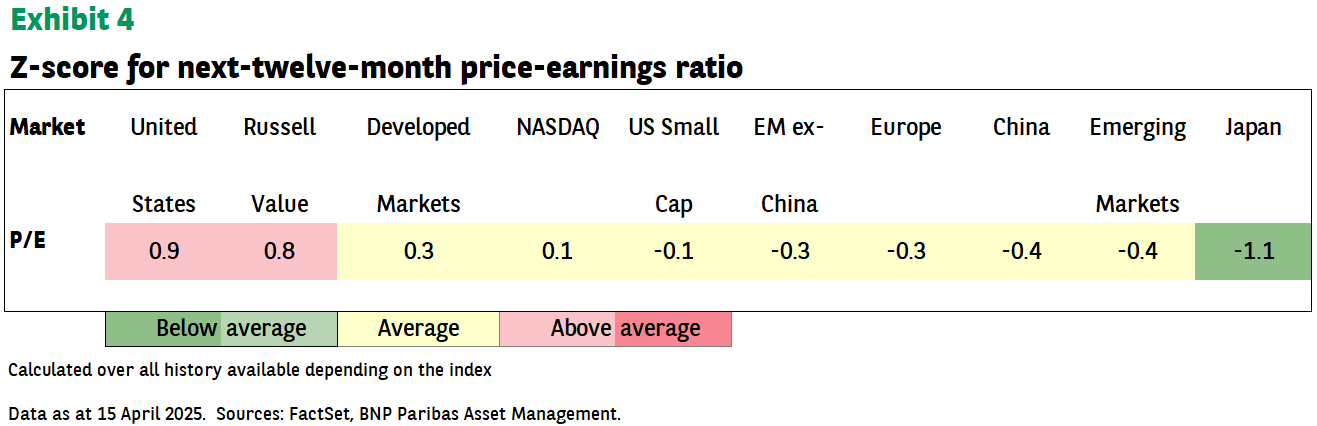
Which markets we will prefer will partly depend on relative valuations at the time. Price-earnings ratios today overstate the ‘cheapness’ of equity markets as negative earnings revisions are not yet reflected in published estimates. Nonetheless, we see opportunities appearing, notably in Japanese equities. Valuations for US value stocks, by contrast, remain somewhat high (see Exhibit 4).
Fixed income outlook
Unlike equities, we have more confidence in the (relative) outlook for fixed income. US Treasury yields have rebounded sharply after the initial risk-off rally post 2 April. The increase in nominal yields has come via real rates and risk premia (reflecting increased investor doubts about the medium-term outlook for the US economy) as long-term inflation expectations have declined.
In the eurozone, with the impact of US import tariffs weakening both growth and inflation, we expect bond yields to remain contained. At the same time, they offer attractive carry, hence our preference for eurozone government debt relative to the US.
US dollar declines against developed market currencies
Expectations prior to ‘Liberation Day’ were that tariffs, while negative for growth globally, were worse for US trading partners than for the US, hence the dollar was forecast to strengthen. The rise in the dollar during the first Trump administration supported this view.
The dollar has in fact gained against emerging market currencies, but it has dropped sharply versus developed market currencies.
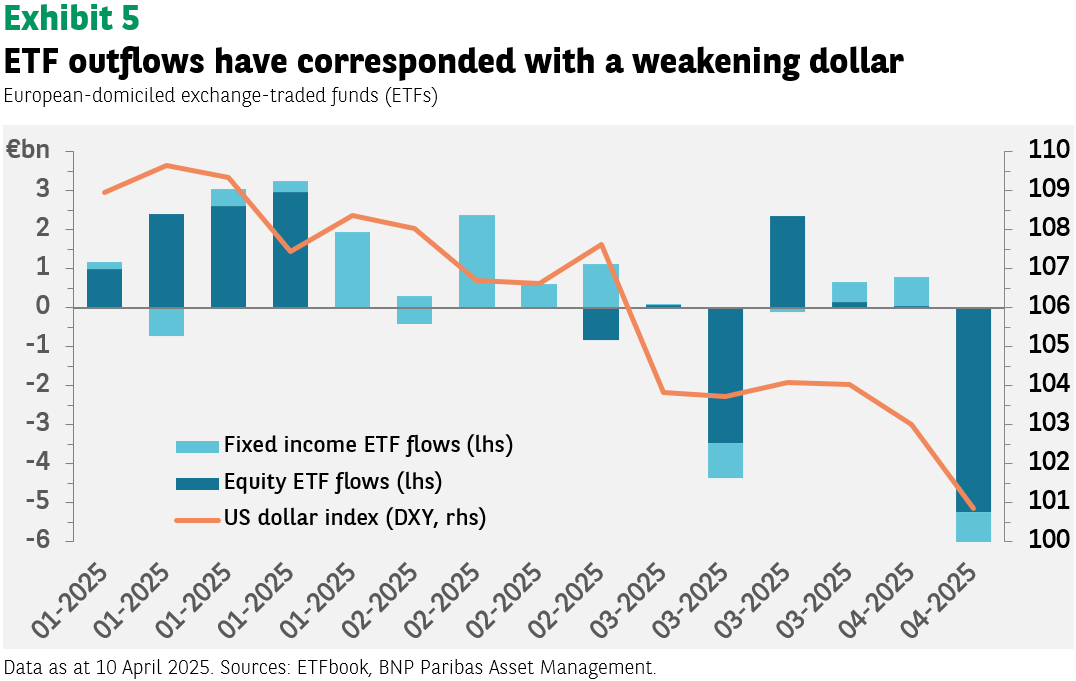
At least one of the drivers of this decline is outflows from US assets (see Exhibit 5) as investors reassess the attractiveness of the US as an investment destination. It remains to be seen whether this is just a short-term reallocation or whether a more fundamental shift is taking place.
Asset allocation
- Recent market volatility has been extreme: The VIX index has risen to its highest since March 2020, stock trading volumes have skyrocketed and most stock prices are lower than before ‘Liberation Day’, signaling some sort of capitulation. While market reactions seem exaggerated to us, uncertainties around US trade policy and its impact on global growth continue to support our neutral stance on equities.
- Early April movements in US sovereign bonds were driven entirely by risk aversion and appear inconsistent with the outlook for inflation and persistent fiscal deficits. We maintain a negative conviction on US Treasury notes alongside a positive conviction on European bonds which provide an attractive carry. While the increase in uncertainty has hit equity markets hard, credit spreads have widened only slightly. We took advantage of this situation to take profits on our long position in euro investment-grade credit and thus reduced the overall risk of our multi-asset portfolio.
- We took additional profits recently on gold after its strong performance. Our conviction remains positive over the medium run on this asset class which has clearly demonstrated its diversification qualities.


