
The US economy has recently experienced the benign combination of steady growth and slowing inflation; a sort of renewed ‘Goldilocks’. The volatility in economic data since the pandemic, however, suggests the situation is unlikely to last. We expect growth to slow modestly in the quarters ahead, with core inflation remaining comparatively high.
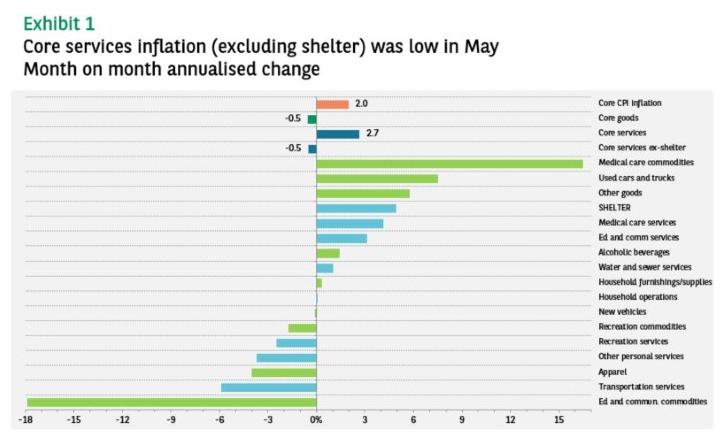
For now, the latest US consumer price inflation data was welcome news for investors and the US Federal Reserve. After unexpectedly strong inflation in the first part of the year, inflation eased to 0.2% on a monthly basis in May (2% annualised) from 0.3% in the prior month. The consensus forecast for May CPI had been 0.3%.
Encouragingly, this was not due to weakness in any one particular category, but it was more broad based. Core goods inflation was negative, but the big improvement was in core services inflation excluding shelter (often referred to as ‘supercore’; see Exhibit 1). This was also negative.
Given the lower weight of shelter in the Fed’s preferred inflation gauge – the Personal Consumption Expenditures (PCE) – the May value for PCE will likely also be low.
A favourable mix of US growth and inflation
Complementing this deceleration in inflation has been broadly positive economic growth. The S&P global services sector Purchasing Managers’ Index jumped sharply in May. US private non-farm payrolls came in above forecasts, with the seasonally adjusted monthly figure rising to 229 000 new jobs versus an expected 165 000 and just 158 000 in the preceding month.
High inflation earlier in 2024, however, has led the Fed to reduce the number of cuts it expects this year from three to one, bringing it in line with market estimates. It’s worth recalling that at the start of the year, a ‘pivot’ by the Fed towards lower rates had been expected, with up to seven cuts.
The unwinding of those expectations has had little impact on equity markets, however. As the reason for fewer cuts is stronger growth, markets are happy with the boost to earnings from a stronger economy, even if it is at the expense of a higher discount rate.
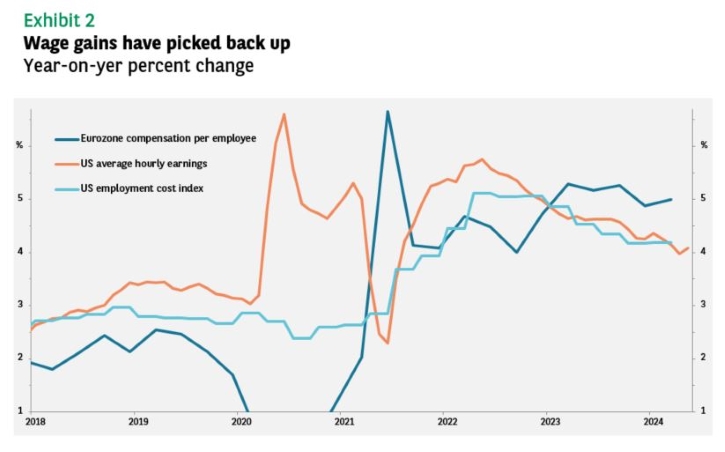
A key risk to the outlook for a continued decline in inflation is the labour market. The unemployment rate in the US rose slightly to 4.0% in May from 3.9%, but it is still below the long-run equilibrium rate of 4.2%. Notably, average hourly earnings rose from 4.0% to 4.1%, breaking a three-month streak of declines.
In the eurozone, unemployment is historically low; while compensation per employee has picked up (see Exhibit 2). With strong wage growth eventually feeding through to services inflation, higher unemployment rates may be needed before inflation moves down.
US Inflation will ease only gradually
The reduction in the number of likely cuts in the fed funds rate from three to one in the latest ‘dot plot’ of projections by Fed policymakers suggests that May’s CPI data has not significantly changed the Fed’s view that inflation will fall only slowly towards its 2% target.
A key decision may come in September, when a first cut could be warranted if inflation stays low or declines. By then, however, political considerations may have become paramount. Reducing rates so close to the US presidential election could be viewed in some quarters as interference, and in any event, a Trump victory in November could necessitate its reversal.
Growth dynamics in the eurozone are similar, with PMIs pointing to continued strength in the services sector and an improving outlook for manufacturing. In contrast to the drop in US core inflation, it rose in the eurozone from 2.7% to 2.9% (driven by services inflation).
The ECB has nonetheless gone ahead with its preannounced 25bp cut in the deposit rate. The move was viewed as a ‘hawkish’ cut as President Christine Lagarde refrained from committing to further reductions. The ECB remains very much ‘data dependent’.
Untroubled equity markets
A bit more growth and even a bit more inflation have apparently not troubled equity markets. Most major indices have continued to rise amid a supportive macroeconomic environment.
While markets continue to assess when and by how much the Fed cuts rates this year, there is as yet little prospect of an increase in policy rates. With steady (as opposed to rising) real rates, the direction of equities (and growth stocks in particular) will depend more on the prospects for earnings. Analysts’ forecasts reflect an optimistic outlook.
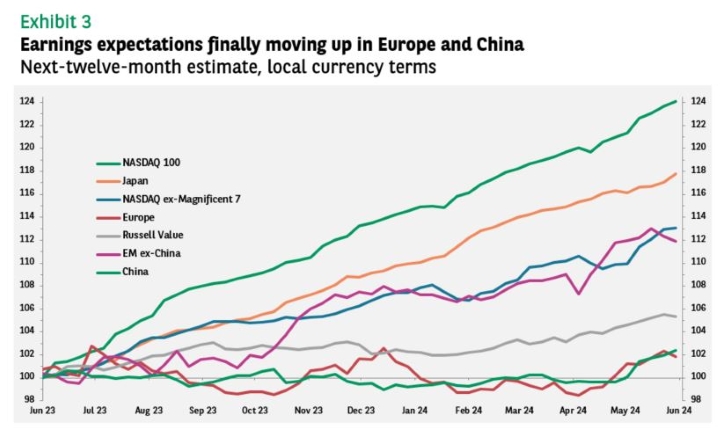
The markets that have seen the most notable change in forward earnings expectations over the last month have been Europe and China (see Exhibit 3). The rise in earnings estimates in the eurozone is understandable as the region rebounds from the slowdown in 2023 and with the ECB cuts policy rates. US growth will pull in European exports, aided by a strong dollar.
The main market concern is weak domestic consumer demand. Despite the low unemployment rate and wage growth, retail sales in the eurozone have been disappointing. Some of the wage gains have come from one-off bonuses (particularly in Germany), and perhaps consumers prefer to save the extra rather than spend more.
Earnings expectations have also turned up for Chinese equities. One might suppose that the recent gains in Chinese equities have been driven by these higher earnings expectations as opposed to being simply a rebound of what were exceptionally low valuations.
Unfortunately, most of the stocks in the MSCI China index are not seeing an increase in expected earnings per share (EPS). The gains are primarily for just two companies – PDD, the e-commerce holding company that trades as Temu, and multimedia conglomerate Tencent.
Meanwhile in Asia…
As an alternative to China, and as another way to take advantage of spending on artificial intelligence (AI), South Korea and Taiwan stand out. We prefer South Korean equities; the Taiwan market has already done well both this year and last (gaining despite persistent geopolitical risk).
Valuations look more attractive for the South Korean market (the z-score for the forward price-earnings ratio is 1.4 for the MSCI Taiwan index vs. just 0.3 for South Korea), and earnings expectations are rising faster.
South Korea also has greater exposure to a re-rating of the memory chip cycle. Memory chips prices have been depressed, but are now starting to recover, in large part due to the demand for the DRAM chips used in AI servers. South Korea is also typically a beneficiary of a potential upturn in the global manufacturing cycle; this could particularly be the case now when inventory levels are low.
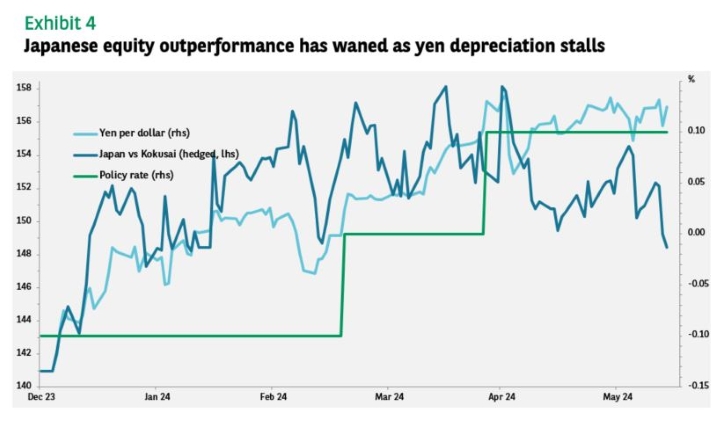
While earnings expectations have continued to rise for the MSCI Japan index, the market has lost the support of a weakening currency. With policy rates finally in positive territory, and the Bank of Japan intervening in the market, the USD-JPY exchange rate has been stable at around JPY 156 per USD. The relative performance of the MSCI Japan has since suffered (see Exhibit 4).
Other market worries are that wage gains and consumption are pausing in Japan, inflation is trending down, consumer confidence has declined, and business confidence is still low. Our multi-asset team has reduced its overweight to Japan, but still views the earnings outlook as supportive.
Commodities – it’s gold
Gold prices have moved in a range between USD 2 300 and USD 2 400 per ounce since April. We believe significant fundamental support for the asset remains. There is a steady appetite from central banks in an increasingly multi-polar world and investors are seeing increasing value in gold’s ability to act as a hedge against geopolitical risk and inflation.
In the near term, a recovery in manufacturing should also be supportive. Our recent article, “Geopolitical risk in a multipolar world leads gold price higher” provides a more detailed discussion.


