
Generating compelling investment returns while addressing the issues around climate change can be daunting. How can sovereign bond investors incorporate the growing investment risks? How can they quantify these risks and implement appropriate protections? And what about engaging with sovereign bond issuers?1
Rising risks
Climate and biodiversity risks are increasingly affecting the creditworthiness of sovereign bond issuers. Over the life of a 30-year bond, rising temperatures stand to introduce both known and unknown risks. Unpredictable weather patterns and extreme events can alter the risk profiles of traditionally stable government bond portfolios.
The World Economic Forum estimates that biodiversity loss threatens half the world’s gross domestic product, placing significant economic value at risk due to the dependence of business on nature.2
Ranking sovereign ESG performance and risks
Sovereign bond managers have long analysed governance-related risks.
To quantify the other ESG criteria – in addition to governance, the environmental and social factors – we developed a framework to score 109 developed and emerging market countries.
This considers, for example, energy infrastructure, water availability, efforts to mitigate the effects of climate change, and exposure to physical climate risks.
One answer – Green bonds
We believe green bonds are essential for funding the transition to a sustainable global economy. They help finance projects that generate positive environmental impacts such as generating renewable energy, energy-efficient transportation, green buildings, and sustainable resource management.
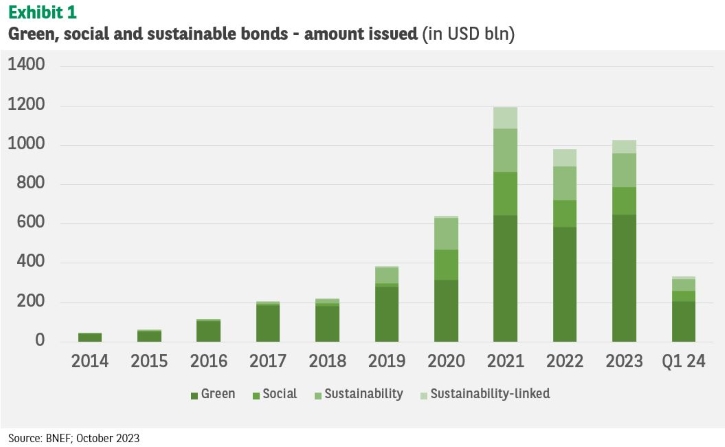
Governments are issuing more and more green bonds (see Exhibit 1): 35 sovereigns issued green bonds in 2023; 17 were developed countries and 18 emerging markets. Seven of the 35 issued their first green bond.
As issuance expands, so do the tools needed to evaluate them, both at the asset management level and the regulatory level.
Taking effect in late 2024, the European Union Green Bonds Standard (EUGBS) will significantly enhance reporting and transparency requirements. For example, the standard will require that at least 85% of the economic activities financed by a green bond align with the EU taxonomy for sustainable activities.
The power of engagement
We believe direct engagement with sovereign bond issuers is a powerful tool for understanding climate risks and catalysing action.
We engage regularly and actively with regulators and sovereigns on environmental policies and with borrowing agencies on individual bond structures.
In our view, this engagement helps ensure that the funds raised are implemented effectively and that environmental performance is monitored and reported regularly. This should contribute to addressing greenwashing concerns.
The necessity of active management
We believe sovereign ESG investing requires active management to address practical concerns and quantify risks, opportunities, and rewards.
Active managers can help mitigate challenges, avoid greenwashing, and generate added value. They can also adjust investment risks dynamically to align with ESG goals while maintaining reasonable tracking error and earning economic returns.
Sovereign bond portfolios and rising temperatures
It is possible to construct a portfolio of sovereign bonds that targets a sustainable reduction in global temperatures while maintaining economic returns.
We believe actively managed ESG sovereign portfolios can focus on traditional economic variables while opting for countries targeting environmental concerns.
Such an approach can lower investment risk, increase returns, or both.
Investors can lower their portfolio’s carbon footprint by replacing conventional sovereign bonds with green bonds issued by the same sovereign.
There is much work to do
Investing in climate change is complex, and the ESG sovereign bond market is still maturing. However, engagement and active management are critical to sustaining momentum on addressing climate change.
We believe the financial services industry has an obligation to engage, educate, and work towards making ESG sovereign bonds more accessible, reliable, and profitable.
With a commitment to ESG and sophisticated portfolio construction expertise, it is in our view possible to build sovereign bond portfolios that help investors reach their ESG goals.
[1] This is abbreviated version. For the full paper by Arnaud-Guilhem Lamy, Cedric Scholtes and Malika Takhtayeva, go to ad34b414-2fef-4548-8f09-e0cf577b5ea3 (bnpparibas-am.com)
[2] World Economic Forum, https://www.weforum.org/agenda/2023/02/biodiversity-nature-loss-cop15/


