
Donald Trump has followed through on the ‘Liberation Day’ tariffs. There was no last-minute reprieve from the White House, so the ‘reciprocal’ tariffs came into force at midnight in Washington on 9 April.
Listen to the article
White House officials had previously raised market hopes that President Trump would soften his stance. They talked up the possibility of possible trade negotiations with South Korea, Japan and other countries.
Trump, however, remained defiant on Tuesday night, saying other countries ‘want to make a deal with us’, but the US did not ‘necessarily’ need any agreements and was ‘happy the way we are’.
The US import tariffs mark a profound reversal of decades of liberalisation in the world economy and will — if sustained — likely lead to a complete reshaping of global trade patterns.
Impact of tariffs
The tariffs include a 104% levy on China whichmeans Chinese exports to the US, amounting to a significant part of China’s GDP, will be largely eliminated. The scale of tariffs appears too large for any exporters or consumers to absorb and will likely be hard to offset completely by currency depreciation. China responded on 9 April by announcing additional tariffs on imports from the US, for a total levy of 84%, to go into effect within hours.
According to the Kiel Institute for the World Economy, the US tariffs on nearly all countries could have severe negative economic consequences – most notably for the United States itself.
There will be other countries that are affected significantly less with the European Union (EU) only moderately impacted by comparison. According to the Kiel Institute’s simulations, the proposed tariffs could reduce US economic output by nearly 1.7% within a year, push up prices by more than 7%, and lead to a drop in exports of almost 20%.
If affected countries retaliate, price effects in the US would likely be somewhat smaller, but the decline in exports would be even larger. This means the economic consequences would be far more dramatic for the US than for nearly any other country.
The EU can expect a decline in output of just over 0.2%. Global economic output would likely fall by around 0.8%. EU exports are projected to decline by around 0.6%. Global trade volumes could shrink by nearly 6%.
Yields of US Treasury bonds rise
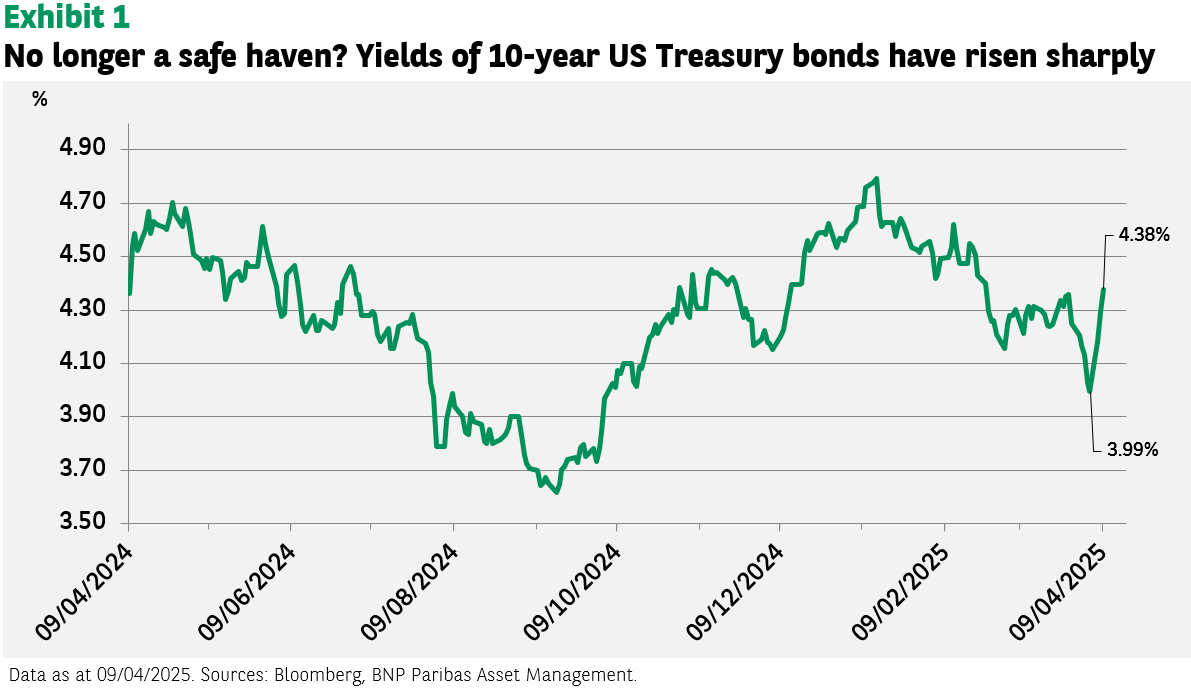
Yields of 10-year US Treasuries have risen sharply over the last two days. Currently, there is no clear explanation . It may be due to investors reducing positions financed by borrowing, or a widespread move into cash as investors take shelter from the volatility in markets.
Sentiment was not helped on Tuesday after a US Treasury Department auction of 3-year T-notes on 8 April attracted disappointing demand from investors. The bond market will now follow this week’s other auctions closely, including the $39 billion of 10-year T-notes on offer on Wednesday and the $22 billion of 30-year bonds to be sold on Thursday.
Upward pressure on long-end US bond yields could be due to rising market concerns over foreign demand for US Treasuries. US trading partners typically recycle profits into US Treasuries, but with trade effectively ceasing under the new tariff regime, this may no longer happen in the same way.
European Central Bank expected to cut rates
ECB Governing Council member Joachim Nagel has described the tariffs as a ‘severe blow to the economic situation’, highlighting their negative impact on growth. He noted growth prospects have ‘deteriorated dramatically’, indicating a potential shift from the ECB’s baseline assessment.
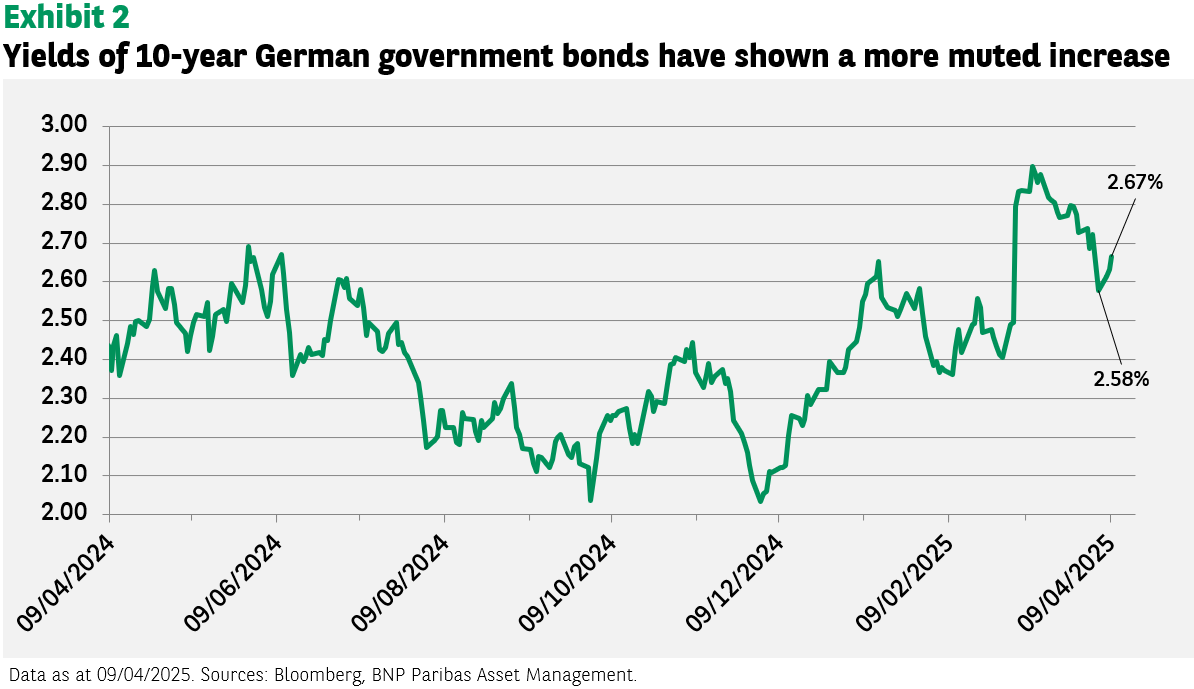
We expect the ECB to cut its key deposit rate by 25 basis points to 2.25% at its policy meeting on 17 April. With greater downside risks to growth, recent remarks from policymakers have suggested to us that the bar for a rate cut may now be lower than previously assumed.
Under these circumstances, our macroeconomic team thinks the ECB could lower its policy rate to a range between 1-1.5%, if, as expected, inflation falls in the coming months. We remain overweight core eurozone sovereign bonds in anticipation of weaker growth and inflation.
Europe – Reacting to US tariff announcements
On Wednesday, EU member states will vote on the list of countermeasures in response to the steel and aluminium tariffs the US announced on 12 March. These retaliatory tariffs are broadly symbolic, targeting high-profile US goods, and their size is unlikely to be macroeconomically significant. The bloc is likely aiming to minimise the negative economic impact of its response.
One option may be non-retaliatory measures, aimed at both diversifying trade away from the US and making the EU less reliant on external demand. While no single tool is likely to neutralise the impact of the US tariffs fully, a well-calibrated mix could significantly mitigate both the direct and indirect consequences.
Portfolio positioning
Our equity portfolio management teams are continuing to reduce risk by trimming positions vulnerable to a growth and/or tariff shock.
Where appropriate, equity portfolios have been rotating capital towards companies with strong balance sheets, minimum exposure to tariffs, with domestic manufacturing and supply chains, and solid revenue backlogs given both their revenue and earnings visibility.
In equity portfolios, we have shifted to favouring large-cap companies with so-called long-cycle exposure.
In multi-asset portfolios, our equity exposures remain broadly neutral relative to benchmarks. We continue to overweight gold and await more clarity on US policy before increasing fixed-income risk positions.
Our fixed income team expects the US Federal Reserve (Fed) to keep policy on hold initially, looking to manage the competing risks of higher inflation and weaker growth. Ultimately, we expect bond yields to fall as the negative impact on US growth becomes apparent.
If the tariffs are sustained, we would expect the consequences for growth and employment to become clear by September at the latest. This would lead the Fed to resume cutting policy rates.
We are positioning sovereign bond portfolios to be overweight five to seven-year maturities in anticipation of a cycle of rate cuts by the Fed from September onwards and through into 2026.


