
Risk assets have bounced higher since the agreement between the US and China on 12 May to cut reciprocal tariffs and enter into negotiations. However, even the lower levels of tariffs envisaged look unlikely to alleviate slowing US growth and rising inflation in the rest of 2025.
Listen to the article
The de-escalation of the trade war between China and the US triggered a relief rally in risk assets. Bilateral tariffs have been cut from more than 100% to 30% on US imports from China and to 10% on Chinese imports from the US. Even at this revised level, the tariffs correspond to a major tax increase for US consumers.
The reduction in tariffs is initially set for 90 days to allow both sides to negotiate over trade policy more broadly.
Valuations of US equities gained after the news. The S&P 500 index has now completed its recovery from the lows seen in early April, wiping out all the losses sustained in the wake of the ‘Liberation Day’ tariff announcements on 2 April. Risk premia for US and European high-yield and investment-grade credit have fallen back to levels that are low on a historical basis.
Investors in the US Treasury market responded to the news by trimming the number of policy rate cuts by the US Federal Reserve (Fed) over the course of 2025. This reflects the market’s view that the risk of a US recession in 2025 has receded to well below a probability of 50%.
Tariffs remain a drag on growth and inflation
According to the Budget Lab at Yale, US consumers still face an overall average effective import tariff rate of 17.8%, the highest since 1934. At these levels, tariffs are high enough to hit corporate profits significantly. Stock markets are not yet pricing in such an impact.
While we do not anticipate a recession in the US this year, US growth is likely to fall in the second half of the year as tariffs squeeze real (inflation-adjusted) income for consumers, while general uncertainty and supply chain issues will likely put pressure on capital expenditure.
US core inflation looks set to rise as the issues around trade significantly boost goods inflation, with the core personal consumption expenditures (PCE) inflation measure rising into a 3.5-4.0% range by year-end, and the unemployment rate drifting higher.
This will amount to a mild stagflationary environment. We expect that, given its dual (inflation and employment focused) mandate, the Fed could, under such a scenario, lower policy rates further should there be clear signs of a deterioration in the US labour market.
Too soon to see impact of tariffs in the data
While surveys of sentiment among US consumers and businesses reflect much concern and an expectation of significant negative consequences from the administration’s tariffs, recent US macroeconomic data have suggested continued resilience.
Data for core US consumer price inflation published on 13 May was a little softer than expected in April, increasing by 0.2% month-on-month. There was relatively little sign of a tariff impact, with goods prices falling slightly as both used vehicle and clothing prices declined.
However, comments from US retailing giant Walmart alongside its quarterly results have signalled upward pressure on goods prices in the coming months.
Investors will await the latest report on the US labour market due on 6 June for a clearer view of the situation. On 18 June, the rate-setting Federal Open Market Committee meets.
We expect it not to lower policy rates at this meeting unless there are clear signs of weakness in the labour market. It looks likely that Fed policymakers will wait until the end of the summer when they should have more clarity on the shape of the economy and the inflationary impact of the tariffs.
US dollar holds its ground
Events since the start of the year have raised questions among investors about the notion of US economic exceptionalism and a potential for greater diversification of investments by investors beyond the US.
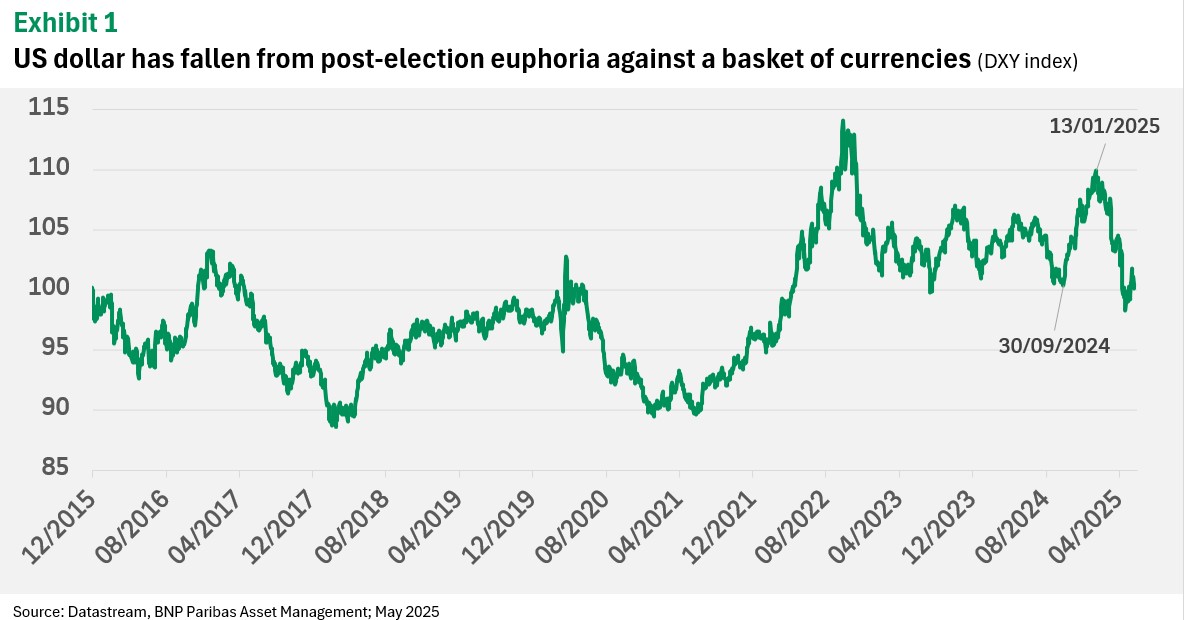
While the initial post-election euphoria has now faded, the US dollar remains at relatively high levels on a historical basis (see Exhibit 1). Given the absence of credible alternatives, there seems little reason to question the ‘exorbitant privilege’ of the US dollar as the main international reserve currency.
Weaker growth forecast in Europe
The European Commission has cut its forecasts for growth in the eurozone in 2025. The European Union executive now expects the economy to grow by just 0.9% this year — down from a previous estimate of 1.3% published in November.
The Commission also lowered its GDP growth outlook for 2026 to 1.4%, from 1.6% previously. These revisions come after the announcement of 20% ‘reciprocal’ US levies on most EU imports.
These were cut to 10% for 90 days on 9 April to give the two sides time to negotiate. Tariffs of 25% on EU steel, aluminium and cars still stand.
The Commission’s latest outlook assumed ‘reciprocal’ tariffs on most EU products would end up at 10%, while sector-specific tariffs would stay at 25%. But given that ongoing negotiations have yet to yield results, the Commission recognises that a further escalation in trade tensions could depress GDP.
We expect the European Central Bank to continue lowering its policy rates to a level well below the neutral rate of 2%.
So far, the ECB has lowered its benchmark interest rate seven times since June 2024, from 4% to 2.25%. We anticipate another cut in the key rate of 25bp at the ECB’s next policy meeting on 5 June.


