Investors found some relief in July, with trade tensions easing, reports of a good earnings season, signs that the global economy was resilient in the first half, and the US S&P 500 equity index setting a record high. Crossing the threshold into August, however, has seen stress return.
Listen to the article
President Donald Trump’s executive orders set new import tariffs on 31 July, marking the latest iteration of a protectionist US policy. On 1 August, the employment report shook markets with poor data for July and significant negative revisions to the data for prior months.
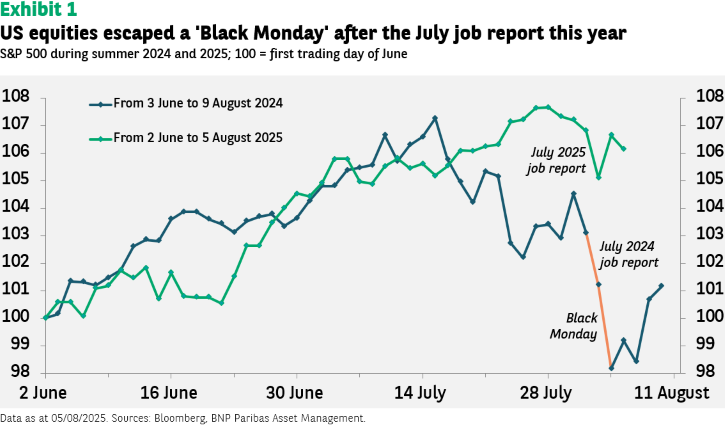
Could we be seeing a replay of the ‘Black Monday’ turmoil of August 2024, when a similarly disappointing jobs report profoundly changed investors’ perceptions of the US economy and led to a sharp fall in equities?
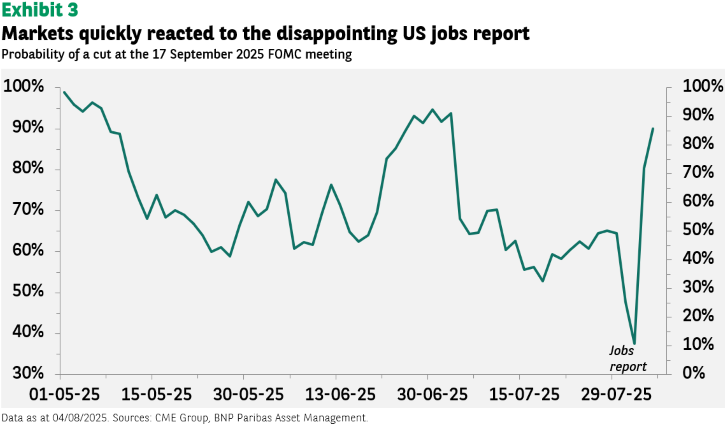
This time — so far — is different. The S&P fell by about the same amount in both 2024 and 2025 after the release of the payrolls report, but this time, increased market expectations of a cut in the benchmark US fed funds rate and good earnings news from companies led to a quick rebound; by contrast, in 2024, poor jobs news was followed by ‘Black Monday’ (see Exhibit 1).
Little cheer in US employment report
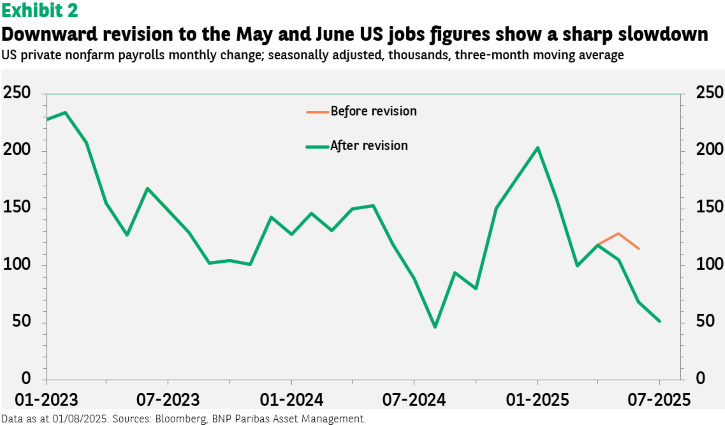
Net job creation in July came in below market expectations (73,000 versus 115,000 expected). But what really attracted attention was the sharp downward revisions to the May and June figures, which the Bureau of Labor Statistics modestly described as ‘larger than normal’ (down by 258,000 over the two months; see Exhibit 2).
These massive revisions mean only 33,000 jobs (seasonally adjusted) were added in the two prior months. Government payrolls accounted for a large part of the downward revisions.
Several economists argue that the collection rate of the BLS survey is too low and recalled the difficulties the agency has long encountered with the birth-death ratio, an estimate of the net number of jobs created when new businesses open and the number of jobs lost when firms close.
President Trump sharply criticised the quality of the BLS data. He fired its commissioner, whom he suspected of having presented a more favourable image of employment just before last November’s elections. In addition to the jobs report, the BLS calculates the consumer price indices (CPI).
The president’s decision has added to investor nervousness about the accuracy of critical economic data.
Fed notes risks to the US economy
Concerns over the health of the US labour market are warranted. At his 30 July press conference, Federal Reserve Chair Jerome Powell acknowledged that ‘downside risks to the labour market are certainly apparent’. He noted that the upcoming Quarterly Census of Employment and Wages (QCEW) benchmark adjustments could show that job creation was even lower.
Christopher Waller, one of the two Fed governors in favour of an immediate 25bp cut in policy rates, explained that “while the labor market appears fine on the surface, other data suggest downside risks have increased”.
Chair Powell said he was not unduly worried about the state of the labour market, highlighting the stability of the unemployment rate. This reflected, he said, a healthy balance between supply and demand.
Markets, though, do appear concerned. Expectations are now for a terminal level for the fed funds rate of just above 3% in early 2027 with a first cut likely in September (see Exhibit 4). The rate is now at 4.25-4.50%. The last 25bp cut dates back to August 2024. It was at 3.00-3.25% in September 2022.