
Tech stocks have suffered over the last few weeks, but there is more to this market movement than just a rotation out of the sector.
Listen to the article
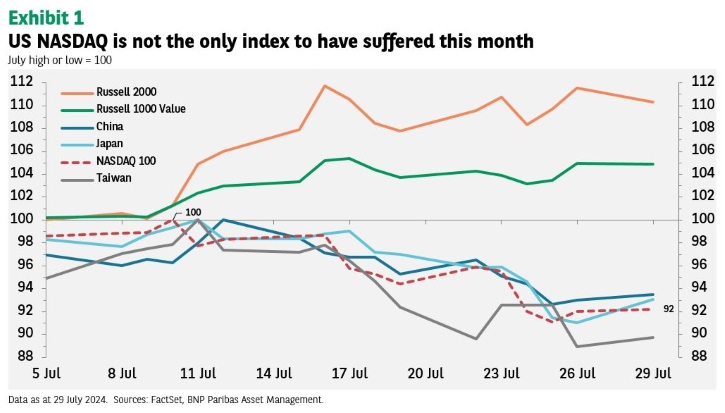
The decline in the US NASDAQ 100 and ‘Magnificent 7’ stocks over the last few weeks has been described by some as air coming out of the AI (artificial intelligence) bubble. We believe this mischaracterises what has occurred. While the NASDAQ has fallen by 8% from its July peak [1] after having gained 23% this year, it is far from the only stock market to have dropped. China, Japan and Taiwan have seen similar declines.
Taking profits after a good run
Not coincidentally, these are markets that had also outperformed this year — China +16%, Japan +26% and Taiwan +47% at the peaks. That is to say, the market declines have, in our view, been driven more broadly by profit-taking than by a change in investor attitudes toward the technology sector.
The initial beneficiaries of the newly liberated funds were value stocks and especially small-cap stocks (see Exhibit 1). The gains have not been sustained even as the other markets continued to decline, though it evinces investor confidence in equities as an asset class at this economic juncture.
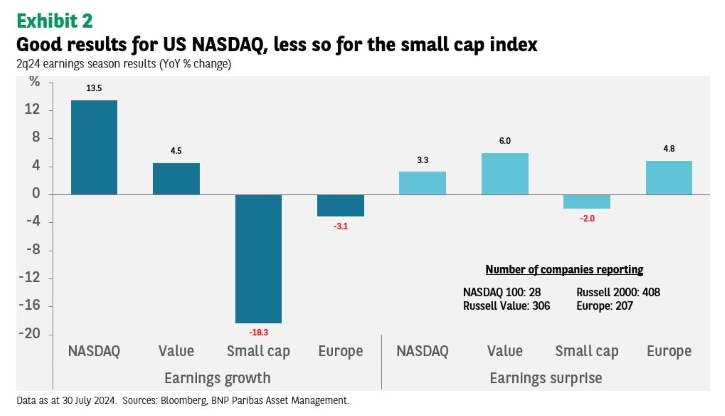
One reason to have more confidence in the outlook for the NASDAQ index in the months ahead is that the results from the current earnings reporting season have been encouraging. With 27 companies having reported, earnings are 14% higher than they were in the same quarter a year ago and 3% better than expected. By contrast, companies making up the Russell 2000 index have seen earnings decline by 18% in aggregate and even those figures are 2% below forecast (see Exhibit 2).
US GDP – Not that rosy
Market worries about the medium-term outlook for the US economy nonetheless persist. Growth is inevitably slowing as central bank policy rates remain restrictive, and the concern is that this slowdown could end in a recession.
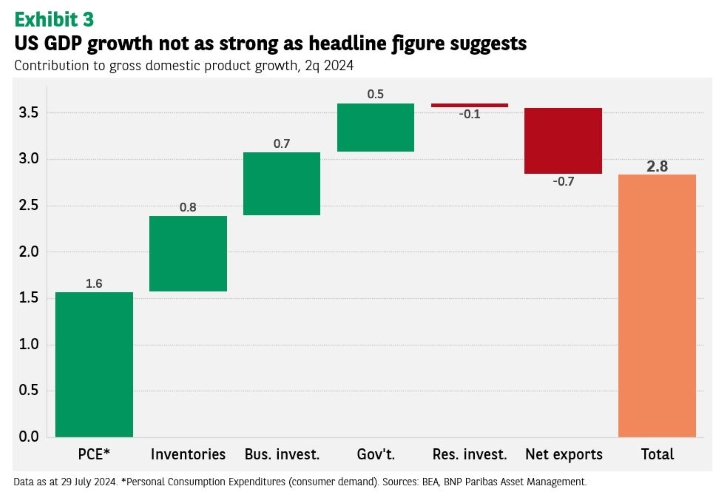
To judge by the latest data on GDP in the second quarter, that risk appears small. The economy expanded by 2.8% in real (inflation-adjusted) terms, or twice the rate in the prior quarter and easily surpassing analyst expectations of a 1.9% gain.
These figures are not quite as rosy as they seem, however. Looking at the components contributing to the headline 2.8% figure, one comes to a more modest conclusion.
Consumer demand (PCE = Personal Consumption Expenditures) did rebound from a weak rate in the first quarter, but the 1.6% contribution is below average. It also aligns with soft retail sales data and anecdotal evidence that consumers, particularly those on lower incomes, are struggling.
The gain in inventories, while adding to GDP growth, could in fact be a negative signal. It suggests companies are producing goods that they are not able to sell, with stocks rising as a result. Inventory levels are inevitably volatile, and the most recent increase follows two quarters of decline. However, if inventories rise again next quarter, it could be a further signal of a slowdown in the economy.
The negative contribution from net exports reflects the strength of the US dollar as well as relatively weak global demand, notably in Europe and China.
Business spending goes to AI
The most encouraging figure from the release was the increase in business investment. This has been strong ever since the passage of the Inflation Reduction Act incentivised US companies to invest in climate-related technologies, infrastructure and semiconductor production.
More important, though, has been AI-related investment. The bulk of the increase in business spending was on software, information processing equipment, and research and development. This bodes well for future earnings in the sector.
References
[1] as of 27 July 2024


