
The US economy has been in a maelstrom since January. The Cambridge English dictionary defines a maelstrom as ‘a situation in which there is great confusion, violence, and destruction’. Many investors would probably agree. Nevertheless, at least so far, hard data points to a resilient US economy.
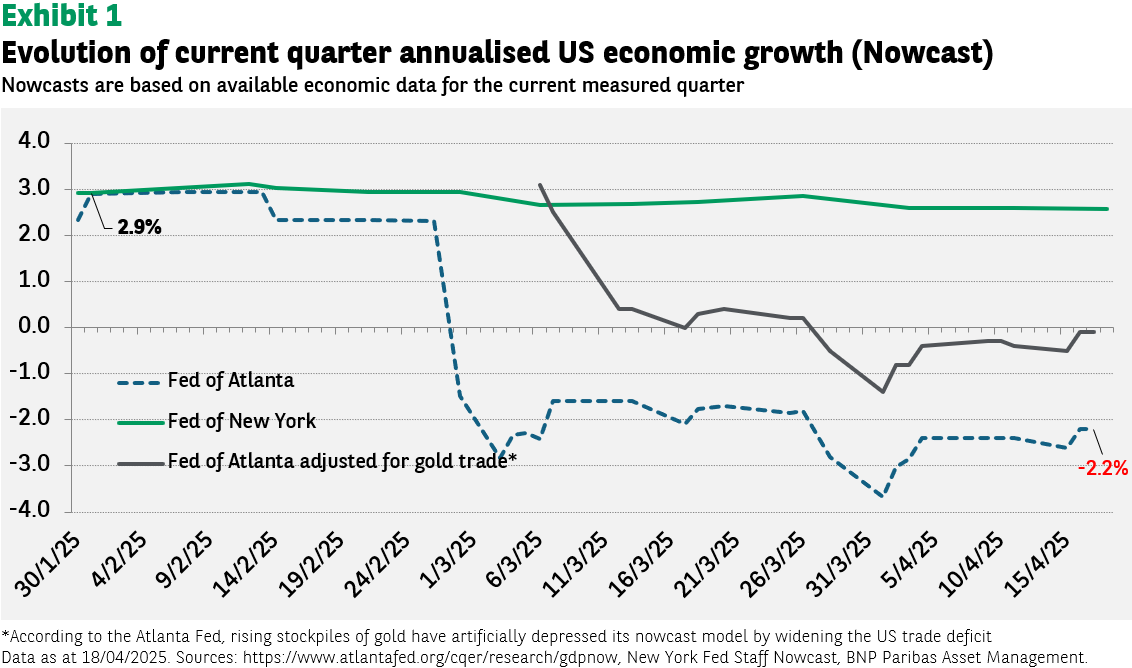
The advance estimate for US GDP growth in the first quarter will be released at the end of April. The consensus is for a 0.4% annualised growth (source: Bloomberg as at 24 April) with GDP Nowcasts from the Fed of Atlanta and the Fed of New York sending diverging messages (see Exhibit 1).
Whatever the outcome will be, the data could be difficult to read. Contributions from net US exports and inventories are likely to have been substantial: to avoid the rise in US import tariffs, many exporters to the US and importers in the US brought forward shipments and orders.
We believe a shrewd analyst should wait for the numbers on final domestic demand (i.e. private consumption plus government consumption plus gross fixed investment) for a more definitive assessment.
It’s probably that private consumption will make the difference this year between a slowdown in the economy and a recession. The health of the labour market will be crucial.
Almost one year ago, investors discovered the Sahm rule recession indicator1.
According to the latest jobs report, unemployment stood at 4.2% in March (vs. 3.9% a year ago) and alternative measures of labour underutilisation have also crept higher. For instance, the ‘U-5 rate’2 has hovered at around 5% since last July. What has happened?
The Federal Reserve of San Francisco recently published a note to assess which labour market transitions explain this rise (Assessing the Recent Rise in Unemployment). It is worth reading, even if the conclusion sounds less optimistic than Fed Chair Jerome Powell’s recent assessment that “overall, the labor market appears to be in solid condition and broadly in balance”.
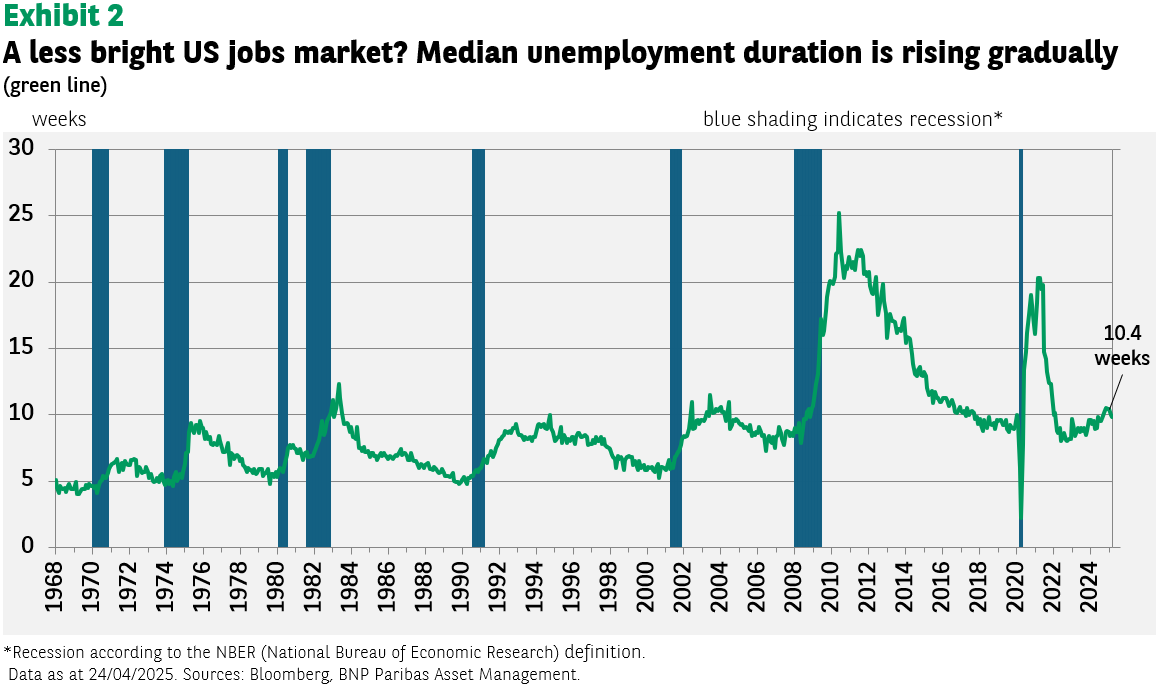
The SF Fed’s main findings are that during the past 18 months, the job-finding rate (a person moving from unemployed to employed) declined and the period of unemployment increased (see Exhibit 2). In the past, these patterns were seen ahead of recessions. So far, the time of unemployment has risen gradually, but the note advises monitoring these elements closely.
In its latest Beige Book, the SF Fed said that ‘employment levels fell slightly in recent weeks, and the labor market outlook generally deteriorated. Contacts across industries and geographies reported recent and planned layoffs’. The country-wide summary is more positive, but points to ‘a slight deterioration from the previous report with a few more Districts reporting declines’.
San Francisco Fed President Mary Daly is cautious about the risks to inflation and considers that there’s no urgency for the Fed to cut interest rates. She concluded, however, ‘That doesn’t mean [a] tight [monetary policy] forever because, ultimately, inflation is coming down.’
[1] One way to define the so-called Sahm rule, developed by former US Federal Reserve economist Claudia Sahm, is to say that when the unemployment rate’s three-month average is just half a percentage point above its 12-month low, the economy is in recession
[2] Total unemployed, plus discouraged workers, plus all other persons marginally attached to the labour force, as a percentage of the civilian labor force plus all persons marginally attached to the labor force


