
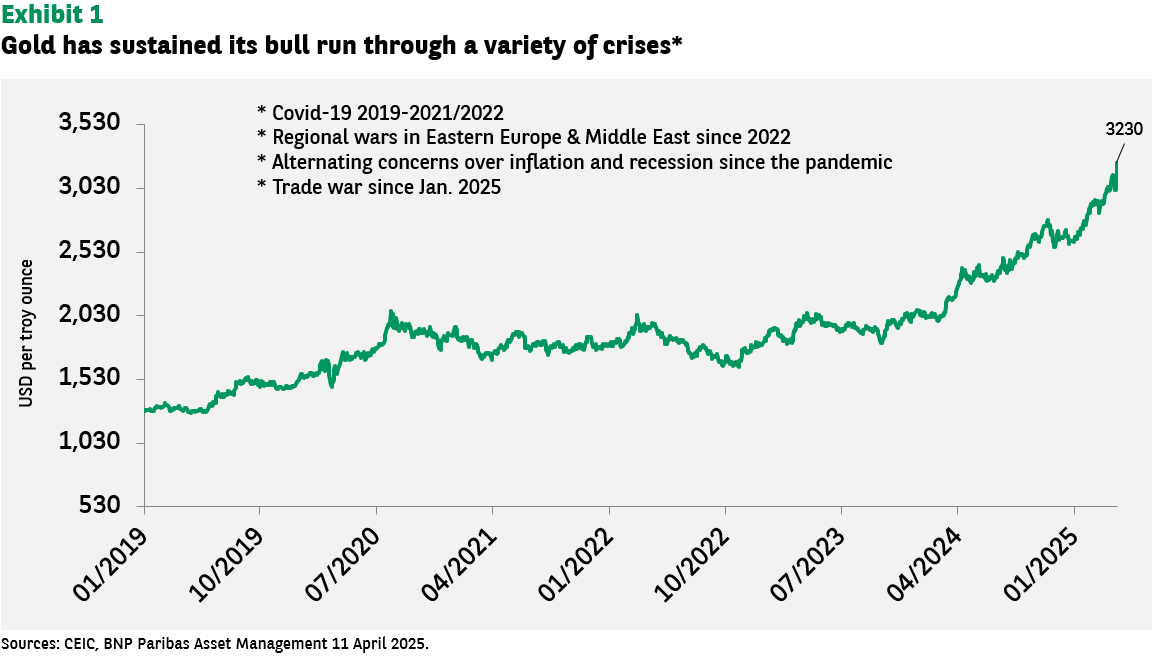
Since the 2007-08 Global Financial Crisis, gold has been seen as a hedge against a variety of risks: rising inflation, loss of investor confidence, deflation concerns, currency depreciation, health crises such as Covid-19, geopolitical tensions… And now also a full-blown trade war pitting the world’s two largest economies against each other, while not leaving out smaller economies.
Already the price of the precious yellow metal has risen sharply. The current environment of escalating economic and market uncertainty, the risk of US stagflation, and lingering geopolitical tension (including most recently between China and the US over trade and Taiwan’s sovereignty) still appears benign for investors looking to diversify into haven assets. Read – further upside potential for the price of gold.
Demand is expected to come from various sides including the ‘official’ sector (notably central banks loading up reserves) as well as long-term asset managers, private wealth, macroeconomic funds, and retail investors, especially in China and India.
Meanwhile, supply is unlikely to rise significantly. Mining supplies growth is limited. Scrap supply is being held back by hoarding amid a bullish outlook for gold. Higher demand and limited supply could intensify gold market volatility and result in exaggerated price moves – more to the upside than to the downside.
In our multi-asset portfolios, we recently took profits on gold after its robust performance. We remain positive over the medium run on this asset class which has clearly demonstrated its diversification qualities.


