
Transitioning to a net zero world requires not only large-scale economic shifts, but also a profound societal transformation that obliges us to ensure that change does not come at the expense of workers and communities. In other words, to make sure that no one is left behind. Sindhu Janakiram, Equality Lead and ESG Analyst, explains.
A ‘just transition’ seeks to safeguardthatthe move away from fossil fuels towards a low-carbon – net zero – future takes place fairly and inclusively. This means limiting the negative impact of climate action on workers and communities while maximising and sharing the benefits of such action.
The concept is aligned with the Paris Agreement. This recognises that wealthier nations have powered their economic growth with fossil fuels, thus generating the bulk of greenhouse gas (GHG) emissions which now contribute to an estimated 5.1 million excess deaths annually from air pollution.
In contrast, poorer nations, while having contributed less to GHG emissions, are the most vulnerable to climate change. Many feel that they have been left footing the bill. Over the next six years, 48 developing countries will face estimated annual costs of USD 5.5 trillion to combat climate change, reduce pollution, and protect biodiversity.
Job losses and opportunities
Without a just transition, moves to decarbonise will likely intensify existing inequalities, while creating new ones by disrupting sectors and countries heavily dependent on fossil fuels.
For example, an estimated 414 200 coal mining jobs will be lost by 2035 due to the transition to a low-carbon economy. Without careful planning and management, this could generate a backlash, hampering efforts to fight the high economic and social costs of unchecked climate change.
To prevent such a reaction, the just transition requires ‘social dialogue’ between businesses, workers and government on topics including the need to retrain and redeploy workers in fossil fuel-intensive sectors such as steel, cement, chemicals, aluminium, ceramics, glass, pulp and paper.
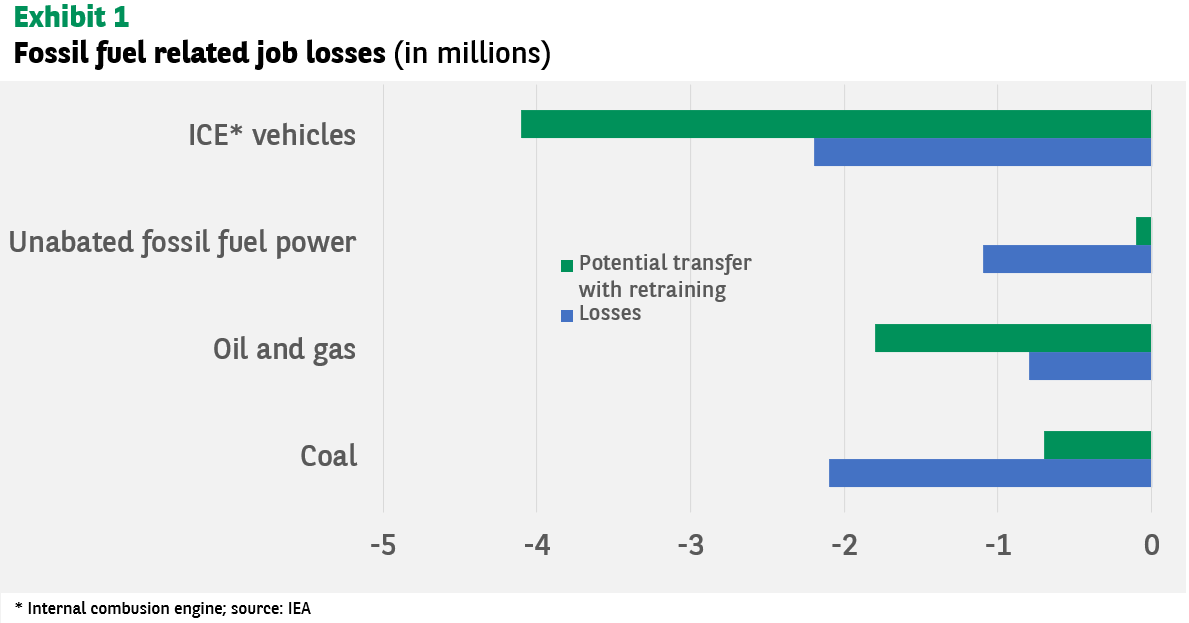
The location of green jobs is almost as important as their creation. A recent analysis of the US job market found that fossil fuel workers prefer retraining over relocating. At present, green employment opportunities are not located close enough to them to be appealing.
The analysis suggests it would be more effective to develop five million geographically targeted green jobs than 10 million green jobs spread across the entire US.
Getting it right
Although the global economy could still make progress towards reducing emissions without a just transition, the social costs could be high. Discontent can affect the effectiveness of tools in the fight against climate change.
For example, 2024 saw farmers in several EU countries protest volatile prices, high costs, and reforms to the EU’s Common Agricultural Policy (CAP), which sets subsidies and environmental requirements for the sector. As a result, the EU scrapped its target of halving pesticide use by 2030, which had been a key proposal in the bloc’s Green Deal to combat climate change.
As this example illustrates, one of the key challenges is balancing ambitious decarbonisation plans and the needs of workers and communities.
Looking ahead, we believe it will be important to keep a close eye on those who would use the need for a just transition as an excuse to delay or weaken plans for a low-carbon transition.
Our view on the just transition
Our Global Sustainability Strategy outlines our belief that the optimal economic model is built on a successful energy transition, healthy ecosystems, and greater equality in our societies. Our just transition strategy lies at the intersection of two of these ‘3Es’ – energy and equality – and is a lens through which we evaluate systemic social and environmental risks that pose long-term challenges to society and investors alike.
We are committed to building knowledge and shaping views through our active participation in industry working groups such as the just transition group of the Business Commission to Tackle Inequality (BCTI), and the just transition group of French investment industry group AFG, where we aim to advise investors on regulatory guidelines for climate transition assessment.
As stewards of capital, we integrate just transition into how we engage with companies. Our recently launched net zero transition strategy illustrates this. We engage with companies in our portfolio on how they implement climate strategies, including their approach to a just transition. Our goal is to mitigate the social risks to workers and communities of the transition plans of these companies.
We regard the just transition as a practical imperative when financing the energy transition, and at the same time paving the way for economic prosperity, social equity, and environmental stewardship.


