
The EU’s sustainable finance framework aims to redirect private financing to sustainable economic activities. It includes three complementary regulations – the EU Taxonomy, the Sustainable Finance Disclosures Regulation and the Corporate Sustainability Reporting Directive (CSRD) – these regulations strengthen disclosure and transparency.
In this article, we take a closer look at the EU taxonomy – a tool that should guide companies, investors, project promoters and other stakeholders including policymakers in the transition to a low-carbon, resilient and resource-efficient economy.
Let’s start with a brief description of each of the three regulatory measures:
- The EU Taxonomy defines criteria to identify those economic activities that are considered to be aligned with a trajectory that will lead to net zero greenhouse gas emissions by 2050. The EU taxonomy also defines criteria for the EU’s non-climate related environmental goals.
- The CSRD defines a detailed set of extra-financial information that companies must disclose. It includes a requirement to report on the alignment of business activities with the EU Taxonomy.
- The SFDR aims at strengthening sustainability disclosure of financial service companies. In particular, it requires these companies to disclose how their Article 8 and 9 products align with the EU Taxonomy. In addition, for many companies, the taxonomy is one of the building blocks of their definition of Sustainable Investment.
EU Taxonomy disclosure – Required since 2022
Applicable from January 2022[1], the taxonomy establishes screening criteria under which economic activities can qualify as contributing substantially to climate change mitigation or adaptation without causing significant harm to any of the EU’s other relevant environmental objectives and while complying with minimum governance and social safeguards.
We should note that for nuclear and gas activities as well as automotive and aviation, amendments have been made. Details including the criteria for ‘substantial contributions’ and ‘do no significant harm’ (DNSH) can be found on the European Commission’s online platform.
Corporates must report their eligibility under the EU Taxonomy since 2022 and their alignment with the EU Taxonomy since 2023. They can disclose the proportion of their activities eligible or aligned to the taxonomy using three indicators: turnover, capital spending and operational spending.
In 2024, financial corporates will have to report their alignment for the first time. This is measured through the Green Asset Ratio (GAR) and Green Investment Ratio (GIR).
In June 2023, the Commission adopted new criteria for its four remaining environmental objectives under the taxonomy regulation beyond climate change mitigation or adaptation:
- Sustainable use and protection of water and marine resources
- Transition to a circular economy
- Pollution prevention and control
- Protection and restoration of biodiversity and ecosystems.
These criteria came into effect in January 2024 and companies must report their alignment with these additional objectives in 2025 for the first time.
While the EU Taxonomy focuses on environmental aspects, plans for a social taxonomy have not progressed due to the complexity of defining clear criteria or standardised metrics for social impact. The EU Platform on Sustainable Finance has published a report on social taxonomy, but the European Commission has not announced any new initiative in this area.
Corporate reporting – Nascent, but progressing
At BNP Paribas Asset Management, we rely on data provider Bloomberg to assess the alignment of our assets under management with the taxonomy. This gives us access to data on about 50 000 companies. Of these, 531 companies are actually reporting an alignment of their turnover with the taxonomy, and 657 companies are reporting an alignment when it comes to capital spending.
The numbers reported are modest, but we regard these as encouraging first steps. We see this reporting through the capex indicator as being consistent with the aim of the taxonomy to incentivise transitioning companies that currently don’t meet the criteria of the taxonomy, but that are investing in activities that are aligned. It is likely that the alignment of turnover with the taxonomy will increase in the future as companies progress on their transition.
The companies reporting an alignment to the taxonomy are located mainly in France, Germany, Sweden, Italy and Spain. Industrials, materials and utilities are the top three sectors with the highest number of companies reporting an alignment.
To fill the gap and cover companies that now do not report, we rely on data providers to provide an assessment. However, a lack of disclosure can complicate such an assessment.
We believe there is a need for companies to improve disclosure of ESG metrics generally. The adoption and phased implementation of the CSRD should boost the reporting on taxonomy alignment and ESG-related data. This should make assessing taxonomy alignment easier.
Exacting technical screening criteria reflect a robust classification
Reporting on can be challenging. Indeed, it requires a complex four-step process on eligibility, substantial contribution, do no significant harm (DNSH) and minimum social safeguards (MSS).
This relies on stringent and complex technical screening criteria. These usually refer to other EU directives. In particular, assessing ‘do no significant harm’ raises difficulties. Considering the large number of criteria, data providers usually aggregate the results of each criterion into a score. It is then up to the asset manager to decide the level of the score it accepts.
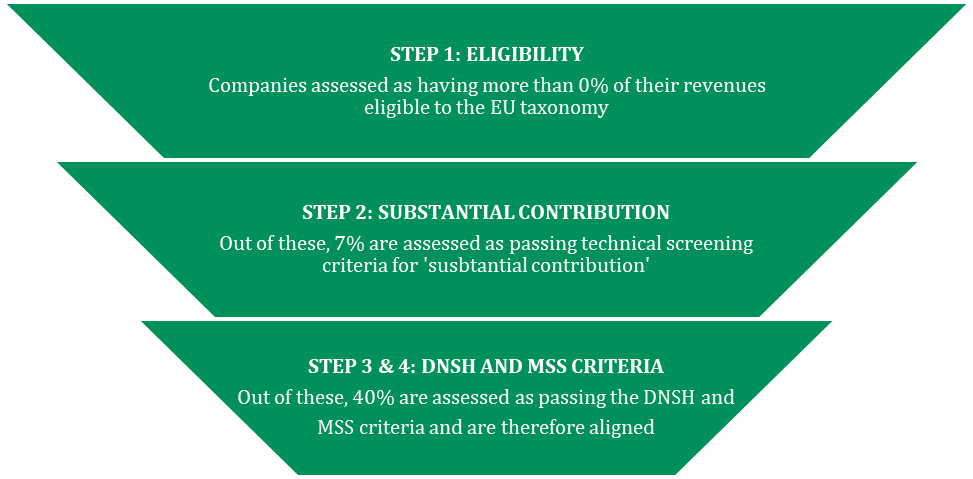
The graph below shows the proportion of companies passing each of the different steps of the EU Taxonomy process according to our data provider’s alignment assessment:
- Only about 7% of the companies with revenues eligible under the EU taxonomy pass the substantial contribution criteria.
- About 40% of the companies which passed the substantial contribution criteria passed the ‘do no significant harm’ and minimum social safeguards criteria.
We believe this illustrates the robustness of such an assessment. In our view, the stringency of the technical screening criteria is substantial since they set a robust and high-quality standard.
Towards greater traction
While companies should be able to overcome the challenges related to EU Taxonomy alignment reporting in the coming years, asset managers are already aggregating the available alignment data at a portfolio level.
At BNP Paribas Asset Management, we have 22 funds with EUR 15.5 billion in assets under management with a commitment to the EU Taxonomy[2] – one of the highest amounts in the industry. For these funds, we have committed to including a minimum proportion of companies aligned with the taxonomy.
Even though the level of our fund commitments on EU Taxonomy alignment is currently relatively low – the highest being 15% – this should increase as company reporting improves.
Conclusion
The EU Taxonomy, CSRD and SFDR are key regulations to strengthen sustainability disclosure.
Since 2023, companies must report on their alignment with the EU Taxonomy. Their reporting is embryonic, but advancing. Assessing compliance with the demanding technical screening criteria on ‘substantial contribution’ and ‘do no significant harm’ can be challenging.
The fact that only 3% of companies reporting eligibility are actually aligned with the taxonomy illustrates its rigour and credibility. While fund data shows low levels of alignment, we expect this to increase as reporting improves.
In parallel with the EU Taxonomy, taxonomies are being developed in almost 30 countries. While most are modelled on the EU framework, these initiatives will raise questions about comparability and interoperability as well as progress towards a single standard defining green activities.
References
[1] Taxonomy Regulation (europa.eu)
[2] Source: BNPP AM as of September 2023


