
The urgent need to detect, treat and destroy the ‘forever chemicals’ in water and soil that are causing health issues for people and animals is attracting attention from governments, regulators and investors, write Lisa Beauvilain, Johan Florén and Justin Winter.
Water quality issues only occasionally bubble to the surface of public debate. Yet they can no longer be overlooked as they can pose systemic risks to biodiversity and human health – and, by extension, the global economy.
Governments and regulators are increasingly paying attention to per- and poly-fluoroalkyl substances (PFAS), a family of synthetic chemicals that have been used since the 1940s in applications from non-stick pans to fire-resistant foams and pesticides.
Yet the properties that make them so useful – high stability and oil and water resistance – mean these ‘forever chemicals’ are extremely resistant to degradation.
The health risks associated with PFAS are now driving a wave of regulation and litigation that is restricting their future use and setting targets for much lower levels in public drinking water.
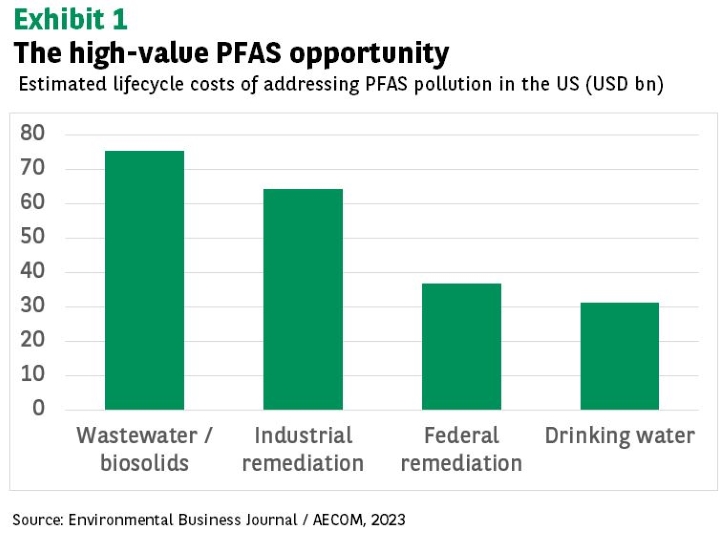
Consultancy AECOM estimates that confronting the PFAS issue will involve more than USD 250 billion in spending globally. We see this creating a tide of opportunities for companies whose products and services can detect forever chemicals, remove them from treated water, and safely dispose of them.
PFAS, PFAS, everywhere
The chemical persistence of PFAS means they have accumulated in water sources and soil, and in animals and humans. The US Centers for Disease Control and Prevention (CDC) has consistently found PFAS in 99% of the sampled population since it began testing human blood for the chemicals in 1999. The UK’s Environment Agency has found PFAS in 96% of samples taken from surface water.
Forever chemicals have been linked to increased incidence of some cancers, hormone disruption, and delayed child development. Exposure to PFAS is also leading to health issues in animals.
Bioaccumulation and persistence make it extremely challenging to reduce their presence in drinking water to levels deemed safe for consumers.
Forever chemicals, today’s solutions
We see opportunities in three broad categories of technological solutions to the PFAS challenge:
- Detection –This is a costly, laboratory-based process. Sophisticated mass spectrometry machines are the standard technology used to analyse samples for the presence of PFAS.
- Treatment – Existing removal technologies include reverse osmosis filtration, ion exchange resins, and granular activated carbon filtration. Many utility companies already employ these technologies in their water treatment plants. Over time, it could be that additional treatment is introduced at the tap. This approach could lower system-wide costs.
- Disposal – Incineration is typically seen as the most suitable commercially available approach. Supercritical water oxidation, using high temperatures and pressure to break the chemical bonds in PFAS, has been successful, but only a handful of commercial-scale plants are in use.
Regulatory and legal tailwinds
Supporting demand for these solutions are regulatory measures.
The US Environmental Protection Agency (EPA) has proposed tight limits on PFAS in drinking water. The EU is considering banning the production, use and sale of PFAS in non-essential applications, having already restricted and phased out certain chemicals. The revised EU Drinking Water Directive includes provisions for member states to monitor and limit PFAS in drinking water to protect public health.
Rising public awareness should reinforce the tightening of regulation. Litigation concerns are fuelling investment in on-site wastewater treatment by companies that make products using PFAS. The health impacts associated with PFAS are triggering class actions on behalf of communities exposed to dangerous levels. Water utilities are also bringing claims against PFAS manufacturers.
Lawsuits like these could be the tip of the iceberg; PFAS litigation may stretch over decades.
A multi-decade opportunity
A rapid increase in expenditure to remediate PFAS pollution and reduce levels in drinking water is expected across major developed economies.
The US Infrastructure Investment and Jobs Act of 2021 contained USD 4 billion specifically to address PFAS and other emerging water contaminants. Bank of America and American Water Works Association have estimated that the costs of complying with the EPA’s proposed drinking water standards could be USD 48 billion.
Addressing the PFAS challenge over the coming decades could involve solutions including the development of substitutes for PFAS which are vital for industries such as semiconductor manufacturing, hydrogen production, food packaging, textiles and firefighting agents.
The imperative to reduce PFAS levels in water and soil will only grow more pressing. We believe this creates a multi-decade opportunity for investors focused on leaders in water testing and treatment technologies and on innovations that can make the issues arising from ‘forever chemicals’ a thing of the past.
This is an abbreviated version of an article that was previously published by Impax Asset Management.


