
Although US small-cap stocks joined the extraordinary rally in the final quarter of 2023, many small caps continue to trade at a significant discount to their larger-company counterparts. This creates an attractive entry point. So says Geoff Dailey, Head of US Equities. In this interview, he explains why he sees the start of 2024 as a good time to allocate to US small caps.
Back in September, you saw an attractive entry point. How do valuations look today?
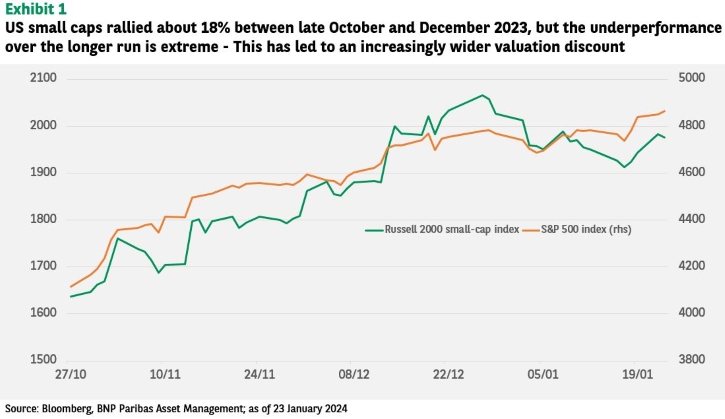
In the broad-based equity market recovery since late October (see Exhibit 1) small caps outperformed large caps as investors revised their expectations that the US Federal Reserve would aggressively cut interest rates in 2024. After lagging large caps in recent years, US small caps are back, but still trade at what I see as a wide and attractive discount relative to large-cap stocks.
A year ago, at the start of 2023, investor sentiment was negative; inflation was proving sticky, and all the talk was of an impending US recession. Not a great environment for stocks generally.
Despite that, small caps had an outstanding start to 2023, with the Russell 2000 index rising by 10% in January. Several stocks in our portfolio rose by over 25% in that first month. The rally demonstrated the power of small caps when valuations are favourable and investor sentiment on the forward economic outlook inflects positively.
In mid-March, the mini regional banking crisis derailed momentum, but the market recovered, leaving the Russell 2000 essentially flat over the first five months of 2023. Then, as the US economy’s resilience became apparent, the market sprang to life through the summer. By the end of July, the index had returned nearly 15% over the year to that point.
After its peak in the summer, the Russell 2000 retraced lower, with the price-to-book of the index falling by 16% to 1.8x, which is close to the biggest discount to large caps on record.
When small caps have traded with this type of discount in the past, they have gone on to deliver strong returns over the following 12 months and tended to outperform large caps.
If you compared the price-earnings ratios of profitable small caps (around a third of Russell 2000 companies are life science or tech companies that lose money) to large caps, they were trading at about a 30% discount — the widest gap since the peak of the tech bubble in 2000.
We are cognizant of the risk of the lagged impact of tighter monetary policy and the higher-for-longer rate scenario, but in our view, there are signs of a more optimistic base case for the US economy: growth remained robust in the second half of 2023 on the back of strong consumption and business investment.
US consumer activity is still healthy, and services consumption has been steadily rising since the pandemic. The job market remains resilient and balance sheets among our US small-cap companies have remained healthy.
We see valuations as compelling, and we expect the asset class to perform well now that it is becoming more likely that the economy is not on the brink of a deep recession and monetary policy should become more accommodative this year. In my view, we are still at – or close to – a favourable entry point for US small caps.
Why do you advocate active management of US small caps?
I am a big believer that small caps are an inefficient asset class and are better suited to an active approach.
Firstly, there is less analyst coverage. The average number of analysts focusing on small caps is about five on the sell-side, compared to around 25 analysts for mega caps and 15 for large-cap stocks. That creates a lot of opportunity for rigorous fundamental analysis to identify idiosyncratic investment opportunities.
Secondly, there are lower levels of liquidity, and with that comes greater volatility. Our team of sector experts have views on the intrinsic value of stocks, and we can use that volatility to our advantage.
A third point is the immaturity of the firms. There is a greater variability in the quality of management and maturity of capital structures. Having fundamental analysts evaluating the strength of the management team and assessing the strength of the balance sheet allows us to identify outstanding businesses.
The last element I see in the case for an active approach is mergers and acquisitions. We are constantly talking to management teams. We know the types of products or services that are sought after and most likely to be acquired, as well as those management teams that are potential sellers. Acquisitions can be a large driver of outperformance in a small-cap portfolio. This is an area where we can add value through active management.
Do you expect small caps to catch up on large caps?
We will see small caps begin to catch up, although this is hard to time. A discounted small-cap valuation argument would have suggested a catch-up was due a year ago. We are still at extreme levels of valuation with the price-earnings ratio of small caps relative to large caps close to the lows of the past 20 years. We expect that gap to narrow.
We expect earnings to drive the next leg higher for small caps. According to FTSE Russell, analysts anticipate that expected earnings growth among companies in the Russell 2000 will rebound by 28.2% in 2024, after an expected decline of 11.2% in 2023.
The timing depends somewhat on the ultimate path of the US economy. We do not expect a deep or prolonged recession. Currently, all the signs are pointing to a soft landing in 2024.
But, if a recession did occur, it would delay a recovery in small caps. We expect the increasingly better visibility of a soft landing to bolster the small cap recovery. Large caps would clearly benefit as well, but there is more upside to small caps in this scenario.
So, why should investors allocate to US small caps now?
In my view, investors should hold a permanent, long-term allocation to US small caps to give them exposure to innovative, faster-growth companies, and to an asset class with a long-term track record of strong absolute and relative returns compared to other asset classes.
Over time, valuations have proven to be a good indicator of the potential for longer-term outperformance.
There are periods when macroeconomic concerns and negative sentiment weigh on valuations and create an opportunity for investors.
Small caps remain relatively cheap. Companies in the Russell 2000 are trading at 15.2 times projected earnings over the next 12 months, which is below the 10-year average of 16.7, according to FTSE Russell. The large-cap index’s multiple is 19.6.
We are at or near levels that we believe offer investors potential for outperformance in the longer run. The pieces are in place for small caps to perform well.
Disclaimer
This material is issued by BNP Paribas Asset Management USA, Inc. (“BNPPAM USA”)*. In Australia, BNPPAM USA is exempt from the requirement to hold an Australian financial services license under the Corporations Act 2001 in respect of the financial services. BNPPAM USA is regulated by the SEC under US laws, which differ from Australian laws. This material is distributed in Australia by BNP PARIBAS ASSET MANAGEMENT Australia Limited ABN 78 008 576 449, AFSL 223418 .
This material is produced for information purposes only for the exclusive use of wholesale clients and does not constitute:
1. an offer to buy nor a solicitation to sell, nor shall it form the basis of or be relied upon in connection with any contract or commitment whatsoever or
2. investment advice.
Opinions expressed are current as of the date appearing in this document only. This document is not to be construed as an offer to buy or sell any financial instrument. It is presented only to provide information on investment strategies and current financial market trends. The analyses and opinions contained in this document are those of BNPPAM USA, and are based upon information obtained by BNP PARIBAS ASSET MANAGEMENT USA, Inc. from sources which are believed to be reliable. BNPPAM USA provides no assurance as to the completeness or accuracy of the information contained in this document. Statements concerning financial market trends are based on current market conditions, which will fluctuate. Investment strategies which utilize foreign exchange may entail increased risk due to political and economic uncertainties. The views expressed in this document may change at any time. Information is provided as of the date indicated and BNPPAM USA assumes no duty to update such information. There is no guarantee, either express or implied, that these investment strategies work under all market conditions. Readers should independently evaluate the information presented and reliance upon such information is at their sole discretion.
The information contained herein (and any calculation of targeted/expected returns) includes estimates and assumptions and involves significant elements of subjective judgment and analysis. No representations are made as to the accuracy of such estimates and assumptions, and there can be no assurance that actual events will not differ materially from those estimated or assumed. In the event that any of the estimates or assumptions used in this presentation prove to be untrue, results are likely to vary from those discussed herein. Past performance is not indicative of future results. The value of investments and the income derived from those investments may fluctuate over time such that the value of a portfolio at any given point in time may be more or less than its original value.
*BNP PARIBAS ASSET MANAGEMENT USA, Inc. is registered with the US Securities and Exchange Commission as an investment adviser under the Investment Advisers Act of 1940, as amended.


