
Markets have faced no shortage of challenges over the last quarter, most notably the threat of US import tariffs after ‘Liberation Day’, but also the prospect of a surge in oil prices stemming from the conflict in the Middle East and a sell-off in US Treasury yields following an expansionary budget bill in the US.
So far, at least, markets seemed to have made it through the rapids comparatively unscathed. Major equity indices are up by between 17% and 35% since April’s lows (see Exhibit 1).
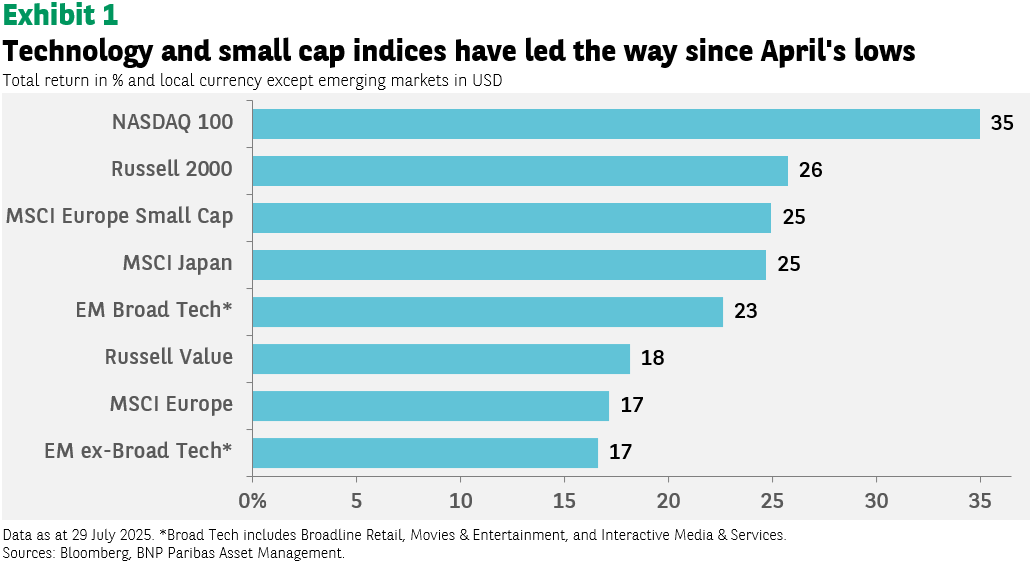
The three threats markets have faced so far would seem to pose less risk for the rest of the year. Though a trade deal between the US and China has yet to be finalised, a 90-day extension leaves time for that to happen. The prospect of a global trade war looks distant now, and markets have already largely priced in the impact on company profits of stiffer tariffs.
US Treasury yields are modestly higher than they were before ‘Liberation Day’ in April, but well below the highs seen earlier in the year. They are also lower than they were at the time of the first passage by the US House of Representatives of the One Big Beautiful Bill Act (OBBBA) in late May. The ‘bond vigilantes’ appear to be resting for now.
While the Middle East has always been unpredictable, oil prices are $10 per barrel lower than they were on average in 2024, providing a boost to economic growth and a damper on inflation.
Outlook: Risks ahead in Europe and the US
Future risks appear greatest for the outlook for growth, both in the US and in Europe.
The higher-than-expected baseline tariffs on imports into the US from Europe will only add to the weakness in the region’s manufacturing sector, exacerbated by the strong euro. Fortunately, the services sector is expanding, and business sentiment has been buoyed by the prospect of increased defence and infrastructure spending.
Previous cuts in policy rates by the European Central Bank should continue to support growth.
For all the benefits to the US from the tariff deals (increased domestic investment, customs revenue, greater foreign market access), there is a price to pay. Companies have so far paid for most of the tariffs, cutting into margins and profits.
While this effect has already been priced in, companies will now likely try to pass along the increased costs to consumers, raising the prospect of higher inflation and weaker demand.
Consumption was already less strong compared to last year due to the inevitable exhaustion of the excess savings that households accumulated during the Covid lockdowns.
Prior to President Trump’s election, the slowdown in consumption had been expected to be accompanied by falling inflation and lower policy rates from the US Federal Reserve (Fed). Now neither of those is likely to happen soon.
The labour market, too, has softened. What job growth there is appears to be unhealthily reliant on the government and healthcare sectors. Though these jobs provide income for workers, this sector concentration does not suggest a dynamic economy.
These economic worries, however, could well be offset by positive factors:
- The OBBBA should provide fiscal stimulus in the short term
- Mergers and acquisitions are picking up
- While more investment due to the tariffs is unlikely to materialise any time soon, investment linked to artificial intelligence is already growing strongly
- Markets expect the Fed to begin cutting interest rates by September.
China is in a similar position to Europe insofar as tariffs impinge on economic growth. Beijing will likely attempt to offset the drag through more stimulus in support of domestic consumption, but it remains to be seen whether this simply pulls consumption forward rather than actually increasing it.
The key issue remains the weak property market and its deleterious effect on consumer confidence.
Equities
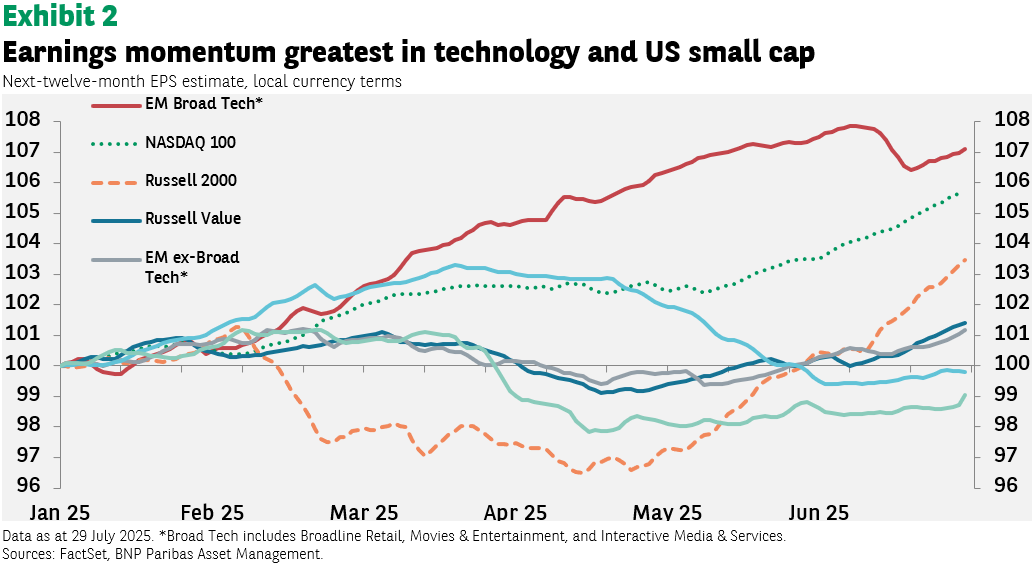
It is no coincidence that technology-heavy indices and small-cap stocks have led the rebound in equity markets since early April. Tech sector earnings continue to be supported by AI investing in both the US and emerging markets. They are also less affected by tariffs as tech companies tend to sell services rather than goods.
Small caps have provided a haven from tariffs, too, as these companies are more focused on non-traded, domestic demand. In the US, they benefit from tariff-induced consumption, while in Europe, anticipation of increased infrastructure spending provides additional support (see Exhibit 2).
European equity gains have been led by the financials sector thanks to rate cuts from the ECB. Industrials have done well as investors expect big increases in government spending on infrastructure and defence, which will help offset some of the impact from US tariffs. Both of these factors should continue to support profits, and the stock market, in the quarters ahead.
US exporters are benefiting from a weak dollar and should see gains from improved market access and lower tariffs as a result of the deals agreed with America’s trading partners.
The decline in the US dollar, however, has not been all that sizeable. In real, trade-weighted terms, the currency has dropped by 5% this year through the end of June, compared to a 9% decline during the first Trump administration.
In any case, given the size of the US current account deficit, a depreciation in the currency to move things back into balance would not be surprising.
Fixed income
The outlook for bond yields is more challenging. One can picture two scenarios — with not wildly different probabilities — leading to opposing moves in US yields.
- On the one hand, rising term premiums — due either to ongoing quantitative tightening or concerns over the long-term sustainability of the US’ fiscal situation — could result in higher yields. Better growth, too, could push yields back up.
- On the other hand, a sharp slowdown in growth due to tariffs would likely prompt the Fed to cut rates quickly with longer-dated yields falling in sympathy.
Similarly, in Europe, fiscal largesse may come at a cost of higher interest rates, while weaker growth through tariffs and higher (redirected) Chinese imports could have the opposite effect.
Asset allocation
For now, we are cautiously optimistic on the outlook for equities, with our biggest overweight position in technology stocks in the US.
Valuations for most major indices look reasonable, with the notable exception of US value, where the forward price-earnings ratio for the Russell 1000 Value index is well above average.
As far as fixed income is concerned, we prefer a relative position in favour of Europe over the US. The rapids that investors have ridden this year created opportunities for those willing to lean the other way. We anticipate further turbulence in the months ahead, and with it, new opportunities to capture.


