
Emerging market (EM) sovereign and corporate bonds saw a broad-based rally in the final months of 2023 as investors became more certain the US Federal Reserve (Fed) would be able to pivot to easier monetary policy in 2024.
Should major developed economies indeed be able to shift from higher to lower interest rates, this would reduce market uncertainty and volatility in the months and quarters ahead, including for emerging market bonds.
There were significant outflows from EM assets as investor tolerance of risk withered and the US dollar strengthened amid growing concerns over the impact of higher inflation, rising interest rates, and a poor outlook on global growth. However, with confidence now growing that major central banks have succeeded in taming inflation without causing a hard recessionary landing, we expect flows to accelerate back into EM.
USD (hard currency) denominated bonds – Attractive returns
We expect hard currency sovereign and corporate EM bonds to generate attractive returns in 2024 given their relatively high yields and the potential for capital appreciation in selected pockets of the markets.
We are particularly optimistic about the higher-yielding sub-investment grade sectors, where some valuations have remained appealing – despite the recent rally – and should normalise in the months and quarters ahead.
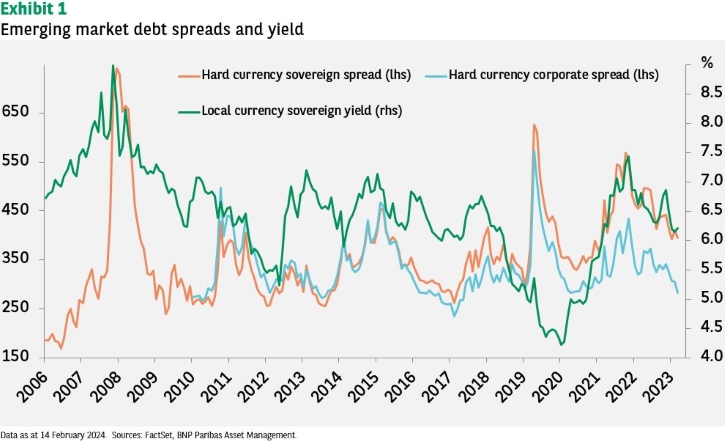
Notably, the combination of surging inflation and heightened geopolitical tensions led to credit spreads widening materially and prices falling across many high-yielding countries in Africa and Europe. The resulting flight to quality drove yield levels to beyond those reached when Covid-19 nearly caused a global financial panic.
However, inflation has since fallen dramatically in many economies and, while geopolitical uncertainty is likely to persist, we expect it to produce less market volatility than seen in recent years. As such, we believe yield spreads on selected high-yielding sovereign bonds can now be expected to narrow.
In the corporate sector, spreads on both investment-grade and high-yield bonds have tightened in recent months, but these bonds still offer attractive yields relative to their developed market counterparts.
Spreads in the high-yield segment in particular could narrow as overall corporate fundamentals are compelling, in our view. Relative to their developed-market peers, net debt is 1.5-2.5 times lower and cash levels tend to be higher, while interest coverage ratios are comparable. From the perspective of the credit rating agencies, the ratings of most EM companies have been more stable than in developed country high-yield markets and there are fewer negative outlooks or names on a watchlist.
In our view, the bottom line is that the expected default rate among EM corporates is low, fundamentals are solid, but yields are higher.
On a technical basis, increased financing costs since the Fed began raising rates have reduced the supply of new bonds. This has resulted in bond issuers looking to alternative funding channels, especially in domestic markets. While we believe new bond issuance is likely to rise in 2024, we expect it to be moderate, meaning that a supply/demand imbalance is likely to persist into 2024, providing additional support to bond prices.
We believe the combination of a stronger fundamental backdrop and more supportive technical factors can, especially in an environment of improving risk appetite, create unique opportunities.
Thus, senior debt issued in the financials sector has largely been priced in line with the fundamental outlook. However, the yields offered for newly-issued subordinated debt can be disproportionate to the additional risk that such instruments entail. In our view, careful analysis of individual borrowers could reveal compelling relative value opportunities.
Bottom line: We see a supportive environment for EM hard-currency bonds in 2024. The income from current yields looks attractive, but we also see room for spread compression, particularly in HY sovereign and corporate bonds.
Local currency bonds – Supports in place
Emerging market countries are, broadly speaking, a step ahead of the developed world: Economic growth has been improving for some months now, and monetary policy is already being eased in some regions. We believe improving fundamentals, attractive valuations, and supportive technical factors presage an outperformance by EM local currency bonds.
We expect emerging market growth to exceed developed market growth in the year ahead, led by Asia. China should be a tailwind as we expect further stimulus and policy initiatives to support growth. We also expect a broad decline in underlying EM inflation. The decline in inflation was already impressive in 2023 and we expect this trend to continue.
Insofar as lower inflation allows for lower policy rates and real (inflation-adjusted) policy rates in many EM remain well above their long-run neutral level, we see significant room for interest rates to fall.
There will likely be regional divergences. For example, while the pace of policy rate easing was recently reduced in Poland and Chile, it has been stable in Brazil and Peru. Indonesia and the Philippines have both seen tightening monetary policy. Overall, though, emerging market central banks have remained in a better position than developed markets to loosen policy, which should boost economic growth.
Bottom line: Lower interest rates and stable/appreciating local currencies support exposure to local currency denominated EM bonds.
The main risks – Global economics and geopolitics
The biggest risk to our view is that global markets back-peddle on their optimism for a soft landing in the main developed economies and thus for lower policy rates in 2024. Indeed, we are modestly cautious in the short term as we expect some consolidation in hard and local currency bond markets after the recent strength.
Longer term, geopolitics remains our largest concern. Existing conflicts could spread, while 2024 is an election year in the US. It is not our base case that existing conflicts or US politics will necessarily lead markets to correct, but they warrant close monitoring.
Disclaimer
This material is issued and has been prepared by BNP PARIBAS ASSET MANAGEMENT UK Limited (“BNPPAM UK”). Registered in England No: 02474627, registered office: 5 Aldermanbury Square, London, England, EC2V 7BP, United Kingdom. BNPPAM UK is regulated by the FCA under UK laws, which differ from Australian laws. In Australia, BNPPAM UK is exempt from the requirement to hold an Australian financial services license under the Corporations Act 2001 in respect of the financial services. This material is distributed in Australia by BNP PARIBAS ASSET MANAGEMENT Australia Limited ABN 78 008 576 449, AFSL 223418. This material is produced for information purposes only and does not constitute:
an offer to buy nor a solicitation to sell, nor shall it form the basis of or be relied upon in connection with any contract or commitment whatsoever or
investment advice.
Opinions included in this material constitute the judgement of BNPP AMAU at the time specified and may be subject to change without notice. BNPP AMAU is not obliged to update or alter the information or opinions contained within this material. Investors should consult their own legal and tax advisors in respect of legal, accounting, domicile and tax advice prior to investing in the financial instrument(s) in order to make an independent determination of the suitability and consequences of an investment therein, if permitted. Please note that different types of investments, if contained within this material, involve varying degrees of risk and there can be no assurance that any specific investment may either be suitable, appropriate or profitable for an investor’s investment portfolio.
Given the economic and market risks, there can be no assurance that the financial instrument(s) will achieve its/their investment objectives. Returns may be affected by, amongst other things, investment strategies or objectives of the financial instrument(s) and material market and economic conditions, including interest rates, market terms and general market conditions. The different strategies applied to the financial instruments may have a significant effect on the results portrayed in this material. Past performance is not a guide to future performance and the value of the investments in financial instrument(s) may go down as well as up. Investors may not get back the amount they originally invested. The performance date, as applicable, reflected in this material, does not take into account the commissions, costs incurred on the issue and redemption and taxes. All information referred to in the present material is available on www.bnpparibas-am.com.


