
Higher-than-expected inflation is raising questions over the likelihood of a ‘soft landing’, a scenario that needs inflation to slow, so that central banks can start cutting policy rates this year. Hotter services inflation in the eurozone isn’t helping.
Listen to the article
It all began with January’s US consumer price index (CPI) data, which came in higher than expected. Of particular concern was the increase in the monthly rate of core (ex-food and energy) inflation, which rose notably from 3.4% (annualised) to 4.8%.
Part of the increase came from the shelter (or housing) component of the index due to changes in the Bureau of Labor Statistics’ methodology. But the services index also jumped, overall and across several sub-indices.
More alarm bells rang when data for the eurozone showed a similar rise in services inflation.
The eventual release of the personal consumption expenditure (PCE) data (the US Federal’s Reserve’s preferred measure) confirmed the jump in the CPI.
The market’s initial reaction was to believe that the ‘soft landing’ narrative — that inflation would continue to slow, allowing central banks to make numerous reductions in policy rates over the course of the year — was now at risk.
Overheating fears eased by disappointing data
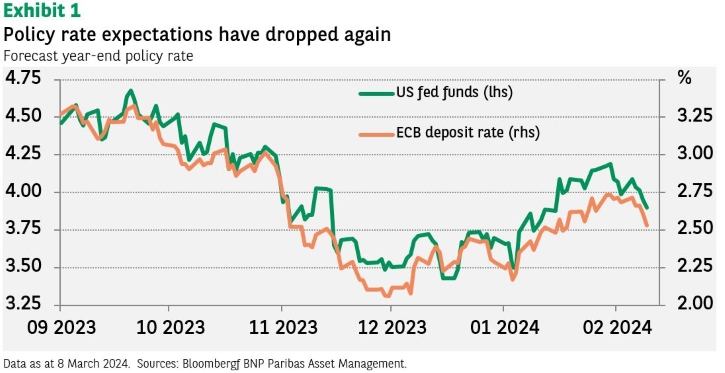
Instead, investors seemed potentially to be facing a re-acceleration in economic growth, which meant inflation might not fall so fast and central banks would not cut rates by as much as hoped. Expectations for the level of the benchmark US fed funds rate at the end of 2024 consequently rose.
These overheating fears were assuaged by generally disappointing economic data over the last few weeks. Whereas normally one might expect risk assets to react poorly to weaker growth, in the current environment it was perceived as good news since the market could again look toward policy rate reductions (see Exhibit 1).
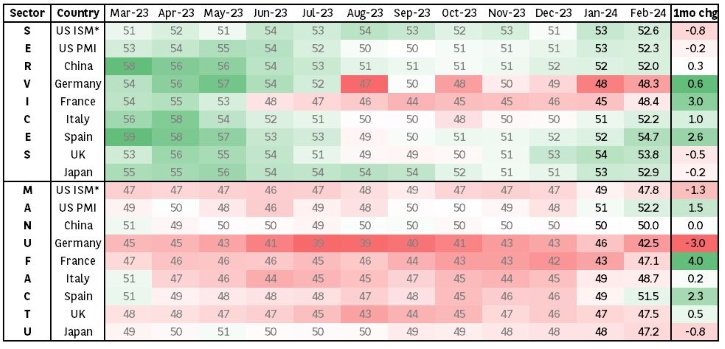
Support for the view that economic growth was slowing came from the latest purchasing managers’ indices (PMIs). Most of the figures came in below market expectations and presented at best a mixed outlook (see Exhibit 2). The strongest data was for the services sector, with most of the indices above 50, indicating expansion.
The notable exceptions were Germany and France. Even there, though, the data was somewhat less bad in February than it had bene in January. For other countries with expanding services sectors, the numbers deteriorated, the US being the key standout.
Exhibit 2
Purchasing managers’ indices (PMIs)
Data as of 8 March 2024. Sources: S&P, ISM, BNP Paribas Asset Management.
The manufacturing sector continued to struggle globally, with most indices below 50, though again, many showed an improvement in February.
It is difficult to assess the state of the US manufacturing sector. One index, the Institute for Supply Management’s (ISM) manufacturing PMI, worsened in February and still pointed to contraction, while the S&P Global PMI index improved and continued to signal an expanding manufacturing sector.
Such divergent data reflects differences in survey methodology, with the S&P Global survey covering more companies, while the ISM survey addresses a wider range of businesses.
Beijing – Must try harder
China’s PMI data showed little change versus January in either manufacturing or services.
Investors have been focused on the annual ‘two sessions’ congress which ended on 11 March to assess whether the government will take more significant measures to support growth. Its target of around 5% GDP growth for 2024 (similar to the 2023 target) will likely require additional efforts by Beijing – last year’s post-Covid reopening surge in consumption will likely fade, meaning an equivalent growth rate in 2024 will be harder to achieve.
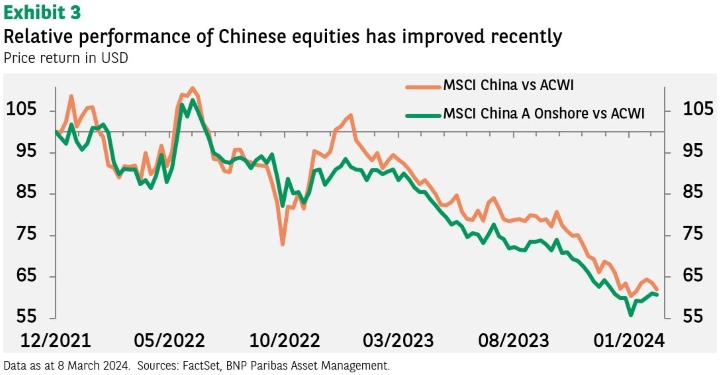
The reaction of Chinese equity markets so far would suggest at least some disappointment. The MSCI China index fell by 1.8% last week (in USD terms), while the MSCI All Country World index gained 0.6%. The domestically focused MSCI China A index did a little bit better, rising by 0.1%, but still lagged global equities (see Exhibit 3).
Mixed US employment data
Other recent key data included US non-farm payrolls, which also painted a mixed picture. Non-seasonally adjusted payrolls rose by more than would have been expected at this time of year, but the strong readings from prior months were revised downwards.
The number of jobs created over the preceding 12 months was steady at 175 000, down from the 300 000+ rate of a year ago. The unemployment rate rose slightly, and the participation rate was unchanged. Participation actually rose for those aged over 24, but this was offset by a fall in the participation rate for younger people.
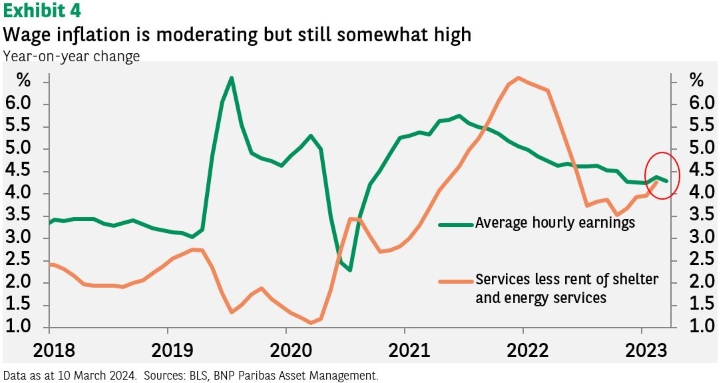
The pivotal figure for the question of whether inflation was reaccelerating was the change in average hourly earnings. The increase in services inflation is likely due at least partly to higher wages, and if the rate of earnings growth accelerates, services inflation might also do so. The data, though, showed a deceleration from 4.4% year-on-year to 4.3% (see Exhibit 4).
While encouraging, the rate has been at or above 4.3% since October, whereas the US Federal Reserve would likely be more comfortable with a 3.5% rate of increase.
Slowing growth and sticky inflation show that the possibility of stagflation cannot be entirely dismissed.
Disclaimer
This material is issued and has been prepared by BNP PARIBAS ASSET MANAGEMENT UK Limited (“BNPPAM UK”). Registered in England No: 02474627, registered office: 5 Aldermanbury Square, London, England, EC2V 7BP, United Kingdom. BNPPAM UK is regulated by the FCA under UK laws, which differ from Australian laws. In Australia, BNPPAM UK is exempt from the requirement to hold an Australian financial services license under the Corporations Act 2001 in respect of the financial services. This material is distributed in Australia by BNP PARIBAS ASSET MANAGEMENT Australia Limited ABN 78 008 576 449, AFSL 223418. This material is produced for information purposes only and does not constitute:
an offer to buy nor a solicitation to sell, nor shall it form the basis of or be relied upon in connection with any contract or commitment whatsoever or
investment advice.
Opinions included in this material constitute the judgement of BNPP AMAU at the time specified and may be subject to change without notice. BNPP AMAU is not obliged to update or alter the information or opinions contained within this material. Investors should consult their own legal and tax advisors in respect of legal, accounting, domicile and tax advice prior to investing in the financial instrument(s) in order to make an independent determination of the suitability and consequences of an investment therein, if permitted. Please note that different types of investments, if contained within this material, involve varying degrees of risk and there can be no assurance that any specific investment may either be suitable, appropriate or profitable for an investor’s investment portfolio.
Given the economic and market risks, there can be no assurance that the financial instrument(s) will achieve its/their investment objectives. Returns may be affected by, amongst other things, investment strategies or objectives of the financial instrument(s) and material market and economic conditions, including interest rates, market terms and general market conditions. The different strategies applied to the financial instruments may have a significant effect on the results portrayed in this material. Past performance is not a guide to future performance and the value of the investments in financial instrument(s) may go down as well as up. Investors may not get back the amount they originally invested. The performance date, as applicable, reflected in this material, does not take into account the commissions, costs incurred on the issue and redemption and taxes. All information referred to in the present material is available on www.bnpparibas-am.com.


