
For investors expecting a ‘Dry January’ – one when they didn’t have to listen to central bankers’ comments for a few weeks – it’s already a bust. The US Federal Reserve has started to call the shots and equities are suffering.
Listen to the article
So far in this new year, stocks have fallen on the sword of the broad-based rise in long-term bond yields. Indeed, this was already happening in December. If we take 13 December as a reference point, global equities have lost 3.7% over the last four weeks, and 10-year yields have risen by 36bp in the US, 34bp in Germany and 43bp in the UK.
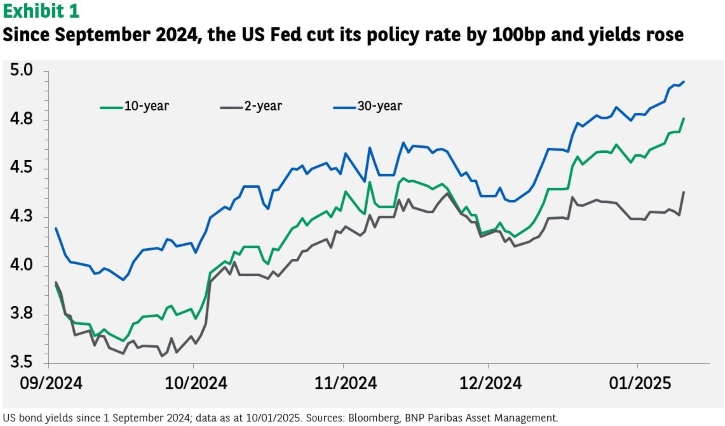
Even though, as usual, trading volumes were light in the run-up to Christmas and in the first week of January, these movements were significant. The main driver was the Federal Reserve’s change in tone at its policy meeting on 17/18 December: this prompted a (further) adjustment in market expectations on US monetary policy.
Soft landing – Perhaps not so certain?
The jobs report released on 10 January confirmed the strength of the US labour market: 256 000 jobs were created in December. This could be seen to justify the Fed’s caution.
With policymakers focused on the path of inflation, Fed Chair Jerome Powell said: “We still have some work to do [on inflation] and we need policy to remain restrictive to get that work done”.
Other central bankers have indicated they want inflation to resume its trend towards 2% before any further interest rate cuts. The Fed Chair made it clear the forecasts provided by some policymakers took into account the likely inflationary impact of Donald Trump’s economic policy proposals. Powell referred to Fed estimates in 2018 of the impact of tariff increases on inflation.
The first results of the University of Michigan’s latest household confidence survey found their 1-year and 3-year inflation expectations had risen in January to a one-year high.
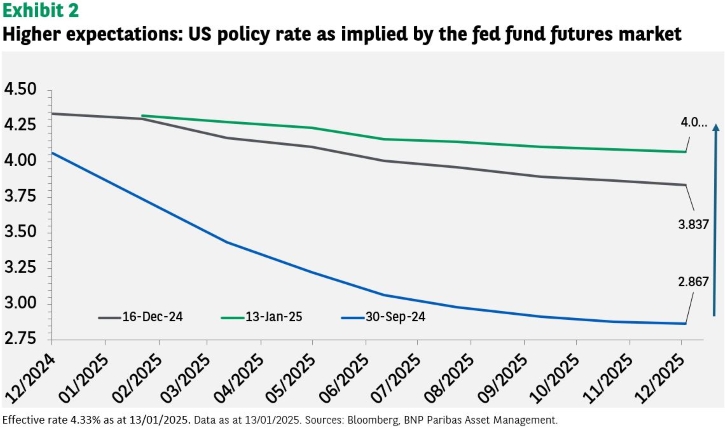
Futures markets do not point to any rate cuts for the first three policy meetings this year (January, March and May), and only one by the end of the year. This is a more hawkish assessment than that presented by the Fed at its December meeting.
Major brokers are also reviewing their expectations and forecasting a status quo in the first quarter followed by one or two cuts. Most observers seem to agree that the US monetary policy easing cycle is coming to an end.
Several policymakers highlighted the notion of a recalibration of US monetary policy that would have been achieved with December’s rate cut and a policy rate in the 4.25%-4.50% range.
Most recently, St. Louis Fed Governor Alberto Musalem hinted that with this level of federal funds rates, financial conditions are still supporting economic activity.
Among the prominent voices on the policymaking committee, Governor Christopher Waller appeared to dissociate himself from this cautious stance, claiming that further cuts are justified.
Desynchronisation
In any event, a new consensus is emerging that could be summarised as ‘wait and see’, while policy rate cuts are likely to continue in other major developed economies (with the exception of Japan).
In addition to the widespread upward pressure on long-term bond yields mentioned above, the most visible consequences of higher bond yields have been seen in the foreign exchange market.
The US dollar index (calculated against a basket of the euro, the yen, the pound sterling, the Canadian dollar, the Swedish krona and the Swiss franc) had gained 2.6% in December. It has continued to rise, reaching its highest since November 2022. That is up by 1.1% compared to the end of 2024.
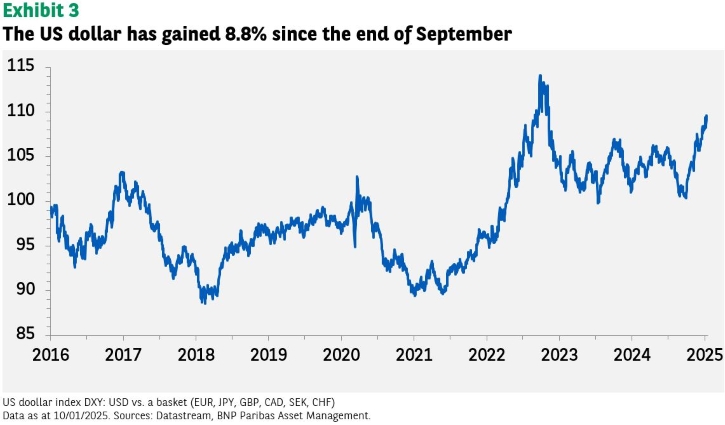
The dollar’s appreciation has been rapid, reaching symbolic levels (for example, driving EUR/USD to below 1.02 on 13 January ). This situation could tempt the authorities to intervene. When the Chinese yuan dropped to close to a record low, Beijing warned measures would be taken to stabilise expectations and ‘correct pro-cyclical market behaviour’.
More easing by the ECB – But how much?
Faced with sluggish growth prospects, the governors of the European Central Bank (ECB) are speaking with (almost) one voice in talking about further cuts in key policy rates in 2025.
According to the Governor of the Banque de France (8 January): “If the decline in inflation is confirmed in the coming quarters as we forecast, it makes sense to go toward the neutral rate by next summer without slowing the pace.” Piero Cipollone, a member of the ECB Executive Board, believes that keeping demand low in an attempt to safeguard against future inflation shocks would be ‘counterproductive’.
On 13 January, the ECB’s chief economist, Philip Lane, said there would probably more monetary easing ‘to make sure the European economy grows’. He said, however, that a path needed to be found that would neither provoke a recession nor delay the return of inflation to the ECB’s 2% target.
Yet the expectations reflected in futures markets have changed. At the end of December, a cumulative 125bp of cuts was priced in for 2025. Now, slightly less than four [25bp] cuts are priced in.
Movements in the EUR/USD exchange rate are probably not unrelated to the doubts that are beginning to manifest themselves, even though the ECB has yet to comment on the level of the euro.
More exposure to US equities as the year’s first step
The divergence between economies can be seen in the most recent indicators, with likely consequences for financial markets and monetary policy expectations. In the short term, it appears difficult to envisage a sudden reversal of these trends.
We are convinced the US economy can achieve a soft landing. Ruling out a recession in the US in 2025 appears reasonable. This provides a favourable environment for risk assets. In addition, the earnings outlook for US companies is promising – even for small caps which could benefit from protectionist measures.
Analyst expectations for the stocks that make up the tech-dominated NASDAQ are favourable. However, as we saw in December, the Fed’s monetary policy stance will be decisive for the Treasury market and therefore for equities, especially large tech stocks. Differentiation between sectors, styles and capitalisation sizes could characterise the first months of the new year and thus require keen and active management. With this in mind, broadening and diversifying the exposure to US equities beyond the major technology stocks appears to us to be a good first step.
Disclaimer
Please note that articles may contain technical language. For this reason, they may not be suitable for readers who do not have professional investment experience. Any views expressed here are those of the author as of the date of publication, are based on available information, and are subject to change without notice. Individual portfolio management teams may hold different views and may take different investment decisions for different clients. This document does not constitute investment advice. The value of investments and the income they generate may go down as well as up, and investors are likely not to recover their initial investment. Past performance is no guarantee for future returns. Investing in emerging markets, or specialised or restricted sectors is likely to be subject to a higher than average volatility due to a high degree of concentration, greater uncertainty because less information is available, there is less liquidity or due to greater sensitivity to changes in market conditions (social, political and economic conditions). For this reason, services for portfolio transactions, liquidation and conservation on behalf of funds invested in emerging markets may carry greater risk.


