
Although the incoming Trump administration has set adrift a raft of uncertainties for markets, recent economic data and policy signals from the US and Europe continue to suggest a cycle of interest rate cuts will run into 2025. Investors have however scaled back the extent of the easing they anticipate in the US while raising their expectations for cuts to policy rates in the eurozone.
Listen to the article
Meanwhile, the Chinese economy surprised by posting another month of recovery in the manufacturing sector. Beijing successfully issued sovereign bonds at the same cost of comparable US Treasuries: the issuance was oversubscribed a solid 20 times.
Policy easing into 2025
Data showed the US economy grew by 2.8% in the third quarter, supported by solid consumption growth of 3.0%. Price pressures remained at below 2.0%, with core personal consumption expenditures (PCE) inflation slowing faster than expected over the quarter. Meanwhile, core PCE prices for October edged up to 2.8% from 2.7%, but initial jobless benefit claims came in lower than expected.
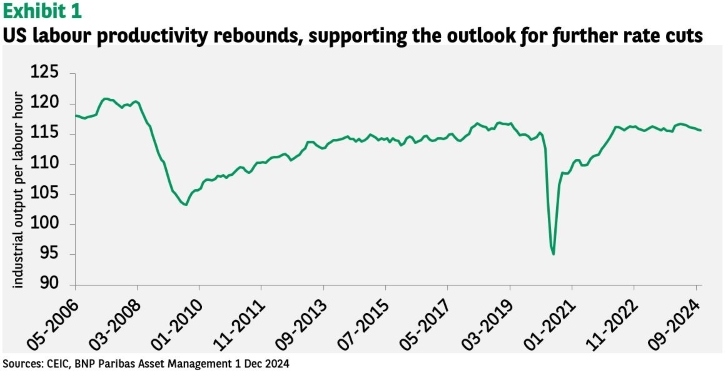
There were no surprises in this data. As a result, investors continue to expect the Federal Reserve (Fed) to cut its key rates by another 25bp at the next Federal Open Market Committee (FOMC) meeting on 17-18 December. Fed Chair Jerome Powell has noted several times recently that he is confident core inflation would continue to fall towards the Fed’s 2.0% target, supported by the continued rebound in labour productivity (see Exhibit 1).
In Europe, several factors are backing the doves at the ECB.
- Firstly, incoming President Donald Trump’s import tariff threats have stirred concerns about the outlook for Europe’s growth.
- Secondly, although headline inflation in the eurozone rose from 2.0% year-on-year (YoY) to 2.3% in November, the rise was due mainly to base effects. Crucially, services inflation fell, albeit slightly, from 4.0% YoY to 3.9%, keeping core inflation at 2.7% YoY. That is unchanged from October.
- Finally, consumer confidence declined in November, ending the upward trend that began in late 2023.
In the Asia Pacific region, the Reserve Bank of New Zealand cut its official rate by 50bp for the second time in a row last week, taking it to 4.25%. It gave dovish forward guidance, signalling further cuts in 2025.
The Bank of Korea delivered a surprise 25bp cut in its official rate to 3.0%, marking a shift in policy focus to halt slowing GDP growth momentum amid moderating inflation.
China recovery continues
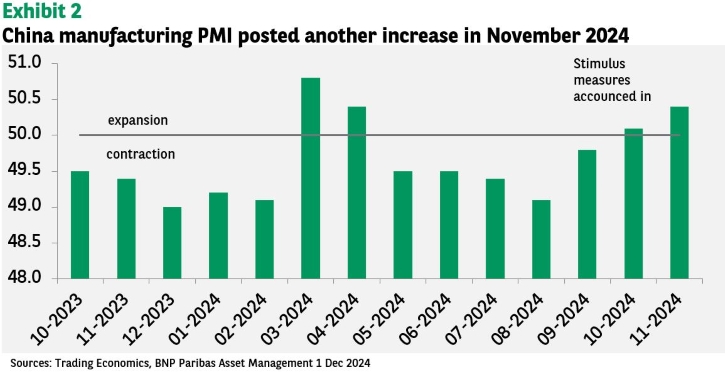
The manufacturing sector saw continued support from recent policy stimulus, with the manufacturing purchasing managers’ index (PMI) rising to 50.3 in November, the second back-to-back monthly increase since April 2024 (see Exhibit 2).
Recent policy support should help put GDP growth on track for the 5.0% target this year.
Li Daokui, an influential voice in China’s policy circles, noted last week that Beijing’s official thinking on macroeconomic policy had fundamentally shifted since late September to prioritise growth. A former People’s Bank of China (PBoC) monetary policy committee member and currently an economics professor at Tsinghua University, he argued that policymakers have finally accepted that the policy easing of recent years had failed to revitalise the private sector and local governments.
Li highlighted that near-term measures would include a further RMB 10 trillion (USD 1.37 trillion) in debt relief in addition to the RMB 10 trillion already announced.
It appears that the first RMB 10 trillion will go towards paying contractors and salaries, as planned, with the second RMB 10 trillion targeted towards debt replacement and new spending. The latter is set to support consumption, including an expansion of the ‘cash-for-clunkers’ programme aimed at boosting car sales, and stimulus for the property sector, including a further easing of policy restrictions.
The bottom line is that Beijing is prepared to counteract the effects of the expected US tariff threats through more aggressive policies to boost the domestic sector.
A Chinese US dollar sovereign bond
It is noteworthy that China issued USD 2 billion in sovereign bonds in Riyadh, Saudia Arabia, just over a week ago. This caught the attention of many official institution investors. While global markets shrugged off the issue, there could yet be implications on the US dollar bond market.
- Firstly, the Chinese bonds with maturities of three and five years were almost 20 times oversubscribed, compared to the usual oversubscription rate of two to three times for US Treasury bond auctions. Such strong demand for China’s USD sovereign debt appears to underscore a global risk diversification out of the US dollar.
- Secondly, the interest-rate spread of the Chinese bonds was only one to three basis points over that of comparable US Treasuries. This implies that China (with an S&P credit rating of A+/A-1) was able to borrow in dollars at almost the same rate as the US government (with a higher S&P credit rating of AA+/A-1). We find this intriguing.
- Thirdly, the Chinese bonds were issued in Riyadh, which was unusual given that sovereign bonds are typically issued in major financial centres. This could indicate closer ties between Saudi Arabia and China – two countries already in bilateral talks about renminbi-based oil trading.
Crucially, by issuing dollar bonds in a smaller financial centre, China is directly competing with US Treasuries for funding by paying almost the same interest rate. The strong demand for the Chinese bonds can be seen as a signal that China could eventually become an alternative manager of dollar liquidity in the global financial system.
If China starts issuing more USD sovereign bonds and can price them at rates similar to those on US Treasuries, it could provide an option for investors and countries to invest their dollars in Chinese government bonds. Such a redirection of dollar flows from US Treasuries to Chinese sovereigns could put pressure on US efforts to fund its current account and fiscal deficits. That would have far-reaching implications for the Treasury market.
Disclaimer
This material is issued and has been prepared by BNP PARIBAS ASSET MANAGEMENT Asia Limited (the “Company”), with its registered office at 17/F, Lincoln House, Taikoo Place, Quarry Bay, Hong Kong. BNP PARIBAS ASSET MANAGEMENT Asia Limited in Australia is an authorised representative of BNP PARIBAS ASSET MANAGEMENT Australia Limited ABN 78 008 576 449, AFSL 223418 (“BNPP AMAU”).
This material is distributed in Australia by BNPP AMAU. This material has not been reviewed by the Hong Kong Securities and Futures Commission. This material is produced for information purposes for wholesale investors only and does not constitute:
1. an offer to buy nor a solicitation to sell, nor shall it form the basis of or be relied upon in connection with any contract or commitment whatsoever or
2. investment advice.
This material makes reference to certain financial instruments authorised and regulated in their jurisdiction(s) of incorporation.
No action has been taken which would permit the public offering of the financial instrument(s) in any other jurisdiction, except as indicated in the most recent prospectus, offering document or any other information material, as applicable of the relevant financial instrument(s) where such action would be required, in particular, in the United States, to US persons (as such term is defined in Regulation S of the United States Securities Act of 1933). Prior to any subscription in a country in which such financial instrument(s) is/are registered, investors should verify any legal constraints or restrictions there may be in connection with the subscription, purchase, possession or sale of the financial instrument(s).
Investors considering subscribing to the financial instrument(s) should read carefully the most recent prospectus, offering document or other information material for further details including the risk factors and consult the financial instrument(s’) most recent financial reports. These documents are available from your local BNPP AM correspondents, if any, or from the entities marketing the Financial Instrument(s).
Opinions included in this material constitute the judgement of the Company at the time specified and may be subject to change without notice. The Company is not obliged to update or alter the information or opinions contained within this material. Investors should consult their own legal and tax advisors in respect of legal, accounting, domicile and tax advice prior to investing in the financial instrument(s) in order to make an independent determination of the suitability and consequences of an investment therein, if permitted. Please note that different types of investments, if contained within this material, involve varying degrees of risk and there can be no assurance that any specific investment may either be suitable, appropriate or profitable for an investor’s investment portfolio.
Investments involve risks. Given the economic and market risks, there can be no assurance that the financial instrument(s) will achieve its/their investment objectives. Returns may be affected by, amongst other things, investment strategies or objectives of the financial instrument(s) and material market and economic conditions, including interest rates, market terms and general market conditions. The different strategies applied to financial instruments may have a significant effect on the results presented in this material. Past performance is not a guide to future performance and the value of the investments in financial instrument(s) may go down as well as up. Investors may not get back the amount they originally invested.
The performance data, as applicable, reflected in this material, do not take into account the commissions, costs incurred on the issue and redemption and taxes.
All information referred to in the present document is available on www.bnpparibas-am.com.


