
The pace of inflation in developed markets has slowed, while China’s economic weakness appears to have hit a ‘pain point’ that has finally got Beijing’s attention. The big question for financial markets is whether we are finally seeing the first signs of a shift in monetary policy towards easing. Developed market central banks are still wary of cutting rates too soon, but China’s central bank has recently moved more assertively.
Despite a fall in inflation…
The markets’ key focus is still very much on inflation. Last week’s consumer price reports in Europe, the UK and the US did not disappoint those anticipating a softening of inflationary pressures.
US headline and core consumer inflation rates slowed to 3.2% year-on-year (YoY) in October from 3.7% in September and to 4.0% from 4.1%, respectively. Crucially, ‘supercore’ inflation (nonhousing core services) – the measure seen as mattering the most to US Federal Reserve policymakers – rose by only 0.2% month-on-month. US stocks jumped for joy, rising by almost 2.0% on the day of the news.
The falling inflation trend suggests the Fed could now revise down its 2023 year-end core inflation forecast when it publishes new projections at its meeting on 12-13 December. In our view, this makes the (already faint) prospect of another rate hike even more remote, at least for now.
Headline inflation also slowed in Europe. It fell to 2.9% YoY in October from 4.7% in September, while the core rate softened to 4.2% YoY from 4.7%.
Even in the UK, which faces the biggest inflationary pressures among the major economies, October headline and core inflation fell to 4.6% and 5.7% YoY from 6.7% and 6.1%, respectively, in September.
…the crystal ball is still murky
However, leading central banks remain cautiously hawkish, warning that future decisions on monetary policy depend on the strength of the economy and progress towards their inflation targets. They need the prevailing tight financial conditions to persist. In the meantime, their crystal ball for predicting inflation remains murky.
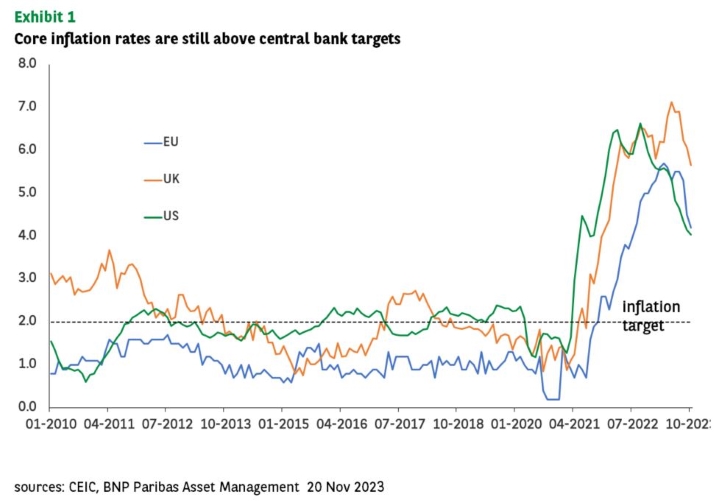
Despite the recent decline, core inflation in all major developed economies is still far above central bank targets (see Exhibit 1). This suggests a period of sub-par growth may be necessary in these economies to bring core inflation back to the 2.0% targets.
Major inflation and macroeconomic gauges for the US (and for the other major central banks) are not (yet) consistently signalling a slowdown. In the US, there appears to be no clear evidence that consumers are expecting inflation to fall back toward central bank targets.
Fourth-quarter 2023 inflation projections from the Survey of Professional Forecasters by the Federal Reserve Bank of Philadelphia show headline CPI inflation averaging 2.4% over the next 10 years. This contrasts with the higher (3.2%) average rate implied by the University of Michigan survey of five to 10-year inflation expectations this month. What’s more, the University of Michigan measure has risen by a substantial 40bp since September 2023.
Ambiguous US employment data also justifies the Fed’s caution. While October’s non-farm payrolls surprised to the downside, job growth was still strong on a three-month average basis. Meanwhile, job gains recorded in the household (HH) survey data were much weaker than those in the payroll data (see Exhibit 2).
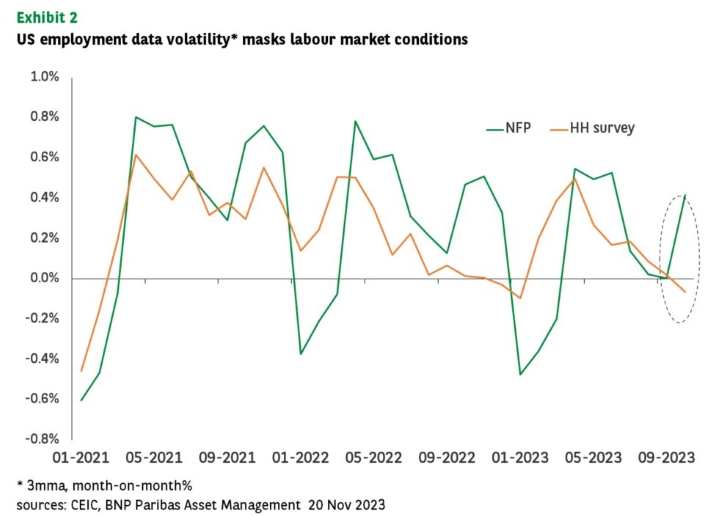
Conflicting signals like these are not new, but they contribute to the uncertain outlook for monetary policy and make market positioning difficult.
Experience suggests that only when the economy has entered a persistent slowdown, notably a recession, do the declines in employment and inflation expectations in the various surveys tend to align.
This implies that the ‘higher-for-longer’ rate view should prevail before monetary policy intentions shift towards an easing mode. That shift will require the major macroeconomic indicators to show:
- Sub-trend GDP growth
- Unemployment rising towards or above the equilibrium rate (or other signals of significant labour market weakening such as a decline in the pace of wage growth)
- Core inflation falling clearly and consistently towards the 2.0% target rate.
China – More aggressive easing
Meanwhile, China’s uneven economic recovery rumbles on as policymakers continue to mull over the question of additional support for the struggling property sector.
China’s macroeconomic data in October showed considerable divergence across sectors, with retail sales and industrial production still growing moderately, but fixed-asset investment slowing, in part due to further deterioration in the property sector.
While the latest data is consistent with delivering the 5.0% official growth target this year, we believe Beijing will need to stabilise the property sector to prevent momentum from faltering. And it appears the authorities are preparing more assertive measures, with the People’s Bank of China considering injecting at least RMB 1 trillion to fund three major property and infrastructure projects in big cities.
Such a move would come on top of the recently announced RMB 1 trillion of public spending for the rest of 2023. Should push comes to shove, which now appears to be the case, we believe the PBoC has ample leeway to ease policy by monetising debt to fund fiscal spending.
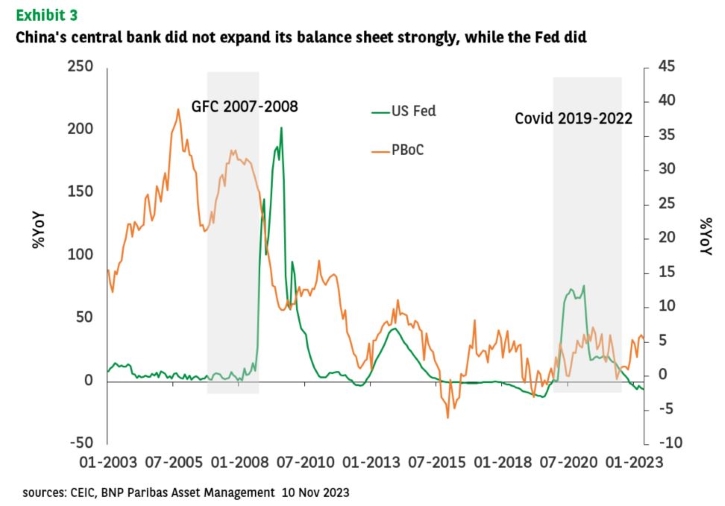
Despite all its talk of policy easing, the PBoC did not expand its balance sheet aggressively during the pandemic to pump-prime the economy – unlike its developed market counterparts (see Exhibit 3).
If Beijing can sustain its assertive policy in the coming months, rebuild confidence and convince markets that the outlook is improving, we believe there is a fair chance of a sustained rebound in Chinese GDP growth and stock valuations in 2024. If not, growth could remain stuck in low gear, keeping a heavy lid on asset prices.
Little room for error
In the face of such a widespread precarious macroeconomic and policy backdrop, there is little room for error in market positioning.
We lean towards a defensive posture by favouring government bonds over equities until such time as the economic and policy dynamics change again, or at least until the fog clears.
Disclaimer
This material is issued and has been prepared by BNP PARIBAS ASSET MANAGEMENT Asia Limited (the “Company”), with its registered office at 17/F, Lincoln House, Taikoo Place, Quarry Bay, Hong Kong. BNP PARIBAS ASSET MANAGEMENT Asia Limited in Australia is an authorised representative of BNP PARIBAS ASSET MANAGEMENT Australia Limited ABN 78 008 576 449, AFSL 223418 (“BNPP AMAU”).
This material is distributed in Australia by BNPP AMAU. This material has not been reviewed by the Hong Kong Securities and Futures Commission. This material is produced for information purposes for wholesale investors only and does not constitute:
1. an offer to buy nor a solicitation to sell, nor shall it form the basis of or be relied upon in connection with any contract or commitment whatsoever or
2. investment advice.
This material makes reference to certain financial instruments authorised and regulated in their jurisdiction(s) of incorporation.
No action has been taken which would permit the public offering of the financial instrument(s) in any other jurisdiction, except as indicated in the most recent prospectus, offering document or any other information material, as applicable of the relevant financial instrument(s) where such action would be required, in particular, in the United States, to US persons (as such term is defined in Regulation S of the United States Securities Act of 1933). Prior to any subscription in a country in which such financial instrument(s) is/are registered, investors should verify any legal constraints or restrictions there may be in connection with the subscription, purchase, possession or sale of the financial instrument(s).
Investors considering subscribing to the financial instrument(s) should read carefully the most recent prospectus, offering document or other information material for further details including the risk factors and consult the financial instrument(s’) most recent financial reports. These documents are available from your local BNPP AM correspondents, if any, or from the entities marketing the Financial Instrument(s).
Opinions included in this material constitute the judgement of the Company at the time specified and may be subject to change without notice. The Company is not obliged to update or alter the information or opinions contained within this material. Investors should consult their own legal and tax advisors in respect of legal, accounting, domicile and tax advice prior to investing in the financial instrument(s) in order to make an independent determination of the suitability and consequences of an investment therein, if permitted. Please note that different types of investments, if contained within this material, involve varying degrees of risk and there can be no assurance that any specific investment may either be suitable, appropriate or profitable for an investor’s investment portfolio.
Investments involve risks. Given the economic and market risks, there can be no assurance that the financial instrument(s) will achieve its/their investment objectives. Returns may be affected by, amongst other things, investment strategies or objectives of the financial instrument(s) and material market and economic conditions, including interest rates, market terms and general market conditions. The different strategies applied to financial instruments may have a significant effect on the results presented in this material. Past performance is not a guide to future performance and the value of the investments in financial instrument(s) may go down as well as up. Investors may not get back the amount they originally invested.
The performance data, as applicable, reflected in this material, do not take into account the commissions, costs incurred on the issue and redemption and taxes.
All information referred to in the present document is available on www.bnpparibas-am.com.


