
Market sentiment on China has improved now that the Politburo has signalled further stimulus and reiterated its focus on structural reforms. Beijing’s pledge of more support for the economy, and now the ailing property market, has lifted Chinese stocks by almost 20% from February’s low. Still, to brighten the outlook for the economy and asset markets further, monetary and fiscal policies should be relaxed further.
What’s new?
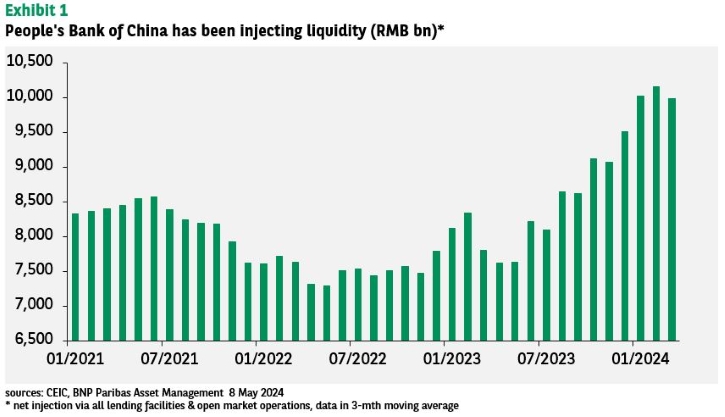
Since late 2023, the People’s Bank of China has been increasing net injection of liquidity in the economy (see Exhibit 1) as part of the stimulus efforts. Beijing has now upped the ante by announcing at the latest Politburo meeting in early May a policy shift towards rescuing the debt-laden property sector by
- absorbing excess housing inventories
- increasing the supply of housing to meet demand for higher-upgrade homes
- lowering the costs of these changes.
If implemented properly, these measures could be a game changer for economic growth and the outlook for asset markets.
Details are pending, but information from previous statements suggests that these steps are likely:
- Socialising unfinished projects by buying them from developers and converting them into social housing. This could be done either by the central government itself or the central government instructing and funding local authorities to do so. This would remove inventory from the commodity (private) housing market and increase the supply of social housing at a cost (due to the government’s cheaper funding cost) that is lower than that of construction by private developers.
- Converting secondary market inventory into rental housing. The property that home-upgraders cannot sell becomes inventory in the secondary market. Local governments could buy these properties from the upgraders and require them to use the proceeds only to buy a bigger home. Local authorities in the cities of Suzhou, Taicang and Zhengzhou have already been experimenting with this approach.
The local governments could then convert this inventory into rental housing using low-cost funding provided by the central bank or the central government. This will convey the inventory from homeowners (with a higher funding cost) to the government (with a lower funding cost), stabilising the market by mitigating the price-cut pressure from homeowners, and increasing the supply of social housing at a lower cost.
A game changer?
The announcement has caused investors to now warm up to the Chinese equity market, though many appear to be looking at the market as a tactical opportunity. Some investors have even turned bullish on the property sector and upgraded Chinese stocks to overweight, setting an upside price target of over 10% for the MSCI China index even after the recent rally.[1]
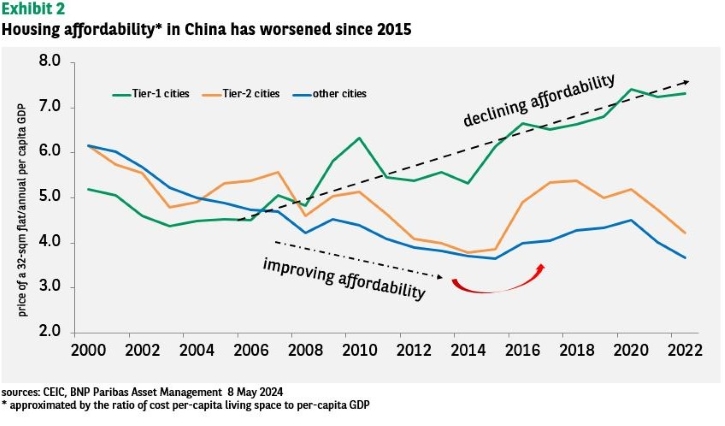
Measures that revive unfinished projects, reduce the housing inventory and increase social housing at a lower cost are all addressing China’s property market problems at the heart. We believe they could go a long way, albeit slowly, to make developers more liquid, improve public confidence, enhance housing affordability (which has deteriorated nation-wide since 2015, see Exhibit 2) and calm social grievances.
Since the Politburo announcement did not contain any stimulus for the private sector and consumption-driven growth, rescuing the property market can be seen as central to reviving sagging public confidence, (see Exhibits 3 and 4). To complement the impact of the rescue package, monetary and fiscal policies should be relaxed further, in our view.
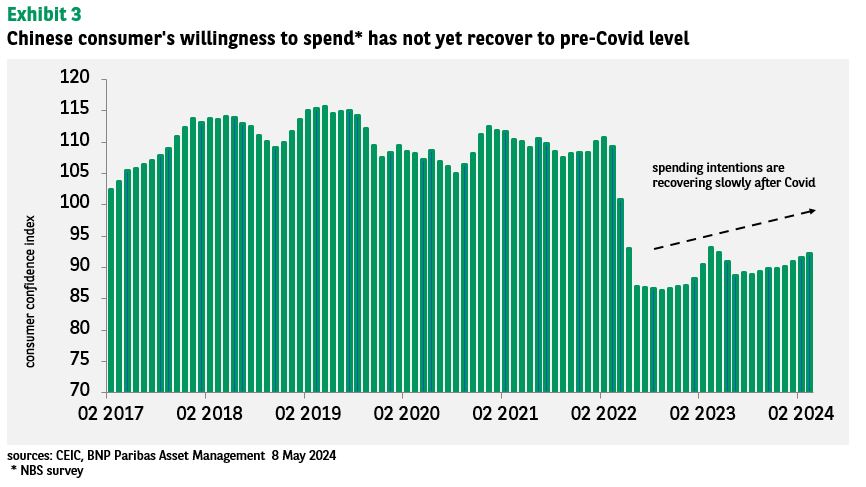
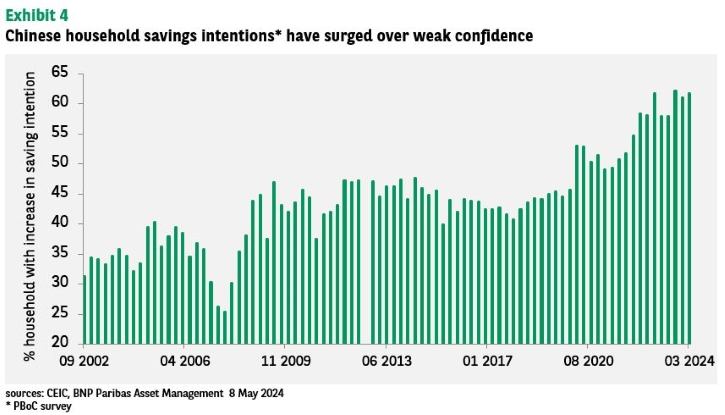
Data from this year’s May Day holiday (1-5 May) clearly illustrates how the deficit in consumer confidence drags on spending. Despite a 28% and 13% increase in the number of domestic trips and total travel spending, respectively, from comparable pre-Covid levels, per-trip spending was down by 11%.
Putting money where the mouth is
Concerns over unfinished projects remain a sizeable hurdle for a property market recovery, reflecting the financial trouble that many developers are facing. The drop in confidence due to the poor state of the property market has a negative effect on private spending.
Beijing’s policy shift towards rescuing the property sector can be seen as a move in the right direction. Together with more macroeconomic policy easing, the package should help improve income growth, housing affordability and property transactions and brighten the prospects of the economy and asset markets.
The policy shift and easing measures are a vindication of what the government has pledged since late 2023. If China is putting its money where its mouth is, we believe there is a fair chance that the economy and asset markets can recover in the coming months.
[1] For example, see “China Property: Our latest thoughts on recent share rally”, UBS, 29 April 2024, and “EM Equity Strategy: China Upgrade – Investor feedback & key debates”, UBS, 2 May 2024.
Disclaimer
This material is issued and has been prepared by BNP PARIBAS ASSET MANAGEMENT Asia Limited (the “Company”), with its registered office at 17/F, Lincoln House, Taikoo Place, Quarry Bay, Hong Kong. BNP PARIBAS ASSET MANAGEMENT Asia Limited in Australia is an authorised representative of BNP PARIBAS ASSET MANAGEMENT Australia Limited ABN 78 008 576 449, AFSL 223418 (“BNPP AMAU”).
This material is distributed in Australia by BNPP AMAU. This material has not been reviewed by the Hong Kong Securities and Futures Commission. This material is produced for information purposes for wholesale investors only and does not constitute:
1. an offer to buy nor a solicitation to sell, nor shall it form the basis of or be relied upon in connection with any contract or commitment whatsoever or
2. investment advice.
This material makes reference to certain financial instruments authorised and regulated in their jurisdiction(s) of incorporation.
No action has been taken which would permit the public offering of the financial instrument(s) in any other jurisdiction, except as indicated in the most recent prospectus, offering document or any other information material, as applicable of the relevant financial instrument(s) where such action would be required, in particular, in the United States, to US persons (as such term is defined in Regulation S of the United States Securities Act of 1933). Prior to any subscription in a country in which such financial instrument(s) is/are registered, investors should verify any legal constraints or restrictions there may be in connection with the subscription, purchase, possession or sale of the financial instrument(s).
Investors considering subscribing to the financial instrument(s) should read carefully the most recent prospectus, offering document or other information material for further details including the risk factors and consult the financial instrument(s’) most recent financial reports. These documents are available from your local BNPP AM correspondents, if any, or from the entities marketing the Financial Instrument(s).
Opinions included in this material constitute the judgement of the Company at the time specified and may be subject to change without notice. The Company is not obliged to update or alter the information or opinions contained within this material. Investors should consult their own legal and tax advisors in respect of legal, accounting, domicile and tax advice prior to investing in the financial instrument(s) in order to make an independent determination of the suitability and consequences of an investment therein, if permitted. Please note that different types of investments, if contained within this material, involve varying degrees of risk and there can be no assurance that any specific investment may either be suitable, appropriate or profitable for an investor’s investment portfolio.
Investments involve risks. Given the economic and market risks, there can be no assurance that the financial instrument(s) will achieve its/their investment objectives. Returns may be affected by, amongst other things, investment strategies or objectives of the financial instrument(s) and material market and economic conditions, including interest rates, market terms and general market conditions. The different strategies applied to financial instruments may have a significant effect on the results presented in this material. Past performance is not a guide to future performance and the value of the investments in financial instrument(s) may go down as well as up. Investors may not get back the amount they originally invested.
The performance data, as applicable, reflected in this material, do not take into account the commissions, costs incurred on the issue and redemption and taxes.
All information referred to in the present document is available on www.bnpparibas-am.com.


