
China’s headline consumer price index fell by 0.3% year-on-year in July to register deflation for the first time in two years. This figure raised concerns that falling prices would lead consumers to delay spending in an already weakening economy. However, in our view, the data is not a harbinger for prolonged deflation.
Weak pork and energy prices were mainly responsible for the decline in headline CPI. The fall nevertheless comes as spending by consumers and businesses softens in an economy hamstrung by a flagging property market and laded with debt (that Beijing has committed to reducing). Producer prices have been falling for longer amid declines in energy, metals and chemicals prices as domestic, but also foreign, demand weakens.
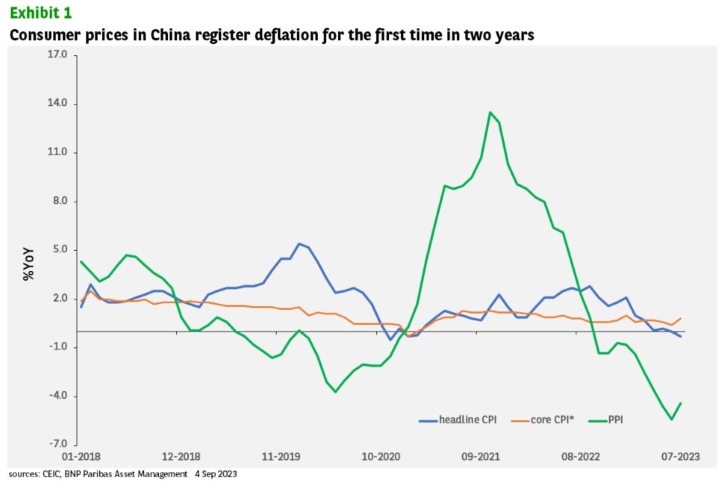
Deflation conditions not met
Why do we think deflation will be relatively short-lived? Looking at the economic fundamentals, lasting deflation requires several conditions:
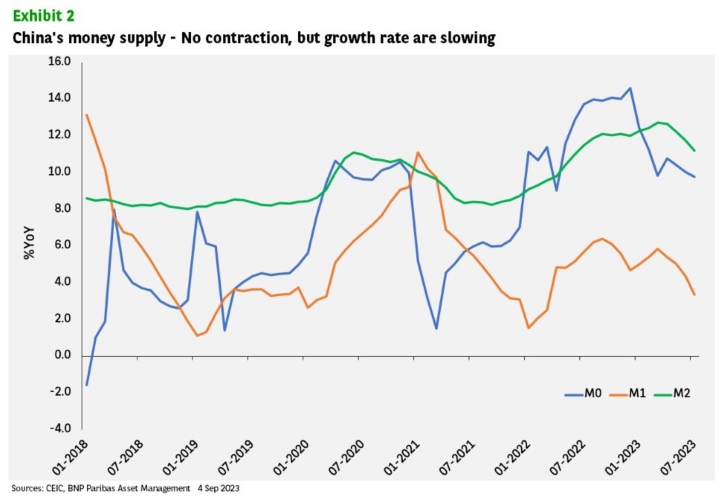
- Monetary contraction – i.e., a decline in money supply due to monetary tightening. We believe this is not the case in China. Data shows that various measures of money supply are in expansion territory (see Exhibit 2), with M2 broad money supply growing at double-digit rates. The growth rate has been slowing, however.
- Demand destruction – outside of exports, we do not see worrying signs of significantly flagging demand. Income growth is slowing, but not contracting. After a weak spell, consumer demand is recovering, mostly for domestic services and tourism; holiday prices jumped by over 10% YoY in July, for example. Non-food prices were unchanged from last year’s level in July, rebounding from -0.6% YoY in June. Youth unemployment is high, but in our view overall labour market conditions are not dire.
- Persistent loss of confidence. This is partially true in China, mainly because of the after-effects of the government’s zero-Covid policy and a persistently bad property market. We believe it is too early to assume that confidence will remain low, however. More assertive policy easing by Beijing in the coming months could stabilise the property market and bolster public confidence, reviving private sector spending and investment. The precondition is that Beijing acts quickly and decisively to shore up economic activity and business and consumer confidence before the current pessimism becomes entrenched and hits growth more heavily.
- Increase in the real value of debt. This is a long-term factor. We are seeing this to some extent as the debt ratio rises when inflation falls. We believe Beijing is aware of the debt problem. Indeed, the government has been addressing it for a number of years through economically good and bad times.
Is there more to come from Beijing?
Beijing has taken steps to support growth, but it has not unleashed the kind of monetary and fiscal stimulus seen during past downturns. There have been no cash handouts to consumers like those that fueled post-pandemic recoveries in the US and elsewhere. Debt-laden local governments do not have the fiscal space to boost spending themselves.
However, given Beijing’s resolve to shore up the economy and reduce the debt in the system, we believe it is unlikely that China will fall into a debt-deflation spiral. Its post-Covid economic recovery is fragile, but in our view, the problems are mainly cyclical and can be resolved effectively by a more aggressive fiscal expansion facilitated by calibrated monetary easing.
Disclaimer
This material is issued and has been prepared by BNP PARIBAS ASSET MANAGEMENT Asia Limited (the “Company”), with its registered office at 17/F, Lincoln House, Taikoo Place, Quarry Bay, Hong Kong. BNP PARIBAS ASSET MANAGEMENT Asia Limited in Australia is an authorised representative of BNP PARIBAS ASSET MANAGEMENT Australia Limited ABN 78 008 576 449, AFSL 223418 (“BNPP AMAU”).
This material is distributed in Australia by BNPP AMAU. This material has not been reviewed by the Hong Kong Securities and Futures Commission. This material is produced for information purposes for wholesale investors only and does not constitute:
1. an offer to buy nor a solicitation to sell, nor shall it form the basis of or be relied upon in connection with any contract or commitment whatsoever or
2. investment advice.
This material makes reference to certain financial instruments authorised and regulated in their jurisdiction(s) of incorporation.
No action has been taken which would permit the public offering of the financial instrument(s) in any other jurisdiction, except as indicated in the most recent prospectus, offering document or any other information material, as applicable of the relevant financial instrument(s) where such action would be required, in particular, in the United States, to US persons (as such term is defined in Regulation S of the United States Securities Act of 1933). Prior to any subscription in a country in which such financial instrument(s) is/are registered, investors should verify any legal constraints or restrictions there may be in connection with the subscription, purchase, possession or sale of the financial instrument(s).
Investors considering subscribing to the financial instrument(s) should read carefully the most recent prospectus, offering document or other information material for further details including the risk factors and consult the financial instrument(s’) most recent financial reports. These documents are available from your local BNPP AM correspondents, if any, or from the entities marketing the Financial Instrument(s).
Opinions included in this material constitute the judgement of the Company at the time specified and may be subject to change without notice. The Company is not obliged to update or alter the information or opinions contained within this material. Investors should consult their own legal and tax advisors in respect of legal, accounting, domicile and tax advice prior to investing in the financial instrument(s) in order to make an independent determination of the suitability and consequences of an investment therein, if permitted. Please note that different types of investments, if contained within this material, involve varying degrees of risk and there can be no assurance that any specific investment may either be suitable, appropriate or profitable for an investor’s investment portfolio.
Investments involve risks. Given the economic and market risks, there can be no assurance that the financial instrument(s) will achieve its/their investment objectives. Returns may be affected by, amongst other things, investment strategies or objectives of the financial instrument(s) and material market and economic conditions, including interest rates, market terms and general market conditions. The different strategies applied to financial instruments may have a significant effect on the results presented in this material. Past performance is not a guide to future performance and the value of the investments in financial instrument(s) may go down as well as up. Investors may not get back the amount they originally invested.
The performance data, as applicable, reflected in this material, do not take into account the commissions, costs incurred on the issue and redemption and taxes.
All information referred to in the present document is available on www.bnpparibas-am.com.


