
Investor optimism that Japan is finally moving from a long-running debt-deflation spiral to a ‘virtuous’ inflation cycle has pushed its stock market to record highs.
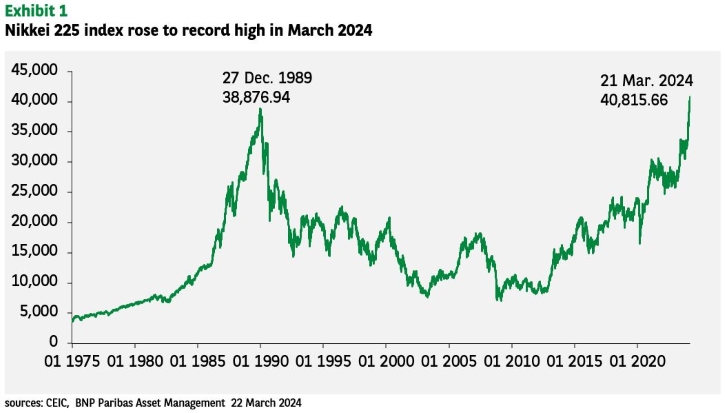
An expected macroeconomic shift from deflation to inflation, improved company earnings and corporate governance reforms (such as increasing the number of independent board members and greater shareholder advocacy) have brightened the outlook for Japan’s stock market since late 2023.
The Japanese yen’s sharp depreciation due to the diverging monetary policies of Japan and the US, and pessimism over China’s outlook, have encouraged investors to refocus on Japan. Monetary policy divergence has opened up a large negative interest rate differential, causing the yen to fall sharply against the US dollar and adding to imported inflation in Japan since 2022.
Japan had been mired in deflation for three decades. This saw nominal GDP growth fall from an annual average of 5.4% in the 1980s to 1.9% in the 1990s and then to -0.4% in the 2000s.
However, nominal growth started to rise after 2012, averaging 1.4% a year between 2012 and 2019 and rising to 3.1% between 2021 and 2023.
The Bank of Japan’s (BoJ) negative interest rate policy created a large gap between Japan’s real interest rate (‘r ‘ in Exhibit 2 below) and the rate of real GDP growth (‘g’): it averaged over -400bp in 2022 and 2023. The gap is significantly wider than the -200bp gap that experience suggests is needed to sustain economic growth in a debt-deflation environment.[1]

The (r-g) gap matters
A large and sustained (r-g) gap is crucial to rekindle ‘animal spirits’ and revive private sector spending to help reflate the economy.
BoJ research shows that Japanese companies and households have responded to the stimulative effects of its persistent ultra-easy policy by changing their pricing habits. Companies are abandoning their reluctance to change prices and lift wages, while unions and workers have begun to ask for – and are actually getting – pay increases.
Notably, Japan’s biggest labour union group Rengo successfully negotiated a pay rise of 5.3% in March 2024 (up from 3.8% in March 2023). The increase was significantly above market expectation of 4.0% and it had not been seen for over 30 years.
The market now expects the ‘Shunto’ annual wage negotiation round between workers and employers to set into motion a cycle of higher wages, which should stimulate consumer spending, lift prices sustainably and help pull Japan out of a decades-long economic morass.
Structural factors boosting Japan’s wages
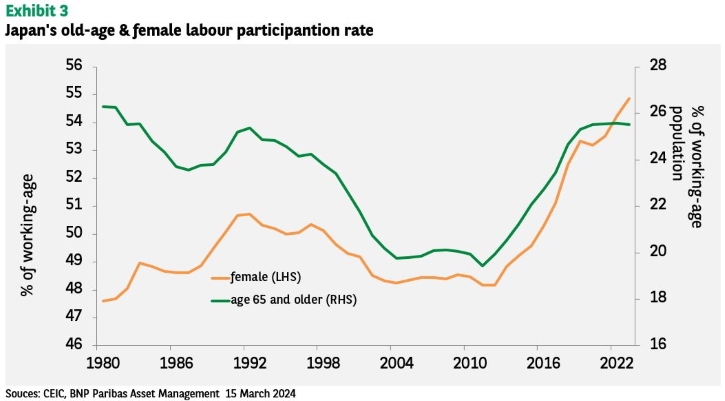
Other recent research has refocused attention on Japan’s labour shortage, which is putting upward pressure on wage growth. While the prime working age population has continued to rise, mainly due to the greater participation of female and older workers, the limits are in sight. More than half of the female labour force is working and, crucially, the older age participation rate, which rose from 20% in 2010 to 26% in 2021, is now stagnating (see Exhibit 3).
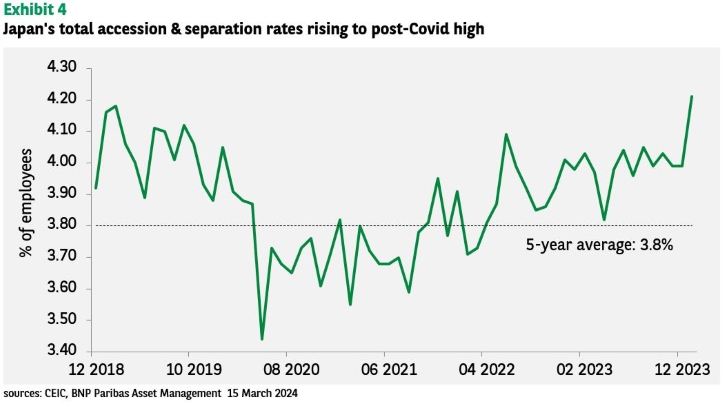
There is evidence that occupational mobility is rising. As approximated by the combined rate of workers joining and leaving their companies, labour mobility rose to a post-Covid high of 4.21% in January 2024, above the five-year average of 3.8% (see Exhibit 4). This should facilitate negotiations for higher pay.
Japan’s demographic problem of a shrinking labour supply limiting GDP growth has been well-known. However, financial markets have recently taken to viewing this long-term negative structural factor as a short-term positive bet on the revival of a wage-price spiral. Markets expect Japanese companies to pass on the higher labour cost to selling prices, thus improving the earnings outlook.
What will sustain Japan’s turnaround?
For Japan to emerge from the debt-deflation squeeze, the rise in wages would need to be translated into greater consumption rather than higher household savings or debt-reduction. Companies would need to pass on the higher labour costs to selling prices. This would prompt workers to negotiate more pay increases, setting off a wage-price spiral which would reflate the economy sustainably.
BoJ policy would need to remain accommodative to keep the (r – g) gap wide at -200bp or more and prevent economic growth momentum from faltering. Despite the BoJ’s recent exit from its long-running ultra-easy policy, it would need to keep real interest rates in negative territory to revive the dynamism of the corporate sector and boost capital expenditure to lift productivity and sustain nominal GDP growth.
The prospect of these developments helps explain the recent investor optimism on Japan. Time will tell if things unfold as expected.
[1] For example, see “Debt Sustainability: r-g Is Key”, Global and US Economics, Morgan Stanley, July 14, 2021.
Disclaimer
This material is issued and has been prepared by BNP PARIBAS ASSET MANAGEMENT Asia Limited (the “Company”), with its registered office at 17/F, Lincoln House, Taikoo Place, Quarry Bay, Hong Kong. BNP PARIBAS ASSET MANAGEMENT Asia Limited in Australia is an authorised representative of BNP PARIBAS ASSET MANAGEMENT Australia Limited ABN 78 008 576 449, AFSL 223418 (“BNPP AMAU”).
This material is distributed in Australia by BNPP AMAU. This material has not been reviewed by the Hong Kong Securities and Futures Commission. This material is produced for information purposes for wholesale investors only and does not constitute:
1. an offer to buy nor a solicitation to sell, nor shall it form the basis of or be relied upon in connection with any contract or commitment whatsoever or
2. investment advice.
This material makes reference to certain financial instruments authorised and regulated in their jurisdiction(s) of incorporation.
No action has been taken which would permit the public offering of the financial instrument(s) in any other jurisdiction, except as indicated in the most recent prospectus, offering document or any other information material, as applicable of the relevant financial instrument(s) where such action would be required, in particular, in the United States, to US persons (as such term is defined in Regulation S of the United States Securities Act of 1933). Prior to any subscription in a country in which such financial instrument(s) is/are registered, investors should verify any legal constraints or restrictions there may be in connection with the subscription, purchase, possession or sale of the financial instrument(s).
Investors considering subscribing to the financial instrument(s) should read carefully the most recent prospectus, offering document or other information material for further details including the risk factors and consult the financial instrument(s’) most recent financial reports. These documents are available from your local BNPP AM correspondents, if any, or from the entities marketing the Financial Instrument(s).
Opinions included in this material constitute the judgement of the Company at the time specified and may be subject to change without notice. The Company is not obliged to update or alter the information or opinions contained within this material. Investors should consult their own legal and tax advisors in respect of legal, accounting, domicile and tax advice prior to investing in the financial instrument(s) in order to make an independent determination of the suitability and consequences of an investment therein, if permitted. Please note that different types of investments, if contained within this material, involve varying degrees of risk and there can be no assurance that any specific investment may either be suitable, appropriate or profitable for an investor’s investment portfolio.
Investments involve risks. Given the economic and market risks, there can be no assurance that the financial instrument(s) will achieve its/their investment objectives. Returns may be affected by, amongst other things, investment strategies or objectives of the financial instrument(s) and material market and economic conditions, including interest rates, market terms and general market conditions. The different strategies applied to financial instruments may have a significant effect on the results presented in this material. Past performance is not a guide to future performance and the value of the investments in financial instrument(s) may go down as well as up. Investors may not get back the amount they originally invested.
The performance data, as applicable, reflected in this material, do not take into account the commissions, costs incurred on the issue and redemption and taxes.
All information referred to in the present document is available on www.bnpparibas-am.com.


