
Political uncertainty has spiked again in France after parliament voted to oust Prime Minister Michel Barnier’s government over his proposed deficit-cutting social welfare budget for 2025, adding to market nervousness which last week drove French borrowing costs to a 12-year high.[1]
Opposition parties banded together in backing a vote of no confidence as Barnier sought to invoke article 49.3 in the constitution to impose social welfare budget measures that would contribute to reducing France’s deficit ahead of the final steps of parliament’s debate on the 2025 budget.
Markets had been nervous about the outlook for the eurozone’s second largest economy since the summer after President Emmanuel Macron delayed the appointment of a prime minister until after the Olympics. Macron had called snap elections for 30 June and 7 July, kindling anxiety over political turmoil. The elections gave no party – or possible coalition – a workable majority in the National Assembly.
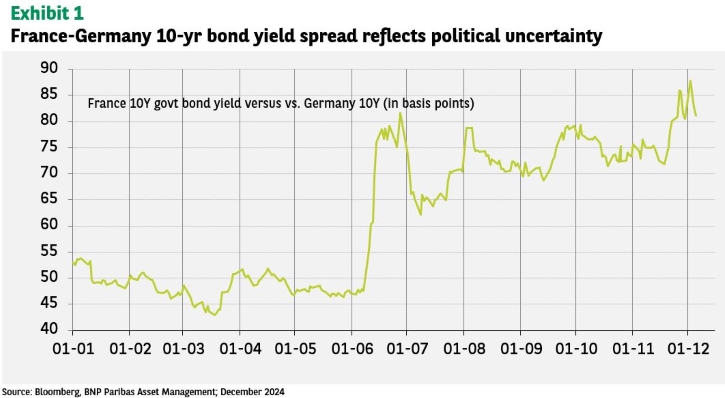
In a ‘flight-to-safety’, investors then bought German government bonds (Bunds). Meanwhile, the France-Germany 10-year bond yield spread rose to above 80bp on 27 June. While December had generally been seen as the decisive month for the survival of the Barnier government, ahead of the vote on the 2025 budget, the spread between the 10-year OAT and Bund had held in a range between 70bp and 80bp in recent weeks (see Exhibit 1).
Outlook for deficit and growth – Murky
From early October, it had become clear that the draft budget faced many challenges, fanning doubts about the government’s ability to cut the public deficit. On 29 November, rating agency Standard & Poor’s said that “despite ongoing political uncertainty, we expect France to comply… with the EU fiscal framework and to gradually consolidate public finances over the medium term”.
The agency warned, however, that a downgrade of the credit rating could not be ruled out if “the government is not able to reduce the large public deficit, or if growth falls below our projections for an extended period of time”. France now has an AA- sovereign rating with a ‘stable’ outlook.
What’s next?
To date, the vote of no-confidence on 4 December and the resignation of the Barnier government have not dramatically raised the spread nor have they weighed on the EUR/USD exchange rate.
Possible outcomes to the political crisis include approval of the budget under ordinance[2] Art. 47 of the French Constitution which reads: “Should Parliament fail to reach a decision within seventy days, the provisions of the bill may be brought into force by ordinance.”
President Macron could appoint a new prime minister or a new (possibly centre-left) government, but he still faces a clear lack of parliamentary support for any coalition, and especially not for a coalition the Nouveau Front Populaire left. Barnier’s had been a minority government.
The absence of a new government would imply that the current government remains in place in a caretaker capacity until the earliest date at which a legislative election can be held (probably September 2025). Such an administration would operate in a context of political instability with limited policy scope and uncertainty, among investors, about the medium-term policy outlook.
The risk now is that uncertainty will weigh on investor and consumer confidence, weakening demand and constraining growth, potentially impacting fiscal revenues negatively.
Weaker-than-expected growth in France would likely strength the case for a series of interest rate cuts from the European Central Bank over the next few quarters.
[1] See French parliament votes to oust Michel Barnier’s government
[2] Art. 47 of the French Constitution reads: “Should Parliament fail to reach a decision within seventy days, the provisions of the Bill may be brought into force by Ordinance. Should the Finance Bill setting out revenue and expenditure for a financial year not be tabled in time for promulgation before the beginning of that year, the Government shall as a matter of urgency ask Parliament for authorization to collect taxes and shall make available by decree the funds needed to meet commitments already voted for.”
Disclaimer
This material is issued and has been prepared by a representative of BNP PARIBAS ASSET MANAGEMENT Australia Limited (“BNPP AMAU”) AFSL 223418 ABN 78 008 576 449.
This material is produced for information purposes only and does not constitute:
1. An offer to buy nor a solicitation to sell, nor shall it form the basis of or be relied upon in connection with any contract or commitment whatsoever or
2. Investment advice.
Opinions included in this material constitute the judgement of BNPP AMAU at the time specified and may be subject to change without notice. BNPP AMAU is not obliged to update or alter the information or opinions contained within this material. Investors should consult their own legal and tax advisors in respect of legal, accounting, domicile and tax advice prior to investing in the financial instrument(s) in order to make an independent determination of the suitability and consequences of an investment therein, if permitted. Please note that different types of investments, if contained within this material, involve varying degrees of risk and there can be no assurance that any specific investment may either be suitable, appropriate or profitable for an investor’s investment portfolio.
Given the economic and market risks, there can be no assurance that the financial instrument(s) will achieve its/their investment objectives. Returns may be affected by, amongst other things, investment strategies or objectives of the financial instrument(s) and material market and economic conditions, including interest rates, market terms and general market conditions. The different strategies applied to the financial instruments may have a significant effect on the results portrayed in this material.
All information referred to in the present document is available on www.bnpparibas-am.com.


