
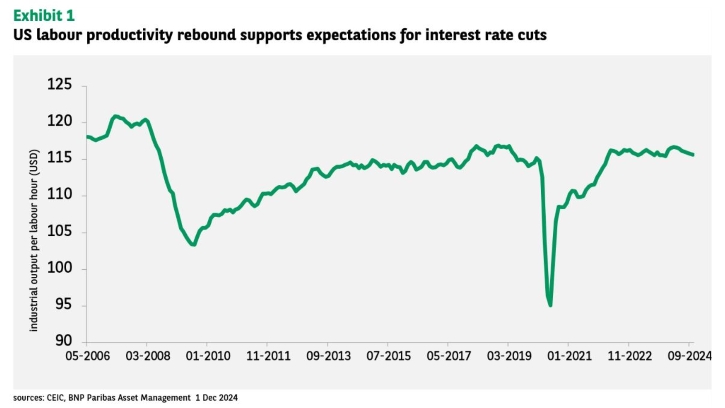
US labour productivity has improved further amid moderating price pressures and a normalising labour market, underpinning investor expectations of more interest rate cuts in 2025. However, markets have scaled back their estimates of the number of cuts as investors worry about the impact on the US economy – and inflation – of the impending ‘Trump import tariffs’.
Measuring how efficiently the US converts inputs such as labour and materials into goods and services, productivity data compares output growth and the rise in hours worked. Data shows non-farm productivity rose by 2.2% in the third quarter as output increased by 3.5%, but hours worked by only 1.2%. Unit labour costs were up 1.9% – slower than the 3.4% increase over the last four quarters.
This continued rebound in productivity underpins the US Federal Reserve’s ‘comfort’ with regard to developments on the inflation front. Chair Jerome Powell has repeatedly stated his confidence that core inflation can be gradually brought back down to the Fed’s 2.0% target.
The question now is whether the imposition of significant and comprehensive tariffs will derail the rate cut story.
Tariffs are typically inflationary in the short term (from a few months to a year after implementation) as they impact an economy’s efficiency and impose costs on consumers and producers. In the long run, they can be expected to be deflationary.
We think the Fed should be able to look through the transitory shock of any tariffs as long as consumers’ and producers’ inflation expectations remain anchored.
The Fed can be expected to resume cutting rates once any deceleration in the economy becomes pronounced. In this case, stocks and bonds would suffer in an initial shock, but recover when the rate cut cycle kicks off again.
Disclaimer
Please note that articles may contain technical language. For this reason, they may not be suitable for readers without professional investment experience. Any views expressed here are those of the author as of the date of publication, are based on available information, and are subject to change without notice. Individual portfolio management teams may hold different views and may take different investment decisions for different clients. This document does not constitute investment advice. The value of investments and the income they generate may go down as well as up and it is possible that investors will not recover their initial outlay. Past performance is no guarantee for future returns. Investing in emerging markets, or specialised or restricted sectors is likely to be subject to a higher-than-average volatility due to a high degree of concentration, greater uncertainty because less information is available, there is less liquidity or due to greater sensitivity to changes in market conditions (social, political and economic conditions). Some emerging markets offer less security than the majority of international developed markets. For this reason, services for portfolio transactions, liquidation and conservation on behalf of funds invested in emerging markets may carry greater risk.


