
As widely expected, the ECB cut its key policy rates by 25bp on 12 December, lowering the deposit rate to 3%. The reference to the need to keep policy ‘sufficiently restrictive’ was dropped from the monetary policy decisions press release where central bankers described the disinflation process as ‘well on track’.
During her press conference, ECB President Christine Lagarde stressed it was not ‘mission accomplished’ yet in the fight against inflation, but developments were on the right track. There is a subtle change in the ECB’s objective, which is now ‘to ensure that inflation stabilises sustainably at its 2% medium-term target’. Previously, it was determined that inflation return to target in a timely manner’.
September’s ECB staff macroeconomic were updated (see Exhibit 1): they now anticipate lower growth and lower inflation, while wage growth is projected to continue its sustained decline, moderating from an average of 4.6% in 2024 to stand at 2.8% in 2027.
At the same time, the ECB acknowledged that ‘labour markets are still tight, which helps to explain why wage growth remains elevated compared with the historical average level of 2.3%’.
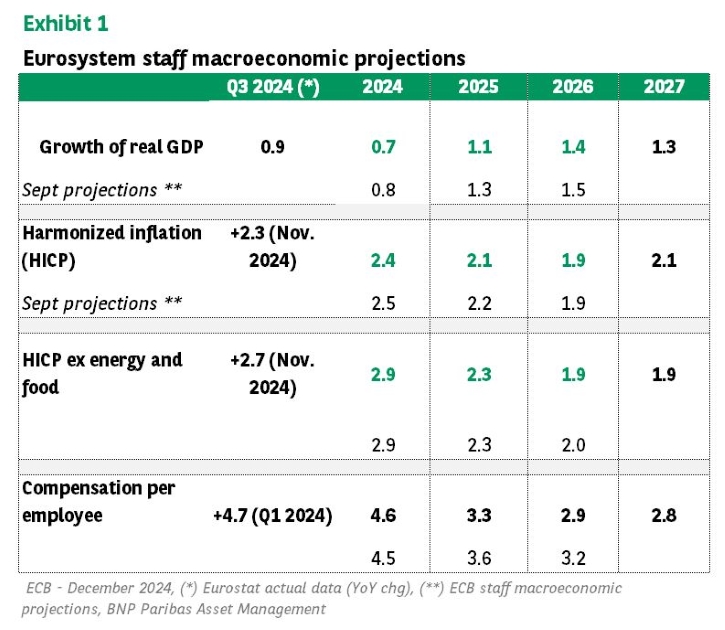
The ECB says policy decisions are ‘data dependent’, but again it appears its projections are playing a part in decisions. Ms Lagarde pointed out that “inflation in our projections has converged towards 2% for six projection exercises in a row… In 2025, we shall be at 2%”. According to several ECB policymakers, such a high level of confidence should have resulted in a rate cut by more than 25bp.
Why not 50bp?
Ms Lagarde said “there were some discussions around a 50bp cut’ during the meeting, but all members agreed 25bp was appropriate. However, sources said after the meeting that ‘around five’ central bank governors favoured a 50bp cut, arguing GDP growth expectations were overdone given all the headwinds that could arise next year, including the unknowns around US trade policy.
Doves have been making themselves heard recently and some governors that were seen as neither doves nor hawks now lean to the dovish side.
One example is in a speech by the Banque de France Governor at the end of November. Commenting on the size of a cut in December and ‘back-to-back’ cuts in each of the following meetings, he said ‘we should stick […] to what I call an “agile pragmatism”, data driven, but not timid’.
Neutral rate in sight?
Mrs Lagarde said the governing council did not discuss the neutral rate and referred to an ECB publication early this year that pointed out the uncertainties around setting the neutral rate and its use as an indicator for monetary policy. She mentioned the neutral rate was probably a little higher now and, that, at some point, the ECB would have to start to discuss when to stop cutting rates.
Nevertheless, Ms Lagarde confirmed that even if financing conditions are easing, they continue to be tight because monetary policy remains restrictive. Asked about the degree of restrictiveness, she said that she would give a speech on 16 December at the Central Bank of Lithuania Annual Economics Conference ‘dissecting in great details’ on how restrictive the monetary policy is and ‘a sort of direction forward’. A promising trailer!
In this cycle’s journey towards the neutral rate, it appears that ECB doves are more likely than hawks to make life difficult for the ECB president – at least in the short run.
Disclaimer
This material is issued and has been prepared by a representative of BNP PARIBAS ASSET MANAGEMENT Australia Limited (“BNPP AMAU”) AFSL 223418 ABN 78 008 576 449.
This material is produced for information purposes only and does not constitute:
1. An offer to buy nor a solicitation to sell, nor shall it form the basis of or be relied upon in connection with any contract or commitment whatsoever or
2. Investment advice.
Opinions included in this material constitute the judgement of BNPP AMAU at the time specified and may be subject to change without notice. BNPP AMAU is not obliged to update or alter the information or opinions contained within this material. Investors should consult their own legal and tax advisors in respect of legal, accounting, domicile and tax advice prior to investing in the financial instrument(s) in order to make an independent determination of the suitability and consequences of an investment therein, if permitted. Please note that different types of investments, if contained within this material, involve varying degrees of risk and there can be no assurance that any specific investment may either be suitable, appropriate or profitable for an investor’s investment portfolio.
Given the economic and market risks, there can be no assurance that the financial instrument(s) will achieve its/their investment objectives. Returns may be affected by, amongst other things, investment strategies or objectives of the financial instrument(s) and material market and economic conditions, including interest rates, market terms and general market conditions. The different strategies applied to the financial instruments may have a significant effect on the results portrayed in this material.
All information referred to in the present document is available on www.bnpparibas-am.com.


