
Given China’s clouded economic outlook and the now deeply depressed ratios on Chinese equities, should investors remain negative on the Chinese market much longer? While it may be too early to become a ‘China bull’, recent domestic policy and geopolitical developments may start chasing away the ‘China bear’. So, what has changed?
Policy signals for growth
China’s recent National People’s Congress specifically emphasised the need for greater policy coordination between various levels of government. If implemented successfully, this should help make policy implementation more effective by improving inter-government departmental cooperation.
The NPC reaffirmed its commitment to the sustainability of both cyclical and structural growth (its GDP target for 2024 is 5%, unchanged from 2023).
In addition to expansionary monetary and fiscal policies, it vowed to:
- Eliminate the ‘housing is for living, not for speculating’ stance – this signals that restrictions on investment in the property market are being relaxed further
- Support consumption with a trade-in programme for durable consumer goods
- Promote new growth engines by boosting the development of artificial intelligence and encouraging the large-scale renewal of equipment and the upgrading of technology industries, transportation, construction, and healthcare
- Provide more regulatory support for the private sector
- Boost the Belt & Road Initiative (BRI) investment and development programme by building transportation links and green infrastructure, and through technological innovation.
Accelerating the advance of strategic industries and the digital economy through AI development, and upgrading and transforming traditional industries should give growth new momentum and raise productivity in the coming years. The digital economy was already worth more than RMB 50 trillion in 2023, accounting for almost 42% of gross domestic product.
A property market policy U-turn
Weak demand and financing problems at developers have been dragging on China’s property market.
Even before the NPC meeting, Beijing attempted to address the funding problem: It shelved the three ‘redlines’ that were introduced in August 2020 and capped the debt-to-cash, debt-to-assets and debt-to-equity ratios of developers (see Chi on China: An Assessment on China’s Property Market Risks”, 29 September 2022), p.4-5). This policy deprived local governments of any flexibility to rescue debt-strapped property companies.
In this regard, the move from ‘redlines’ to ‘whitelists’ in January 2024 marks a major policy U-turn. Under the ‘whitelist’ mechanism, city governments will work with banks to identify residential projects suitable for financial support and investment.
This policy shift could help stabilise the property sector, especially if it is combined with local government incentives to boost property demand and transactions.
Shifting foreign policy
China and the US agreed a tactical thaw in relations in late 2023 to help calm geopolitical tensions. A stable Sino-US relationship should improve foreign investor sentiment on China. Notably, at last November’s Xi-Biden meeting, both presidents pledged to avoid prickly confrontations. A new Trump presidency could upset this newly found stability.
Liu Jianchao, the top contender to become foreign minister, has echoed President Xi’s pledge by reassuring that China had no intention to change the international order, and that it would remain open for foreign businesses. In a sign of greater cooperation, US and Chinese officials have begun work on curbing illegal drugs trafficking, resuming their joint efforts after Beijing cut bilateral counternarcotics cooperation after the now former House Speaker Nancy Pelosi visited Taiwan in 2022.
Crucially, Beijing’s response was muted after President Biden announced that he would send a delegation of former senior officials to Taiwan after the country’s presidential election in January. This contrasts starkly with the combative tone from Beijing over similar events in the past.
Foreign investors returning
To attract foreign capital inflows, Beijing has recently abolished all market access restrictions on foreign investment in manufacturing after lifting all restrictions on foreign capital in the financial sector. Foreign investors can now acquire full ownership of Chinese financial institutions including banks, insurance companies, brokers, and fund managers, and enjoy the same treatment as domestic investors.
In a campaign to revive foreign confidence in the country, Beijing has waived visa requirements for visitors from selected countries in Asia and Europe since February.
There are now signs that investors are returning China.
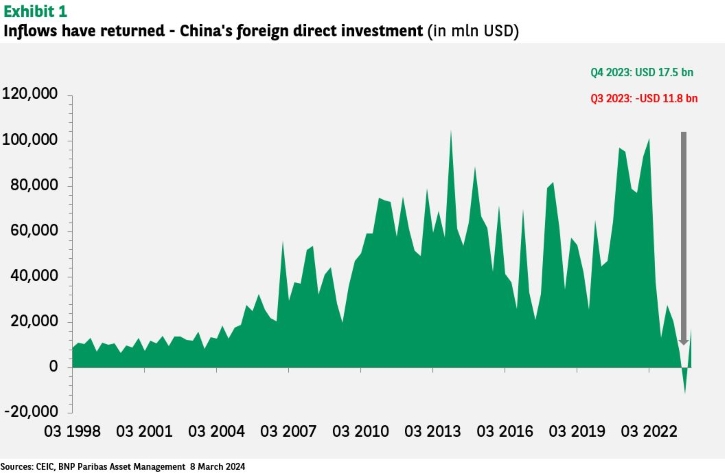
Firstly, foreign direct investment data recorded an inflow of USD 17.5 billion in the fourth quarter of 2023 (the latest numbers available) after the first ever outflow of USD 11.8 billion in the third quarter (see Exhibit 1). That was likely driven by temporary factors such as the drop in excess returns on FDI, rising risk aversion, and negative sentiment on China (see Chi Time: Is Foreign Direct Investment Leaving China, For Good?, 7 December 2023).
Secondly, US Security Exchange Commission data shows that a large hedge fund had been building positions in selected large-cap Chinese stocks listed in the US since the third quarter of last year at a time most international investors were pessimistic on China. Separately, Canada Pension Plan Investment Board tiptoed back into the Chinese market to buy selected large car and e-commerce stocks in the fourth quarter of 2023.
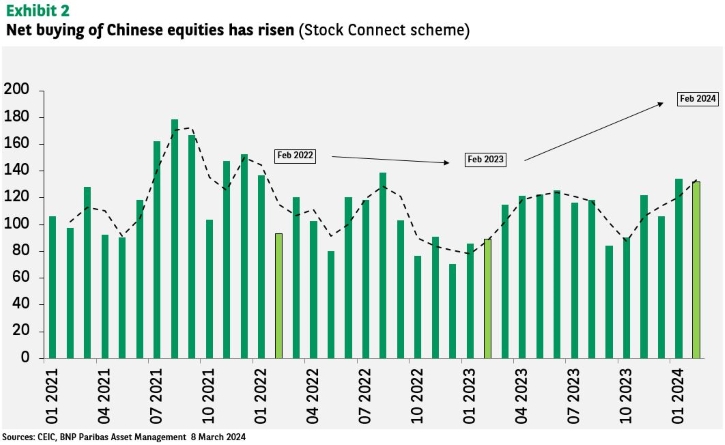
Lastly, portfolio flows have returned with net northbound buying of Chinese A shares through Hong Kong’s Stock Connect scheme increasing since January 2024. According to broker analysis, hedge funds and long-only funds, which typically lead the buying interest, accounted for 25% of net buying of A shares in February (see Exhibit 2).
We believe that the Year of Dragon may see a revival of the Chinese equity market provided Beijing sustains its assertive policy support in the coming months. The risk is that Beijing reverts to an overly cautious policy mode as it did in the past two years.
Disclaimer
This material is issued and has been prepared by BNP PARIBAS ASSET MANAGEMENT Asia Limited (the “Company”), with its registered office at 17/F, Lincoln House, Taikoo Place, Quarry Bay, Hong Kong. BNP PARIBAS ASSET MANAGEMENT Asia Limited in Australia is an authorised representative of BNP PARIBAS ASSET MANAGEMENT Australia Limited ABN 78 008 576 449, AFSL 223418 (“BNPP AMAU”).
This material is distributed in Australia by BNPP AMAU. This material has not been reviewed by the Hong Kong Securities and Futures Commission. This material is produced for information purposes for wholesale investors only and does not constitute:
1. an offer to buy nor a solicitation to sell, nor shall it form the basis of or be relied upon in connection with any contract or commitment whatsoever or
2. investment advice.
This material makes reference to certain financial instruments authorised and regulated in their jurisdiction(s) of incorporation.
No action has been taken which would permit the public offering of the financial instrument(s) in any other jurisdiction, except as indicated in the most recent prospectus, offering document or any other information material, as applicable of the relevant financial instrument(s) where such action would be required, in particular, in the United States, to US persons (as such term is defined in Regulation S of the United States Securities Act of 1933). Prior to any subscription in a country in which such financial instrument(s) is/are registered, investors should verify any legal constraints or restrictions there may be in connection with the subscription, purchase, possession or sale of the financial instrument(s).
Investors considering subscribing to the financial instrument(s) should read carefully the most recent prospectus, offering document or other information material for further details including the risk factors and consult the financial instrument(s’) most recent financial reports. These documents are available from your local BNPP AM correspondents, if any, or from the entities marketing the Financial Instrument(s).
Opinions included in this material constitute the judgement of the Company at the time specified and may be subject to change without notice. The Company is not obliged to update or alter the information or opinions contained within this material. Investors should consult their own legal and tax advisors in respect of legal, accounting, domicile and tax advice prior to investing in the financial instrument(s) in order to make an independent determination of the suitability and consequences of an investment therein, if permitted. Please note that different types of investments, if contained within this material, involve varying degrees of risk and there can be no assurance that any specific investment may either be suitable, appropriate or profitable for an investor’s investment portfolio.
Investments involve risks. Given the economic and market risks, there can be no assurance that the financial instrument(s) will achieve its/their investment objectives. Returns may be affected by, amongst other things, investment strategies or objectives of the financial instrument(s) and material market and economic conditions, including interest rates, market terms and general market conditions. The different strategies applied to financial instruments may have a significant effect on the results presented in this material. Past performance is not a guide to future performance and the value of the investments in financial instrument(s) may go down as well as up. Investors may not get back the amount they originally invested.
The performance data, as applicable, reflected in this material, do not take into account the commissions, costs incurred on the issue and redemption and taxes.
All information referred to in the present document is available on www.bnpparibas-am.com.


