
ECB President Christine Lagarde recently described the nightmare that is disrupting the sleep of many central bankers. At a hearing at the European Parliament on 15 February, she warned: “the last thing [I] would want to see is us making a hasty decision, [only] to see inflation rise again and have to take more measures”.
So far this year, inflation data has pointed to a certain stickiness that has been keeping central bankers from declaring victory after two years of fighting high inflation. Or, in US Federal Reserve speak, policymakers want to ‘have greater confidence that inflation is moving sustainably toward [the] 2% [target]’.
Among the measures of inflation (e.g., core ex housing) and calculations of variations (sequential, year-on-year, 3 months over 3 months, …), an indicator published by the Federal Reserve Bank of New York has caught our eye.
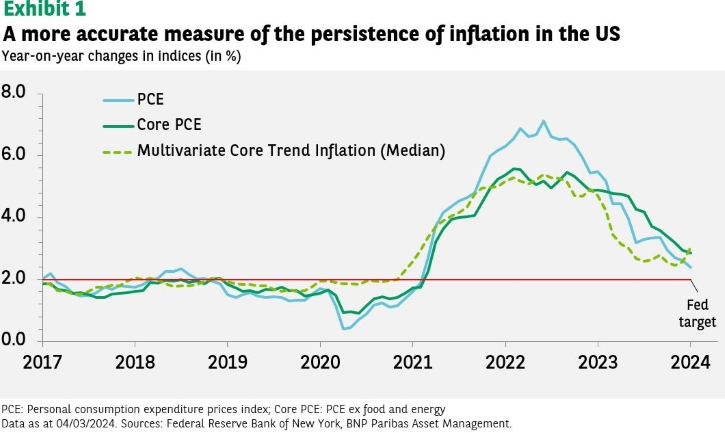
Its Multivariate Core Trend measure uses a dynamic model with monthly data for the main sectors of the personal consumption expenditures price index – core PCE is the Fed’s preferred inflation gauge – to assess the extent to which inflation is sticky and how broad its impact.
While it involves a lot of data engineering, we believe it is worth a look: this indicator rose to 3% in January from 2.6% in December and 2.5% in November and stands at its highest since April 2023. Housing accounted for 0.54 percentage points of the increase relative to its pre-pandemic average, while services excluding housing accounted for a larger 0.7pp.
Compare that to the latest report on core PCE: this index signalled inflation slowed from 2.9% year-on-year to 2.8%. Looking under the hood, though, the so-called Super Core measure (inflation in core services excluding housing cost) rose year-on-year (from 3.34% to 3.45% in January).
In recent weeks, global equities appear to have been only moderately concerned about the stubbornly high level of services sector inflation. Central bankers, however, have signalled that it is still too early to be certain that inflation is clearly moving towards their target and appear less convinced that they can begin cutting interest rates any time soon.
It’s by no means certain that the (inflation) trend is an investor’s friend this time around.
Disclaimer
This material is issued and has been prepared by a representative of BNP PARIBAS ASSET MANAGEMENT Australia Limited (“BNPP AMAU”) AFSL 223418 ABN 78 008 576 449.
This material is produced for information purposes only and does not constitute:
1. An offer to buy nor a solicitation to sell, nor shall it form the basis of or be relied upon in connection with any contract or commitment whatsoever or
2. Investment advice.
Opinions included in this material constitute the judgement of BNPP AMAU at the time specified and may be subject to change without notice. BNPP AMAU is not obliged to update or alter the information or opinions contained within this material. Investors should consult their own legal and tax advisors in respect of legal, accounting, domicile and tax advice prior to investing in the financial instrument(s) in order to make an independent determination of the suitability and consequences of an investment therein, if permitted. Please note that different types of investments, if contained within this material, involve varying degrees of risk and there can be no assurance that any specific investment may either be suitable, appropriate or profitable for an investor’s investment portfolio.
Given the economic and market risks, there can be no assurance that the financial instrument(s) will achieve its/their investment objectives. Returns may be affected by, amongst other things, investment strategies or objectives of the financial instrument(s) and material market and economic conditions, including interest rates, market terms and general market conditions. The different strategies applied to the financial instruments may have a significant effect on the results portrayed in this material.
All information referred to in the present document is available on www.bnpparibas-am.com.


