
Sustainability-linked bonds (SLBs) have become a popular form of finance since their introduction in 2019. Now used in both public and private sectors, SLBs can play a role in addressing environmental and social issues, write Malika Takhtayeva and Clement Niel.
Sustainability-linked bonds allow bond market participants to supplement portfolio returns and hedge against unwanted risks while contributing to a sustainable future. How do they work?
The bond’s characteristics – typically the coupon rate – are adjusted in line with the progress the issuer makes on environmental, social and governance (ESG) targets. For example, an auto firm could aim to reduce carbon emissions across its supply chain, or a utility might aim to increase the proportion of installed renewable capacity in its energy mix.
The level of an SLB’s coupon is a function of meeting specific, pre-set targets, such as cuts in carbon emissions without any recourse to carbon offset actions. If the issuer misses the (externally verifiable) targets by a certain deadline, a step-up is applied to the coupon, raising the borrowing cost.
When government issuers of SLBs deviate from their green policies, holders of SLBs can engage with them.
From an issuer’s point of view, SLBs are of interest because they provide a unique way of obtaining finance with a sustainable objective in mind while diversifying their sources of funds by accessing a broader – ESG minded – investor base. In our view, SLBs are especially well-suited for sovereign issuers seeking to tap global investors.
Investors can expect to earn the same or similar return from SLBs as from conventional bonds with the added sustainability and reputational benefits of addressing environmental and social issues. While there seems to be no ‘premium’ for investors from holding SLBs, there is also no evidence of a ‘discount’ in terms of sub-par returns.
How SLBs differ from use-of-proceeds bonds
There is a difference in structure between use of proceeds (UoP) bonds and sustainability-linked bonds. The criteria for UoP bonds such as green and social bonds are widely seen as easier to satisfy as they often have a narrower, project focus. Policy breaches or flaws in projects do not have any major implications for issuers.
For SLBs, it is the issuer who has to meet the targets; this is typically more challenging and can be harder to oversee. The targets for SLBs can have a wide reach. For example, they often require issuers to address sustainability targets across an entire organisation or even a country.
SLBs offer tangible sustainability benefits, with robust targets helping issuers to make progress on genuine ESG ambitions. They encourage corporate sustainability change. Indeed, the cost of falling short on targets can be substantial.
As an example Italian energy firm Enel missed its 2023 SLB targets, triggering an additional interest payment of EUR 83 million to investors. This illustrates the appeal that the step-up option of an SLB holds for investors.[1]
Furthermore, SLBs give issuers control over the allocation of borrowed funds instead of having to use funds for pre-agreed projects. For sovereign bond issuers, SLBs can be a definitive, financially backed commitment to achieve sustainability aims, linking debt (and debt servicing) to national climate and environmental targets.
Arguably, SLB targets are more robust than climate goal frameworks such as Nationally Determined Contributions (NDCs), which form part of the Paris Agreement. NDCs are self-determined and carry no financial penalties. Accordingly, almost every signatory to the agreement has to date made little progress, or is even failing, on their NDCs and is likely to fail to comply even by the 2030 target date.
To issue an SLB, a country must align all government institutions to meet the commitments outlined in the bond and take an active role in policymaking. With fiscal penalties at stake, SLBs can thus lead to a more holistic, ambitious approach to national sustainability goals in comparison to NDCs or other international climate targets.
Emerging markets take the lead
So far, emerging markets have led SLB issuance, with little activity from developed markets. The complexity of these bonds likely deters developed markets, as they already have easier access to international finance.
An example of an emerging market issue is Uruguay’s 2022 SLB, which is tied to a quantifiable drop in greenhouse gas (GHG) emissions and the maintenance of native forest areas.1 According to Uruguay’s annual SLB report, the government has achieved a “46% reduction in the intensity of aggregate gross GHG emissions” [from 1990 levels] and preserved 100% of its native forest area compared to the 2012 baseline. Uruguay’s grid has run on 100% renewables since July 2023 (see Exhibit 1). Over the past five years, the cost of producing electricity has declined by nearly half, the clean energy sector has created 50 000 jobs, and the grid has achieved energy independence. This suggests the government has been enacting meaningful climate policies to fulfil its SLB targets.
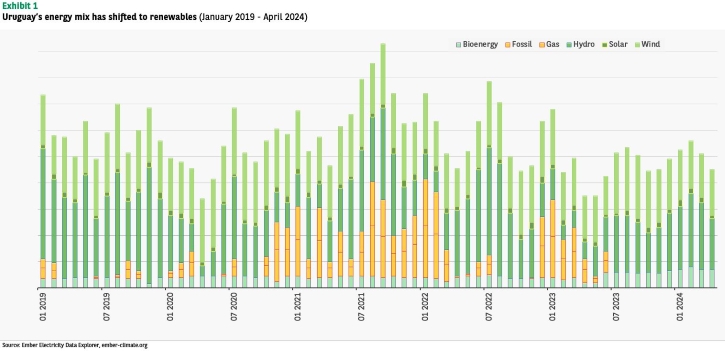
Source: Ember Electricity Data Explorer, ember-climate.org
Chile’s SLB are similarly ambitious, blending social and green targets: GHG emissions and a goal for women to represent 40% of company board members by the end of 2031.1
A bond class under scrutiny
Despite these successes, the rate of SLB issuance has fallen after greater investor scrutiny.
Questions have been raised over the climate impact of SLBs, with greenwashing risk a recurring concern, particularly among private issuers. A Bloomberg analysis of more than 100 SLBs worth almost EUR 70 billion conducted at the peak of the SLB market in 2022 found that “the majority are tied to climate targets that are weak, irrelevant, or even already achieved.”
To improve the credibility and robustness of the market, the International Capital Markets Association is developing and strengthening SLB and sustainability-linked loan principles and standards.
Sovereign SLB risks
Sovereign SLBs come with significant risk due to their complexity. If emerging market sovereigns issue SLBs and do not meet the targets, governments must adjust their fiscal policies, impacting a country’s public services and government spending.
While developed economies do not face the same level of risk, their reluctance to enter the SLB market arguably demonstrates a lack of environmental commitment and ambition. Indeed, developed economies such as the UK have deviated from their climate targets in recent years.
Managing an SLB portfolio
Managing a portfolio of SLBs involves assigning sovereign and corporate ESG scores at the issuer level. It also means monitoring the likelihood that the issuer maintains its sustainability targets throughout the bond’s life and considering the possibility that failure to meet the targets triggers a debt crisis.
The possibility of the coupon fluctuating could deter investors from making these instruments a large portion of their bond portfolios, limiting the size of the SLB market.
We see SLBs, however, as a vital mechanism for extending access to international finance for sovereigns and corporations with climate ambitions. They facilitate a holistic approach to sustainability, considering a country’s or company’s wider policy and strategic aims rather than a single project.
Once improved market regulation comes into force and reduces the threat of greenwashing or inconsequential climate targets, we expect SLBs to take on a greater role as an instrument for sustainability reform.
[1] Issuer named for illustrative purposes only
Disclaimer
This material is issued and has been prepared by a representative of BNP PARIBAS ASSET MANAGEMENT Australia Limited (“BNPP AMAU”) AFSL 223418 ABN 78 008 576 449.
This material is produced for information purposes only and does not constitute:
1. An offer to buy nor a solicitation to sell, nor shall it form the basis of or be relied upon in connection with any contract or commitment whatsoever or
2. Investment advice.
Opinions included in this material constitute the judgement of BNPP AMAU at the time specified and may be subject to change without notice. BNPP AMAU is not obliged to update or alter the information or opinions contained within this material. Investors should consult their own legal and tax advisors in respect of legal, accounting, domicile and tax advice prior to investing in the financial instrument(s) in order to make an independent determination of the suitability and consequences of an investment therein, if permitted. Please note that different types of investments, if contained within this material, involve varying degrees of risk and there can be no assurance that any specific investment may either be suitable, appropriate or profitable for an investor’s investment portfolio.
Given the economic and market risks, there can be no assurance that the financial instrument(s) will achieve its/their investment objectives. Returns may be affected by, amongst other things, investment strategies or objectives of the financial instrument(s) and material market and economic conditions, including interest rates, market terms and general market conditions. The different strategies applied to the financial instruments may have a significant effect on the results portrayed in this material.
All information referred to in the present document is available on www.bnpparibas-am.com.


